






































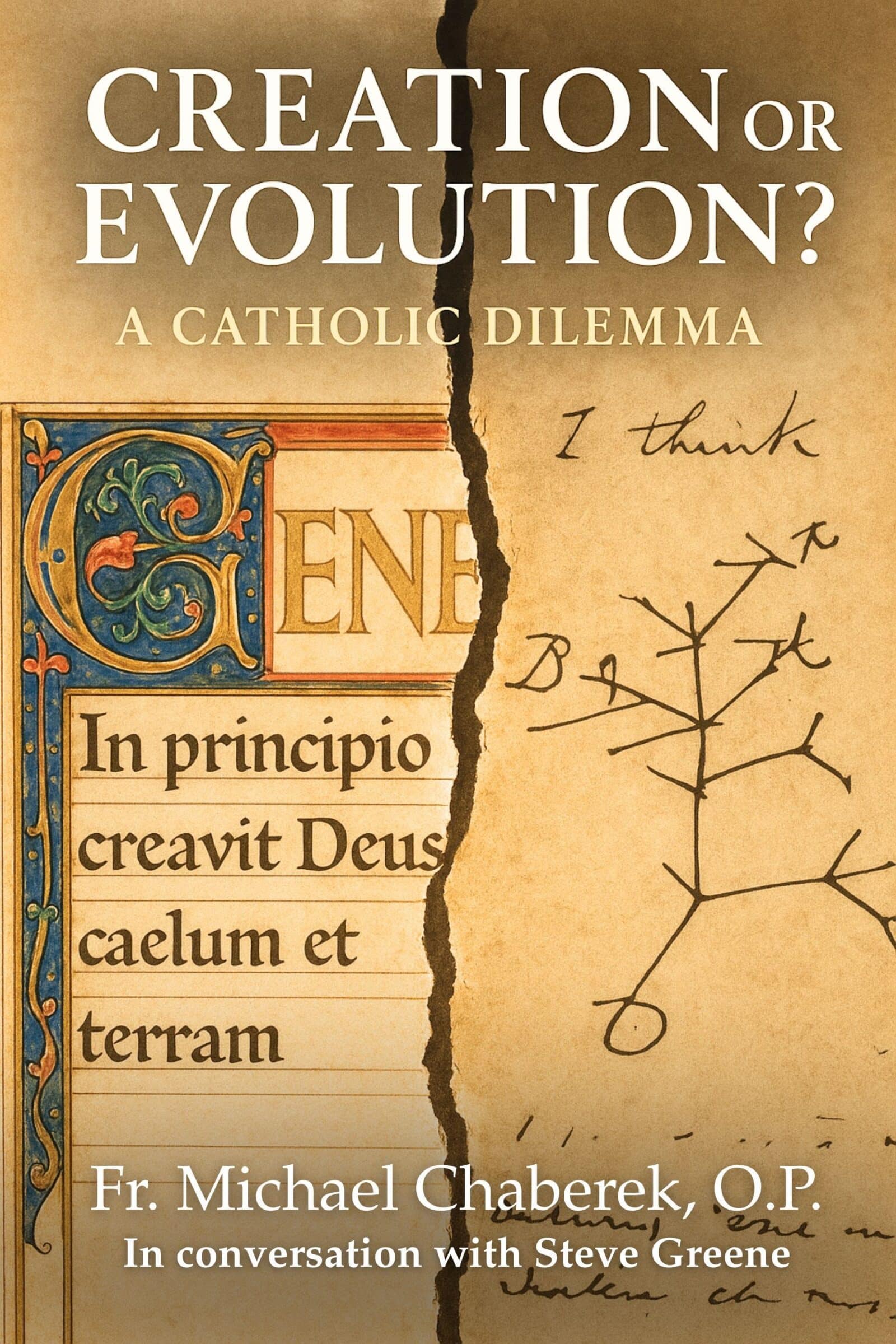
Author’s note: The following is a review of Fr. Michael Chaberek and Steve Greene, Creation or Evolution? A Catholic Dilemma (Lexington, KY: Inkwell Press, 2026).
Through high school and most of junior high, I attended Roman Catholic schools. I liked the discipline. I learned to buckle down on my studies. And I excelled. Even so, my experience in Christian doctrine classes was unsatisfying. We read the Bible, but not with a sense that here was teaching and wisdom critical for one’s Christian walk. I was a nominal Catholic during those years, leaving the church after leaving high school. When I converted to a living Christian faith later, it was in Protestant circles.
Over the years, however, I have felt the pull of Roman Catholicism. Its rich tradition of scholarship from the Church Fathers to the Scholastics to the present rightly deserves respect. Moreover, its consistent stand for the sanctity of human life against the “culture of death” is to its immense credit. I recall in 1973, as a seventh grader in a Catholic school, the medical doctor father of one of my classmates spoke to our entire class. A devoted Catholic, he told us with great gravity of the enormous tragedy that had just befallen our nation on account of the Supreme Court decision in Roe v. Wade. He was right. At the same time, many Protestant denominations and congregations sat on their hands about this case (which Francis Schaeffer and C. Everett Koop in 1976 tried to redress with their video series Whatever Happened to the Human Race?).
A Major Obstacle
Despite my attraction to Roman Catholicism, a major obstacle to my returning to it has been the capitulation of so many Catholic intellectuals to Darwinism. To be clear, I also have some doctrinal reservations that cause me to stay within the Protestant orb. But the willingness of so many Catholic intellectuals in my experience to bow the knee to Darwin has made me reluctant to embrace Roman Catholicism as my community of faith.
For instance, Ken Miller, the Brown University biologist, wrote Finding Darwin’s God (1999), and John Haught, the Georgetown University theologian, wrote God After Darwin (2000). Both have played dominant roles in opposing intelligent design, and both are Roman Catholics.
Emblematic of the Roman Catholic acceptance of Darwin was an encounter I had at the University of Chicago in 1999. The Lumen Christi Institute organized a dialogue between the late Archbishop Józef Mirosław Życiński and me on the topic of intelligent design. Życiński gave not an inch to intelligent design, all the while singing the praises of evolution.
At a dinner following the dialogue, I was seated next to the late Ernan McMullin, a Catholic priest and philosopher of science on the faculty at the University of Notre Dame. He described God’s creativity in biology as funneled through secondary causes and all the information in biological systems as derived from the environment. This sort of baptized Darwinism became the rule in my interactions with Catholic scholarship over the coming years. It is this sort of “theistic evolution” that Fr. Chaberek resists and refutes in his book. And it is this sort of theistic evolution that is incompatible with intelligent design.
In 2005, with the election of Pope Benedict XVI, along with his advisor Cardinal Schönborn, I had reason to hope that intelligent design might gain wider acceptance in Catholic circles. Benedict XVI, writing as Cardinal Joseph Ratzinger before his election as pope, had written In the Beginning…: A Catholic Understanding of the Story of Creation and the Fall. This and other things he and Cardinal Schönborn had written suggested they were not far from giving credence to intelligent design. And yet, they stopped short of doing so, and under their leadership Roman Catholicism made little progress toward accepting intelligent design.
More recently, however, there have been exceptions. Fr. Richard Pendergast’s Cosmic Hierarchy 1: God’s Plan for the Evolution of the Universe (he died in 2012, but this work was published ten years after his death) was favorable to intelligent design. So too was Fr. Martin Hilbert’s recent (2024) A Catholic Case for Intelligent Design.
The Exception into the Rule
Yet the Catholic thinker who seems now to be turning the exception into the rule is the Polish philosopher and theologian Fr. Michael Chaberek. He has written three earlier scholarly works that challenge evolution and open the door to intelligent design: Catholicism and Evolution (2015), Aquinas and Evolution (2017), and Knowledge and Evolution (2021).
Continuing in this vein, Fr. Chaberek has now written, with co-author Steve Greene, a popular-level book refuting theistic evolution and arguing for intelligent design. Published in January of this year through Inkwell Press, it is titled Creation or Evolution? A Catholic Dilemma. With the support of the Steno Institute for Faith and Science, this book attempts to mainstream intelligent design within Catholicism. To that end, a video series accompanies the book and reinforces its message. Here is the first of ten episodes:
Rather than summarize this book, I’ll let the book description on the back cover do that:
To reconcile faith and science, is it enough to say “God could have used evolution”? Many Christians adopt this theistic-evolution point of view. It is now treated as the quasi-official Catholic position. Yet can it really harmonize Scripture, theology, and modern science? How does it align with the Bible read through the Church’s long tradition and in light of classical Christian philosophy? Does it resolve the tension between Genesis and the Church Fathers on one side and the grand evolutionary narrative embraced by atheists on the other? And what role should intelligent design play in Catholic teaching? Creation or Evolution? A Catholic Dilemma presents a searching dialogue between two Catholics — a layman with long pastoral experience and a Dominican priest-scholar specializing in the faith-and-science debate — who probe whether theistic evolution remains a viable option for believers or whether creation, rightly understood, offers the sounder foundation for understanding life, humanity, and the cosmos.
With his summary out of the way, let me comment on the book, indicating why it is significant, why it can be usefully read not only by Catholics but also by non-Catholics, and why I have a special interest in it.
Warsaw in June 2025
I met Fr. Chaberek at an intelligent design conference that took place in Warsaw in June 2025. He was one of the principal organizers of this event. It was refreshing to find in him a Catholic priest who felt no shame in criticizing Darwinism, in embracing intelligent design, and in offering compelling philosophical and theological reasons for doing so.
When I began my professional work to advance intelligent design as a viable intellectual project back around 1990, the most common initial move by Darwinian naturalists was to try to characterize intelligent design as a form of creationism, and thus to identify it as a religious position. After that, any conflict between evolution versus intelligent design could be described as a science versus religion controversy. And in any such controversy — at least in our day — science becomes the automatic winner, being seen in our secular culture as infinitely superior to religion, offering real insights into nature as opposed to fantasies about a non-physical spiritual world. We’ve seen this attempt to cast intelligent design as religion play out time and again, perhaps most notably in the Kitzmiller v. Dover trial.
[DIGRESSION: When I began writing on intelligent design circa 1990, I naively assumed that if intelligent design could be developed as a compelling logical and scientific position that refuted Darwinian evolution, the Christian intellectual community, both Catholic and Protestant, would readily jettison it and embrace intelligent design. What Christians in their right mind, so I thought, would embrace evolution if they didn’t have to? Little did I realize how invested Christian intellectuals had become in evolution. It was as though by a great effort of will they had convinced themselves that evolution was true and that it was reconcilable with their Christian faith, and so, for someone like me and others in the burgeoning ID movement to come along and question the edifice of evolution was to disrupt a position that they had carefully built and that had given them a measure of credibility with secular evolutionists, whose favor they seemed too eager to curry.]
To be clear, intelligent design is not creationism. Intelligent design looks for patterns in nature, and especially in biology, that are best explained as the product of intelligence. It thus looks for evidence of signs of intelligence. The nature of that intelligence — whether it is divine, extraterrestrial, or human — is a downstream question. Creation, by contrast, explicitly identifies God as the designer. Moverover, it is in the first instance concerned with the source of being of the world. Design, resting as it does on a builder’s metaphor, is concerned with the organization of existing materials, not with their ultimate source. By looking at configurations of finite material objects, intelligent design cannot legitimately reason to an infinite personal transcendent creator, which is to say God. Creation, because it is committed to such a being, is therefore inherently a religious notion. Intelligent design, by looking for certain types of patterns in nature, is by contrast a scientific enterprise.
Much of my own work on intelligent design can be understood as challenging the view that the conflict between Darwinism and intelligent design is one between science versus religion, urging instead that the conflict is in fact one between science versus science. Once intelligent design is admitted as a legitimate scientific option in the study of biological origins, the game is up for Darwinism because it can then no longer insulate itself as the only viable scientific option for explaining biological origins. Darwinism has been able to insulate itself by defining science as a purely naturalistic enterprise, which perforce excludes the possibility of design being scientific from the outset.
The case for intelligent design constituting a legitimate science is one that my colleagues and I have developed over the years, and with increasing force. My book The Design Inference (its second edition, co-authored with Winston Ewert), for instance, explains the logic by which design can be inferred with scientific rigor in the biological sciences. I recently wrote a piece on this Substack titled “The Philosophy of Intelligent Design,” which examines the conceptual underpinnings of intelligent design, arguing that it does indeed constitute a scientific theory (see especially section 3).
Turning the Tables
My approach has thus focused on raising the scientific status of intelligent design, but nonetheless ceding to Darwinists that their own theory is scientific. Fr. Chaberek, in Creation or Evolution? A Catholic Dilemma, however, turns the tables even more sharply, according intelligent design full scientific status but at the same time rescinding that status from Darwinism.
At first blush, this might seem like a “cute move” without real substance, designed to catch people’s attention, but on closer examination not to be taken too seriously. But on deeper consideration, I’m inclined now to agree with Fr. Chaberek, consigning Darwinian biology, insofar as it purports to explain macroevolution, to the wastebasket of failed philosophical and quasi-religious ideas, and thus as residing outside the natural sciences. Such a move might seem “too cute,” as designed to garner “likes” on social media, rather than a serious position. So let me outline Fr. Chaberek’s case here, and why I find it convincing.
First off, it needs to be said that Fr. Chaberek is a serious and careful thinker. I write this because it can seem too easy to write him off if one thinks that Darwinism is indeed a scientific position, because, in that case, one may rightly ask what business it is of a philosopher and theologian to urge Catholics to embrace intelligent design and reject Darwinism. If both are scientific positions and evidence could confirm either to be true, then Fr. Chaberek should allow science and scientists to decide the matter, and he should not be urging ID on his fellow theologians. He might personally be convinced that ID is the better science. He might as a pragmatic matter think Darwinism undermines the faith of Catholics. But scientific inquiry rather than philosophical or theological considerations should in the end decide whether Darwinism is credible.
And yet that is precisely what Fr. Chaberek doesn’t recommend. He rejects Darwinism (except in accounting for small evolutionary changes — microevolution) as unscientific. His reasoning here is instructive. His starting point is that where the teaching of the Bible and Church is clear, theology needs to take priority over science, the rationale for this view being that theology deals with definitive knowledge whereas science is fallible and subject to revision.
Certain Young-Earth Creationists
Now, when I first read this in Fr. Chaberek’s book, I recalled my encounters with certain young-earth creationists (such as Kurt Wise), who would let the Bible trump the evidence of science regardless of the strength of that evidence. This was especially problematic, in my view, when it came to the age of the earth because there was so much evidence of an older earth (billions rather than thousands of years) given everything from the transmission of light across the cosmos to ice cores in glaciers.
Fr. Chaberek, however, is not a young-earth creationist. Challenging what he calls biblicism, which he defines as reading the Bible in the most wooden-headed simplistic way, he sees the tradition of the Church as allowing different interpretations of the word for “day” in the Old Testament, and thus in not requiring the early chapters of Genesis to be read as teaching that the earth was formed 6,000 years ago in six 24-hour days.
But — and this is a big BUT — Fr. Chaberek argues persuasively that the clear teaching of the Church with respect to the origin of human beings is that both body and soul were directly created by God. The epigraph of Creation or Evolution? A Catholic Dilemma is the following quote from St. Thomas Aquinas:
The first formation of the human body could not be by the instrumentality of any created power, but was immediately from God.
Fr. Chaberek makes clear that the teaching tradition of the Catholic Church has been unequivocal about God directly, as a matter of primary causation, being responsible for the creation of the first humans (Adam and Eve), and that this creative task could not be offloaded onto secondary causes.
Charles Kingsley, a contemporary and fan of Darwin, remarked in his 1871 lecture “The Natural Theology of the Future”:
We knew of old that God was so wise that He could make all things; but behold, He is so much wiser than even that, that He can make all things make themselves.
This quote perfectly captures the effort of theists to push off onto evolution what otherwise would be the direct activity of God. To this, Fr. Chaberek says in effect (I’m putting words in his mouth, but I’ve read him carefully), “It doesn’t matter what you think better illustrates the divine wisdom. When it comes to the formation of humans, the Church’s Magisterium clearly teaches that God made the first humans, including their bodies, directly, and thus without the instrumentality of other things that he had already made.”
The cumulative case that Fr. Chaberek makes for the Catholic Church’s Magisterium in allowing no alternative to the first humans being directly created by God, thus barring evolutionary precursors dependent on the mediation of created causes, is compelling. I encourage readers who doubt that this is indeed the authoritative teaching of the Catholic Church to read his book. He traces this teaching not only through the Church fathers and Scholastics, but in the Catholic catechisms following Darwin’s Origin of Species.
Now an interesting thing happens once evolution is barred in the creation of the first human. The dominoes start to fall, and in the end Darwinian macroevolution becomes untenable even as a scientific theory. For one must ask why God would have to create the first human directly rather than through secondary causes. That would be because secondary causes lack the ability to do so. And what renders secondary causes without that ability? It’s that humans have an essence that puts them beyond the reach of already created powers.
A New Nature
An implicit Aristotelianism is at play here, but it is one that derives from a deeper consideration of divine creation. Divine creation brings about new natures. Secondary causes, by contrast, can trade only in existing natures. Darwinian evolution doesn’t assign to humans a unique exceptional nature, but rather makes human nature continuous with the rest of animal nature and ultimately with inanimate nature. But humanity is, according to the Church’s Magisterium, something unprecedented — it represents a new nature, indeed the only embodied being made in the image of God. Accordingly, Darwinian processes don’t merely fail to explain humanity’s origin but can’t be the causal conduit for it.
One of the strongest ID arguments against naturalistic forms of evolution centers on the origin of life. All life as we know it is immensely complex. Unlike Darwinism, which explains one living form through the naturalistic evolution of prior living forms, the origin of life represents a discontinuity between life and non-life. The origin of life therefore signifies a breakdown in Darwinian-style explanations. Instead, one needs a reduction of life to chemistry, and all naturalistic proposals in this regard have to date failed spectacularly. See, for instance, the following interview between origin-of-life experts Edward Peltzer and James Tour:
Fr. Chaberek, however, starts at the other end — not life at its simplest but life at its most complex, which is to say with humanity. Once the Church’s teaching on a topic is clear, it is not for science to second guess its teaching. Now the Church’s teaching here could be a problem if the case for human evolution from the fossil record were compelling. But, in citing the work of ID theorists, such as Stephen Meyer in Darwin’s Doubt, Fr. Chaberek shows that the evolution of humans from hominins/nids leaves much to be desired.
There is, of course, much more to Fr. Chaberek’s argument. Indeed, it is a sophisticated cumulative case. For instance, he invokes Augustine’s approach for dealing with scientific challenges to the faith — the Church Father’s frequently had to fend off such challenges (see, for instance, my edited collection The Patristic Understanding of Creation). As Fr. Chaberek describes it, Augustine’s approach requires we consider three options: (1) perhaps we’ve understood the science amiss — there’s a better theory that is compatible with an established theological position (e.g., a cosmology that doesn’t require an eternal universe); (2) perhaps we’ve misunderstood the theology — what we thought was the teaching of the Church was not really its teaching (e.g., the word “day” in Genesis need not mean a 24-hour day); (3) we know the theology and so the science contradicting it must be wrong.
The Third Option, One Better
With regard to Darwinism, Fr. Chaberek goes with the third option. Yet, as noted, he goes it one better, even denying that Darwinism as applied to macroevolution is a science. He arrives at this conclusion on metaphysical grounds. He sees a fundamental distinction between “how” questions and “what for” questions. The age of the universe and earth falls under how questions. But when something fundamentally new arises, we are confronted with a what-for question. Science cannot address such a question because we are then dealing with a new nature, and science, which is limited to secondary causes (how questions), can only deal with the transformation of given things and thus the transmission of existing natures. Hence Darwinism cannot be a science.
Now Darwinists will, of course, reject this argument. But in doing so, they must admit that evolution is committed to ineradicable continuity, and that no new essences are created in the evolutionary process. And they are fine with that, rejecting any sort of classical metaphysics committed to essentialism, and seeing nothing fundamentally exceptional about humans. Darwin’s move, for instance, in The Descent of Man to see human morality in continuity with the morality of apes is entirely in this vein.
Fr. Chaberek’s rejection of Darwinism as a science rests ultimately on theological and metaphysical grounds. And yet, to the degree that the empirical case for the evolution of humanity is weak, as Fr. Chaberek argues it is, he helps his case for the lack of a scientific underpinning for Darwinism. Still, a worry now arises: If Darwinism must be rejected as non-scientific, doesn’t this make things too easy for intelligent design, making it not only scientific but also the only scientific option compatible with Fr. Chaberek’s theology and metaphysics?
A Theory of Information
The reason this worry is unfounded is that intelligent design may be regarded as a theory of information, tracking where infusions of information happen in nature, leading to discontinuities in nature. Intelligent design is able to measure and track these infusions. But insofar as they represent divine input of information, they are not themselves subject to scientific inquiry — thus ID is not guilty of the same presumption as Darwinism, where it claims to reduce novel information in living systems to the operation of a purely naturalistic process such as natural selection. ID measures the empirical degree of discontinuity in informational discontinuities, not what happens inside those discontinuities. This limitation on ID makes it scientific in a way that Darwinism is not, which claims to explain the very discontinuities by in effect eliminating them, breaking them into a series of continuities (though except in the simplest cases never specifying them in any detail).
Accordingly, Fr. Chaberek’s recommendation that Catholic intellectuals accept intelligent design is less about telling them to prefer one scientific theory over another than pointing out that ID is the only scientific theory that avoids the hubris of Darwinism in proposing to explain by naturalistic processes what properly belongs to direct divine power and creativity. In all this, Fr. Chaberek still needs to make a positive case for intelligent design, as in arguing for its explanatory power and empirical adequacy. And he must show, as he does, how Darwinian evolution lacks these “theoretical virtues” (see Michael Keas’s outstanding piece in Synthese on such virtues: “Systemizing the Theoretical Virtues”).
If you will, on theological and metaphysical grounds, Fr. Chaberek is convinced that Darwinism cannot constitute a scientific enterprise and that intelligent design is the only viable scientific position compatible with the Catholic Church’s understanding of creation. And yet, realizing that many of his readers will not accept that theology and metaphysics, he is willing to make an allowance, refuting Darwinism within a broader epistemic framework that might allow it to be a science, albeit without assuming naturalism, which would make Darwinism the only viable scientific explanation of biological origins. Thus he considers scientific evidence that could bear on Darwinism as well as on intelligent design, and he argues that the evidence on balance better supports intelligent design.
[CLARIFYING NOTE: Throughout this review I’ve described the debate between Darwinism and intelligent design as distinguishing among two mutually exclusive and exhaustive options. One might therefore demur that additional options present themselves. Thus there might be naturalistic approaches to evolution that are non-Darwinian, which embrace some sort of internalist teleology. But such a naturalistic teleology remains to this day ill developed (compare The Third Way of Evolution). Moreover, as a matter of textbook orthodoxy, naturalistic approaches to evolution remain overwhelmingly non-teleological. And so, even if they incorporate causal processes beyond natural selection (e.g., symbiogenesis or genetic drift), they remain firmly in the Darwinian paradigm.]
As a Book for Protestants
In closing this review, I want to comment on the value of Fr. Chaberek’s book for Protestants. Even though his book is couched as a Catholic debate, the history of that debate as he describes it, especially going back to the Church fathers and the Scholastics, will be of immense interest to Protestants given that this history predates the Reformation and thus describes a time when the Church was united. And even though Fr. Chaberek argues that certain Protestant distinctives in the debate over evolution are counterproductive — such as Sola Scriptura and its consequent biblicism (though Protestants may dispute his criticism here) — yet the way the ID-Darwinism debate has played out in the Catholic Church overlaps significantly with the way it has played out in Protestantism. In my own experience, Protestant advocates for Darwinism and opponents to ID have been as incalcitrant as Catholics (look no further than BioLogos).
In any case, I want to recommend that Creation or Evolution? A Catholic Dilemma be widely read in all Christian circles, both Catholic and non-Catholic, and even by secular Darwinists, if only to appreciate the coming storm facing Darwinism. Books like this one make clear that Darwinism is the great intellectual delusion of our age. It is a delusion in which the inmates have taken over the asylum (i.e., the academy). It is a delusion that will not disappear overnight. But it is a delusion that will ultimately break into pieces as efforts like those by Fr. Chaberek keep chipping away at it.
Cross-posted at Bill Dembski, on Substack.