






































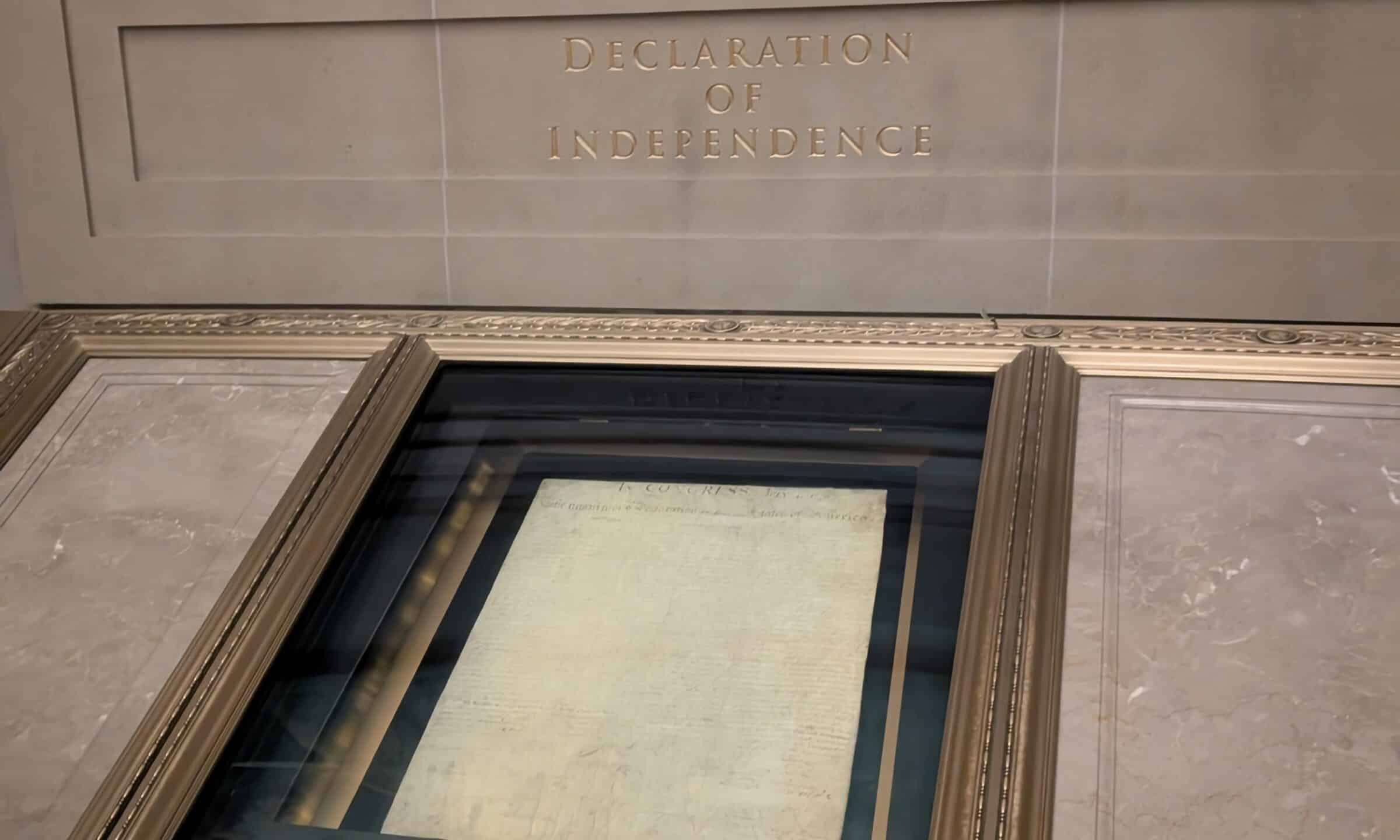
Editor’s note: The following is an excerpt from the new book Endowed by Our Creator: The Bible, Science, and the Battle for America’s Soul, by John G. West, which explores the enduring truths of the Declaration of Independence as America celebrates its 250th birthday this year.
There is a phrase in the Declaration of Independence’s very first sentence worth pausing over. Most people probably pass over it without thinking much about it. The phrase is “the Laws of Nature and of Nature’s God.”
This phrase is important because it provides crucial background for understanding the rest of the Declaration. The words echo British Enlightenment thinker John Locke (1632–1704), who used the phrase “the laws of God and nature” in his Two Treatises of Government. Locke in turn was drawing on a larger intellectual tradition. Anglican theologian Richard Hooker (1554–1600) previously employed the phrase “the law of God, and the law of nature” in his treatise Of the Laws of Ecclesiastical Polity. Hooker in turn was quoting from the great medieval Catholic theologian Thomas Aquinas (1225–1274). For his part, Thomas Jefferson made clear that the Declaration reflected ideas not only from Locke but from Aristotle, Cicero, Algernon Sidney, and others. “The object of the Declaration,” he wrote, was “not to find out new principles, or new arguments, never before thought of… but to place before mankind the common sense of the subject.”
Truths About Reality
The “Laws of Nature” are those truths about reality that all well-formed human beings have access to through observation, reason, and conscience. The Founders weren’t primarily referring here to the laws of physical nature (for example, the law of gravity). Instead, they had in mind the laws of human nature, especially the laws of morality.
The second half of the phrase — the “Laws… of Nature’s God” — points to the Founders’ conviction that the laws of human nature ultimately derive their authority from God himself. It also hints that humans have access to these laws not just through reason and conscience, but also through God’s special revelation to us — the Bible.
In the words of Founding Father James Wilson, God’s law for human beings “is communicated to us by reason and conscience, the divine monitors within us, and by the sacred oracles [i.e., the books of the Bible], the divine monitors without us.” A signer of both the Declaration and the Constitution, Wilson later became a Justice of the Supreme Court and was perhaps the most gifted legal theorist among the Founders. His inaugural law lecture at the College of Philadelphia was attended by luminaries such as George Washington, John Adams, and Thomas Jefferson.
Reason, Conscience, and Revelation
This view that reason and conscience as well as the Bible point in the same direction was not the invention of a secular age of “Enlightenment.” It had deep roots in both the Bible and Christian theology.
In Romans 2:14–15, the Apostle Paul wrote about how the Gentiles were accountable to the moral law even though they did not have the law of Moses, because the dictates of the moral law were “written on their hearts, while their conscience also bears witness, and their conflicting thoughts accuse or even excuse them.”
Subsequent Christian thinkers embraced the same view. Augustine (354–430) wrote that “the hand of our Maker in our very hearts has written this truth: That thing which you would not do to yourself, do not do to another. No one was ignorant of this truth even before the Law of Moses was given, so that there might be some rule by which even those without the Law might be judged.”
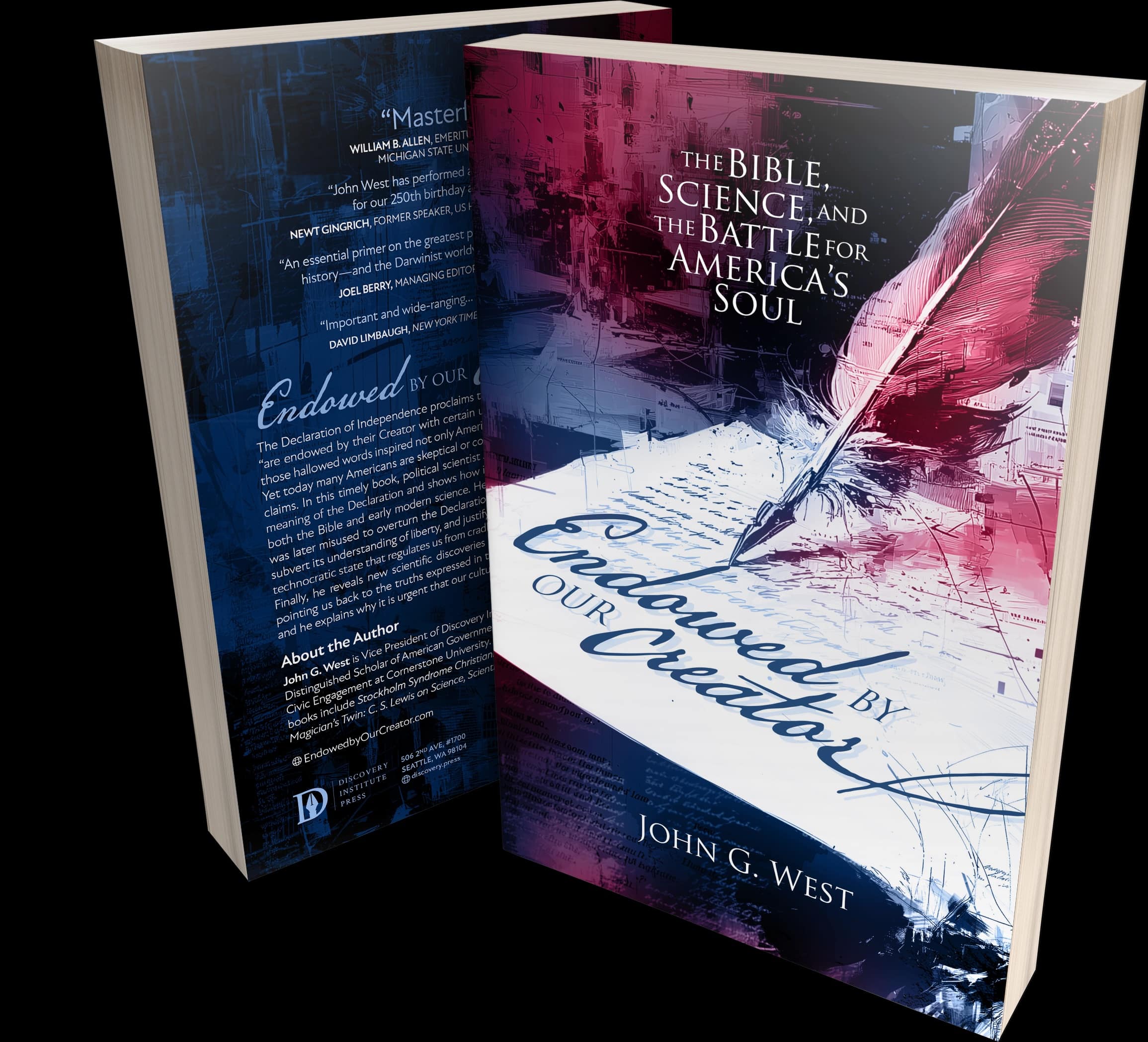 Image credit: Discovery Institute Press.
Thomas Aquinas invoked Romans 2:14–15 to argue that humans have access to the principles of morality through “the natural law” as well as the Bible. Martin Luther likewise cited Romans 2 to argue that the moral law given by Moses in the Ten Commandments is implanted in human beings “by nature”: “For what God has given the Jews from heaven, he has also written in the hearts of all men.” John Calvin agreed, writing that “the law of God which we call moral, is nothing else than the testimony of natural law, and of that conscience which God has engraven on the minds of men.” In the 20th century, C. S. Lewis made a similar argument in his books Mere Christianity and The Abolition of Man.
As I explain in my new book Endowed by Our Creator, this idea that reason, conscience, and revelation converge on the same truths undergirds many of the key teachings in the Declaration of Independence.