






































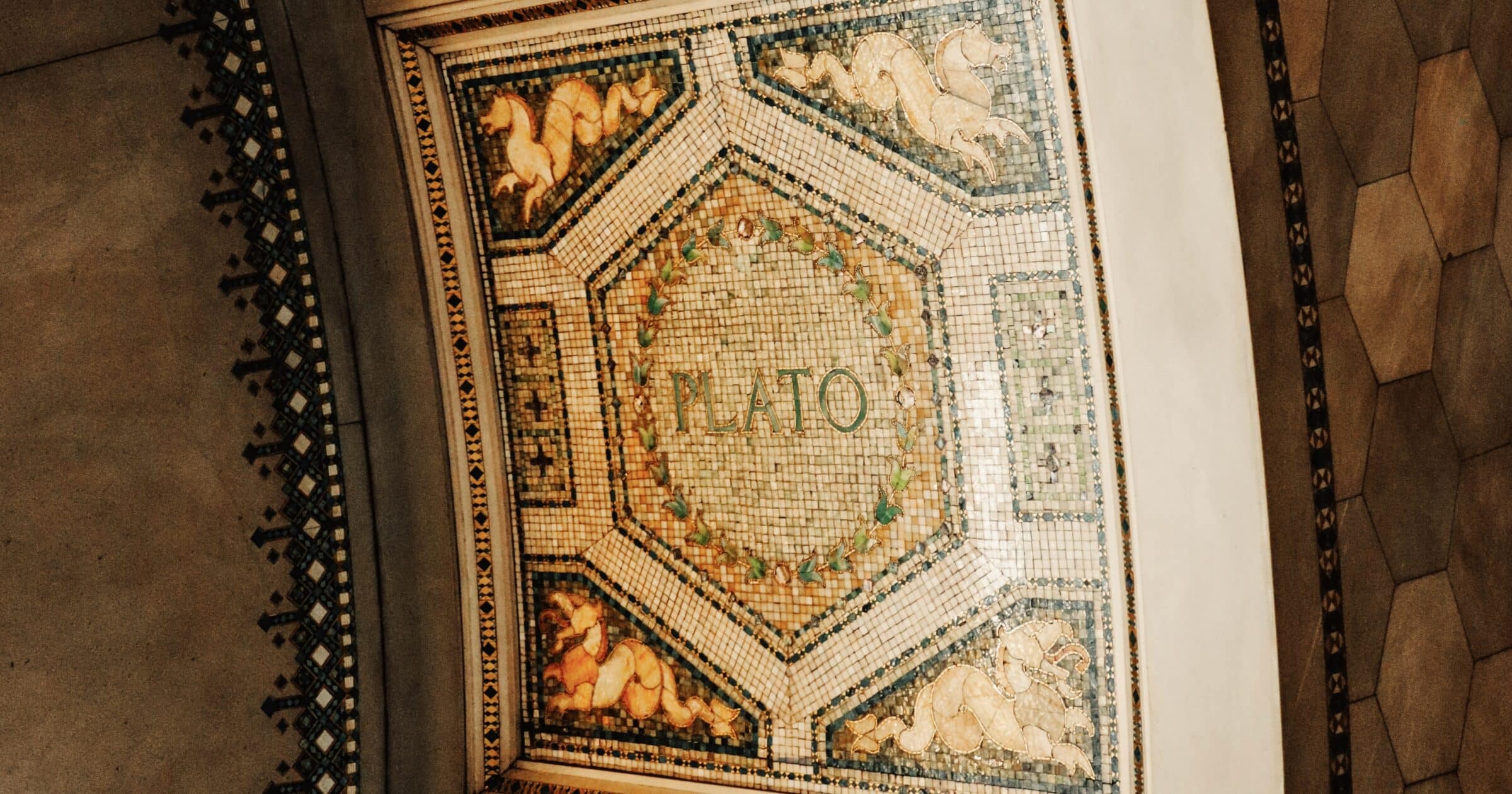
South African scholar Wynand de Beer’s book From Logos to Bios: Evolutionary Theory in Light of Plato, Aristotle & Neoplatonism should be read by everyone interested in the rather tortured and contentious history of the life sciences. Dr. de Beer uses the fathers of Western thought (Pythagoras, Heraclitus, Plato, Aristotle, Plotinus, to name a few) to establish a richer and more nuanced definition of biological evolution, moving (as the title suggests) “from Logos to Bios.”
When the question is asked, “What is evolution?” it is typical that three answers are available. First, evolution is simply change over time; second, it is a theory involving universal common descent of one kind or another; and third, evolution involves specific means and mechanisms of change in which the genetic mutations originating by chance in DNA form the basis of variation by which natural selection operates. Clearly the third form is the preferred neo-Darwinian definition, while the second may certainly include Darwin’s monophyletic “common descent” theory but at the same time may allow for irreducible complexity and even for profound loss-of-function mutation as, according to Michael Behe, “the first rule of adaptive evolution.” However, it would be wrong to rule out polyphyletic origins as a legitimate evolutionary theory as proposed by paleontologists George Gaylord Simpson and H. B. Whittington along with biologist Malcolm Gordon, and some others. Other interesting possibilities are suggested besides common descent. Thus, universal common descent is an interesting proposal but, in the end, an equivocal idea that raises more questions than it answers. Finally, evolution as simply change over time is thoroughly noncontroversial but also descriptively uninformative — virtually a useless tautology.
A Fourth Definition
Thanks to Wynand de Beer, we now have the ancients to consult, and when we do, we find an important fourth definition offered:
The term “evolution” is derived from the Latin evolvere, to roll out or unfold, which in this context means the development of that which is enveloped. “The cosmos becomes what it is through an ‘unwinding’ or explication of what is already inside, which is ‘turned out’ or evolved into what it is initially not, but can then be seen in.” We might say that evolution is the unfolding of inherent possibilities. In Aristotelian terms, we could say that evolution entails a movement from potentiality (Greek dynamis) to actuality (Greek energeia). Since this unfolding involves an acquisition of form for a specific end or purposes, a telos, where intelligible from, eidos, serves as the model or template for sensible form, morphē, an authentic theory of evolution must include both formal and final cause (p. 5).
This deeper historical dive into evolutionary theory is laid out in eight informative chapters that begin, most helpfully enough, with metaphysics (an area all too often neglected in current discussions of the topic). De Beer goes on to present “Aspects of Hellenistic Cosmology” in chapter 2. Chapter 3, “Hellenic Philosophy of Life, or Bio-Philosophy,” features Plato and Aristotle on form, leading to the conclusion that “the development of an organism can only be actualized according to its inner potentiality,” a “view [that] is clearly at odds with the Darwinian hypothesis that new species are formed due to material and mechanical factors alone” (p. 47). Special attention to Aristotle’s teleology and “the Great Chain of Being” complete this most enlightening chapter. Chapter 4, “Form and Transformation,” introduces D’Arcy Wentworth Thompson’s On Growth and Form (1917, revised 1942) as an “epochal work” that affirms “the Hellenistic notion of cosmic lawfulness” (p. 77), launching de Beer’s critique of the fossil record that is “so complete that the lack of transitional series could not be explained by the scarcity of material” (p. 88). In the next chapter, “The Modern Theory of Evolution,” de Beer addresses many problems and unanswered questions raised by the Darwinian hypothesis. He concludes that “while Darwinism provides a feasible empirical explanation of micro-evolution, it fails as an explanation of macro-evolution for which the production of new genetic material is required. We contend that macro-evolution is more feasibly explained as a result of regulated, directed, and convergent evolution” (p. 145), a thesis that is explicated in the remainder of the book.
Owen’s Platonic Cosmogony
De Beer uses Richard Owen’s Platonic cosmogony as a starting point in discussing his On the Nature of Limbs (1849) and Anatomy of Vertebrates (1866). Here the Russian biologist Lev Berg’s nomogenesis replaces Darwin’s chance-based stochastic processes with biological development according to definite laws, a position affirmed by an outspoken Darwinian critic, French zoologist Pierre-Paul Grassé. It should not be thought that evolution by means of natural law commits one to methodological naturalism or scientistic reductionism of any kind; genes do not become the modern-day equivalent of an atomistic universe posited by Leucippus and Democritus (for that one must go to Richard Dawkins’s thoroughly outdated The Selfish Gene). Instead, “since code cannot be produced by the laws of physics and chemistry, it is reasonable to conclude that genetic information originated in the activity of the intelligible reason-principles (Greek logoi) indwelling all existing things, so that we might say the genetic code is designed by a transcendent Intellect and is not due to a Neo-Darwinian chemical accident” (p. 166). My own interpretation is that perhaps John 1:1 already says the same thing in a different way, identifying Christ as the source moving it from plural to singular Logos (a term [λόγος] that appears over 300 times in the Greek NT).1 For Christians, the many logoi are consummated in the One Logos. Thus, Tertullian’s rhetorical question — “What has Athens to do with Jerusalem?” — gets the unexpected answer, everything!
The Cambrian Explosion
Although neo-Darwinians continue to grapple with the Cambrian explosion, it is more easily and logically explained by proposing that “the mutational production of forms proceeds by sudden large-scale mutational saltation, or, the fossil record shows periods when nature works at a slower rate, as would later be recognized in the theory of punctuated equilibrium…. We could therefore say that species arise either through mutational transformation en masse, or through geographical isolation. These two alternatives correspond to the distinction we are making between macro- and micro-evolution” (p. 179). Citing Michael Denton, de Beer concludes chapter 6 by noting that a universe governed by abstract rules conforms similarly to the rules of grammar which “define a set of unique immaterial templates which are materialized into a thousand or so natural forms — a world of rational morphology and pre-ordained evolutionary paths”; in short, “a pre-Darwinian Platonic universe” (p. 197).
De Beer clarifies the import of his book by explaining its metaphysical significance. As new organic forms arrive on the scene by means of mutation, not randomly but through a morphological plan as the formal cause, its survival and reproduction becomes the final cause or purpose phylogenetically. Thus, “the physical reflects the metaphysical, from which it cannot be divorced without a radical loss of both ontological depth and epistemological scope” (p. 264). This final sentence in the book is not a mere summation, it is its essential point — the leitmotif that runs throughout.
Reintroducing Metaphysics to Biology
What de Beer has done is reintroduce metaphysics to biology; he begins and ends on that note. He has shown that the positivists and Darwinian reductionists have thrown away metaphysics at their own peril. By abandoning the insights of the fathers of Western thought, we have instead been presented with a childish building-block world of life in lockstep with principles inadequate to their explanatory task.
This review has merely highlighted certain points of de Beer’s important contribution. There’s much more in its 278 pages. A thorough reading of From Logos to Bios will repay the reader in ways beyond biology. The book recaptures the wisdom of the ages and puts it into service not only of science, but of history, philosophy, and religion. Alfred North Whitehead once remarked that “the European philosophical tradition…consists of a series of footnotes to Plato.” He was only partly correct. Actually, the whole biological and cosmological traditions are a series of footnotes to Plato. To reject that is, as C. S. Lewis would say, just chronological snobbery. Wynand de Beer tempers our modern arrogance and awakens us from our amnesia.
Notes
- Of course, John is drawing upon Jewish traditions he would have been familiar with since Logos, “The Word,” “combines God’s dynamic, creative word (Genesis), personified preexistent Wisdom as the instrument of God’s creative activity (Proverbs), and the ultimate intelligibility of reality (Hellenistic philosophy).” — The New Catholic Answers Bible