






































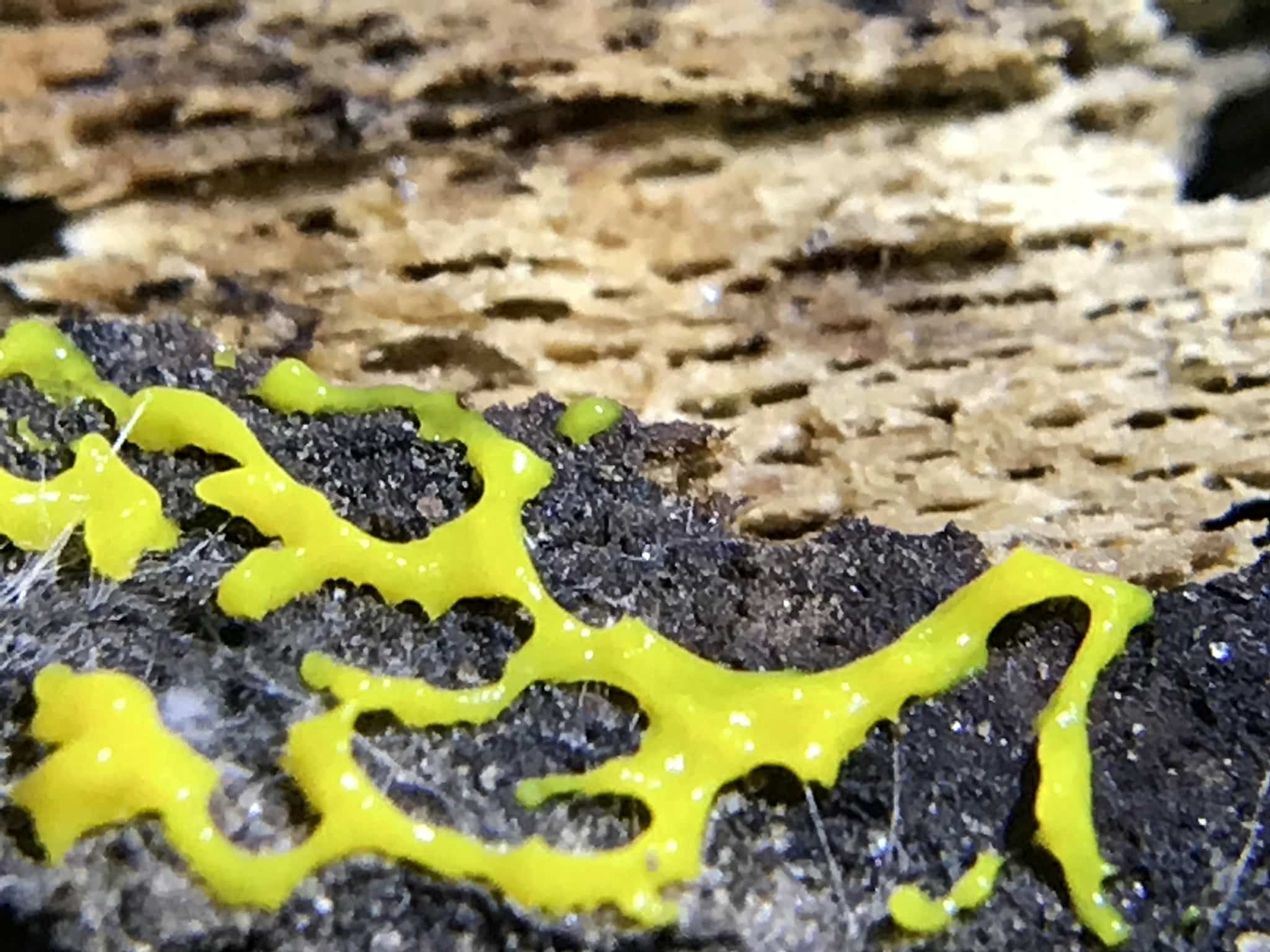
At Aeon, Matthew Sims, a researcher into the evolution of cognition at Leverhulme Centre for the Future of Intelligence at Cambridge, offers some interesting reflections on memory that does not depend on neurons or electrons in computers.
In recent decades, researchers have been learning about memory in slime molds (Physarum polycephalum) which have neither a brain nor neurons. They offer opportunities for study for two reasons: At one stage of their lives, they are rather large and active, making them easy subjects of research.
The other, more significant, reason, of course, is that, despite lacking a brain or nervous system, it can do things we would hardly expect, including “ability to make adaptive decisions, solve mazes and even exhibit habituation — a simple form of learning” (Sims)
The slime mold is quite unusual physically. Now classified as more like an amoeba than a fungus, it is one giant cell with millions of nuclei. It can become very large during the plasmodial stage — up to two square meters, Sims tells us. It can also travel at 5 cm/2 inches an hour as it looks for detritus of plants, fungi, etc., to feed on.
Sims, the author of Slime Mould and Philosophy (Cambridge 2024), discusses some of the experiments that demonstrated its surprising abilities, experiments that have been documented elsewhere.
Chopped Up Molds Reassemble for Collective Decision-Making
In the early 2000s Toshiyuki Nakagaki, then at Hokkaido University in Japan, and his colleagues chopped up a single polycephalum and scattered the pieces throughout a plastic maze. The smidgens of slime mold began to grow and find one another, burgeoning to fill the entire labyrinth. Nakagaki and his teammates placed blocks of agar packed with nutrients at the start and end of the maze. Four hours later the slime mold had retracted its branches from dead-end corridors, growing exclusively along the shortest path possible between the two pieces of food.
Jabr, F. How brainless slime molds redefine intelligence. Nature (2012). https://doi.org/10.1038/nature.2012.11811
So, reassembled, it simply continues as before with no losses.
The Mold Uses Slime Trails as Information
The mold also lays down slime trails. It does not look for food where it senses trails because they indicate that it has already been there:
This past October Reid and his colleagues published a study revealing that the way a slime mold navigates its environment is even more sophisticated than previously realized. As polycephalum moves through a maze or crawls along the forest floor, it leaves behind a trail of translucent slime. Reid and his teammates noticed that a foraging slime mold avoids sticky areas where it has already traveled. This extracellular slime, Reid reasoned, is a kind of externalized spatial memory that reminds polycephalum to explore somewhere new.
“Redefine intelligence” The paper is open access.
It Can Overwrite Outdated Information
From Sims:
A follow-up experiment in 2013 buttresses that interpretation. This time, Reid’s team showed that avoiding extracellular slime is not merely an aversive reflex or fixed response. When a plasmodium was placed in a Y-shaped maze, where extracellular slime lay between it and a source of high nutrient food (yolk) it had perceived, the plasmodium ignored the slime, crossing it to obtain the food. Importantly, this result shows that slime as a memory trace is overwritable in light of new, salient information — the presence of high-quality food — ticking the box for a widely accepted criterion for navigational memory.
“Memories without brains,” July 11, 2025 (Paper.)
He suggests:
That the food was high quality also mattered: it suggests that Physarum’s overriding of the slime cue is an integrated valuation process — analogous to a cost-benefit analysis. Memory, unlike simple stimulus-response circuits, is integrated into an organism’s wider cognitive economy.
“Memories without brains”
Of course, the mold is experiencing a stimulus, not an idea. Even so, one stimulus (yes, go there) is overriding another one (no, don’t bother). Some decision-making work is being done.
Experiments with the mold’s capabilities have been widely reported because it can be used to mimic well-known highway and railway systems — which are themselves designed to reach target destinations most efficiently:
Even more impressively, inside the lab, P. polycephalum was able to recreate Tokyo’s railway network in miniature, as well as the highways of Canada, the UK and Spain. This happened when researchers placed food in the same positions as big cities and urban areas. The mold engulfed the entirety of edible maps. Within days, the slime thinned itself away, leaving behind interconnected branches of slime that linked pieces of food in the same manner as man-made roads. It created the most efficient network possible, given the terrain.
“Brainless Slime Mold Physarum polycephalum Shows Intelligence,” SciTechDaily, January 8, 2013
The Molds Also Demonstrate Habituation
For example, from CNRS (French National Centre for Scientific Research):
During a nine-day experiment, the scientists thus challenged different groups of this mold with bitter but harmless substances that they needed to pass through in order to reach a food source. Two groups were confronted either by a “bridge” impregnated with quinine, or with caffeine, while the control group only needed to cross a non-impregnated bridge. Initially reluctant to travel through the bitter substances, the molds gradually realized that they were harmless, and crossed them increasingly rapidly — behaving after six days in the same way as the control group. The cell thus learned not to fear a harmless substance after being confronted with it on several occasions, a phenomenon that the scientists refer to as habituation. After two days without contact with the bitter substance, the mold returned to its initial behavior of distrust. Furthermore, a protist habituated to caffeine displayed distrustful behavior towards quinine, and vice versa. Habituation was therefore clearly specific to a given substance.
CNRS. “A single-celled organism capable of learning.” Science Daily, April 27 , 2016. The paper is open access.
Can Memories Be Stored Outside the Brain?
In his view, polycephalum‘s ability to use slime to navigate around food-depleted areas challenges our understanding of intelligence as a relationship between brain, body, and the world.
The differences between P. polycephalum and humans may seem vast, but slime mould can reveal a remarkable amount about various aspects of how we remember. While many people might assume that our memories are primarily stored within our brains, some philosophers like myself argue that – along with some other aspects of cognition – memory can extend beyond the confines of the body to involve coupled interaction with structures in the environment. At least some of our cognitive processes, in short, loop out into our surroundings. Slime mould is an intriguing candidate to explore this idea because it doesn’t have a brain at all, yet in some cases can apparently ‘remember’ things without needing to store those associated memories within itself. In other cases, memories acquired via learning by one individual can even be acquired by a separate individual through physical contact. The behaviour of this strange form of life suggests that some of our ideas about how memories are acquired may need a rethink.
“Memories without brains”
And that may not be a welcome project:
These conclusions, of course, remain contentious within traditional cognitive science and psychology where memory is often defined as the result of learning on the part of the same individual whose memory it is. … Both HEC [hypothesis of extended cognition] and memory without learning are not easy pills to swallow, but then again, neither is the very idea that a non-neuronal organism can learn in the first place — an idea that Physarum’s behaviour unequivocally seems to support.
“Memories without brains”
Some Concluding Notes
What deepens the problem that these findings present for a traditional view of the importance of the brain to memory and learning is this: Polycephalum is comparatively easy to study. We don’t really know how many life forms among the amoebae, fungi, and the like use non-neural memory systems. If a number of them do, the problematic findings about polycephalum’s memory cannot be addressed simply by actively neglecting the topic in the future.
More important, there seems to be no consensus on how, exactly, polycephalum remembers things.
Now, it’s worth noting that the memory the researchers study concerns one sole topic — where to find food. Whatever system polycephalum is using may turn out to be poorly suited to navigating for a variety of complex needs or responses. If so, its ability to learn and remember without neurons or a brain is quite compatible with the general importance of neurons and brains for organisms that have more complex needs.
What’s perhaps most interesting is the significant departure from traditional assumptions in biology: If we are talking about memory as something that can “extend beyond the confines of the body to involve coupled interaction with structures in the environment” it is not clear that we are talking about something that is straightforwardly biotic at all. It might function more like a force in physics.
It’s early days yet, but it doesn’t sound as though dogmatism is going to be biology’s best friend. That at least is not a new finding.
Cross-posted at Mind Matters News.