






































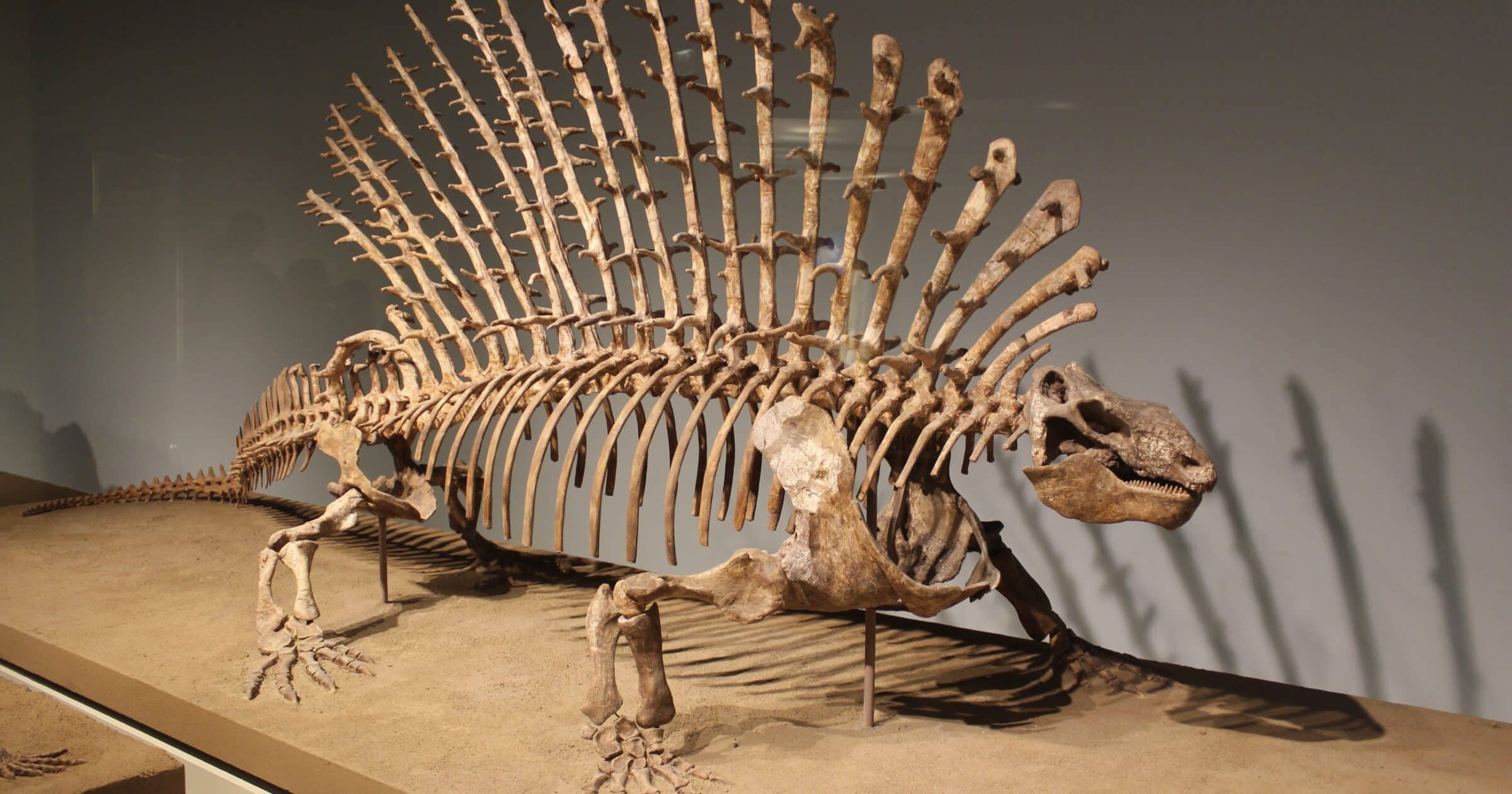
When you look at the way most reptiles walk and compare it with the terrestrial locomotion of mammals, you will immediately recognize a big difference. While reptiles have their legs splayed out to the side and crawl over the ground, mammals have their legs positioned beneath their body and therefore walk with their bellies elevated from the ground. Evolutionists generally assume that mammals descended from reptile-like ancestors (such as the Permian pelycosaur Edaphosaurus featured this Fossil Friday), which may well be correct. Consequently, they have also postulated an evolutionary transition in the locomotory posture correlated with the backbone movement, which has been called the lateral-to-sagittal paradigm.
The latter hypothesis has been described as “an easy to grasp story that’s been taught in college textbooks on anatomy and evolution for decades” (Harvard University 2021), “but according to a new Harvard-led study, that long held belief is wrong” (also see Siliezar 2021). This research (Jones et al. 2021) also found the likely reason for the error: “If we only look at modern animals, such as living mammals and reptiles, we can come up with evolutionary hypotheses but they may not be correct” (Harvard University 2021). One of the study’s authors commented that “Unless we go back into the fossil record and really dig into those extinct animals, we can’t trace what those anatomical changes were, when they happen, or what selective pressures drove their evolution” (Harvard University 2021). Another commenter emphasized that the “findings point to the importance of checking the fossil record” (Siliezar 2021).
In other words: evolutionists make up fancy just-so stories that do not stand up to scrutiny when they are checked with actual empirical data from the fossil record, which contradict the storytelling. Luckily, for most characters beyond hard parts (such as skeletons and shells), the fossil record remains silent and does not get in the way of imaginative evolutionary scenarios. What could go wrong?
References
- Harvard University 2021. Lateral-to-sagittal shift in mammal spine evolution challenged in new study. ScienceDaily March 15, 2021. https://www.sciencedaily.com/releases/2021/03/210302130653.htm
- Jones KE, Dickson BV, Angielczyk KD & Pierce SE 2021. Adaptive landscapes challenge the “lateral-to-sagittal” paradigm for mammalian vertebral evolution. Current Biology 31(9), 1883–1892. DOI: https://doi.org/10.1016/j.cub.2021.02.009
- Siliezar J 2021. Study challenges accepted notion of mammal spine evolution. The Harvard Gazette March 15, 2021. https://news.harvard.edu/gazette/story/2021/03/challenging-the-lateral-to-sagittal-shift-in-mammalian-locomotion/