






































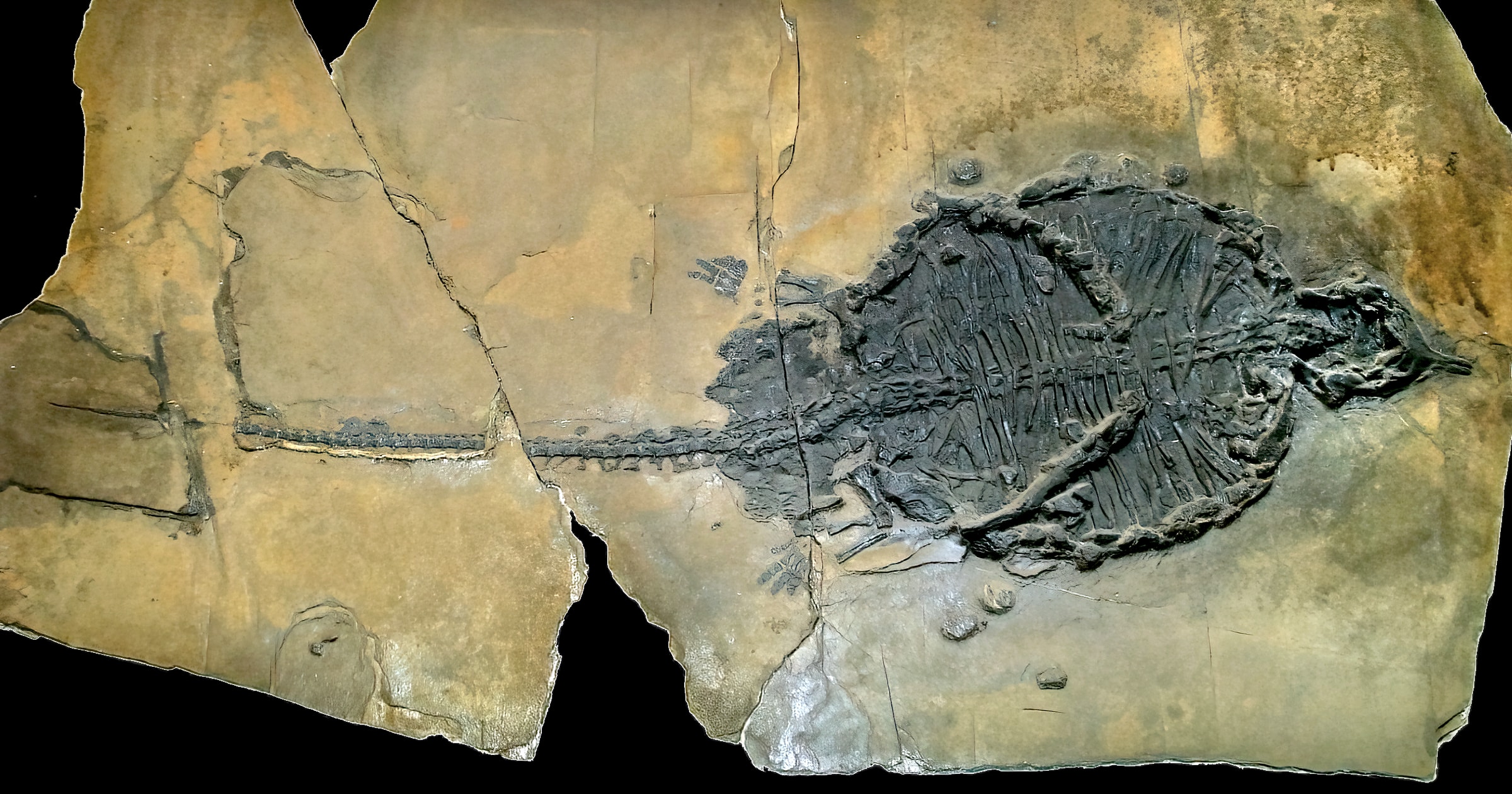
Last week I reported about the abrupt origin of ichthyosaurs in the Early Triassic. However, ichthyosaurs are not the only marine reptiles that appeared abruptly in the Early Triassic. Actually, there are 15 (!) different families of marine reptiles that appear as if out of nowhere in Triassic deposits, while none of them or any putative precursors are known from the preceding Permian period. All aquatic reptiles from the Permian (McMenamin 2019), such as mesosaurs, are clearly unrelated (Laurin & Piñeiro 2017, MacDougall et al. 2018).
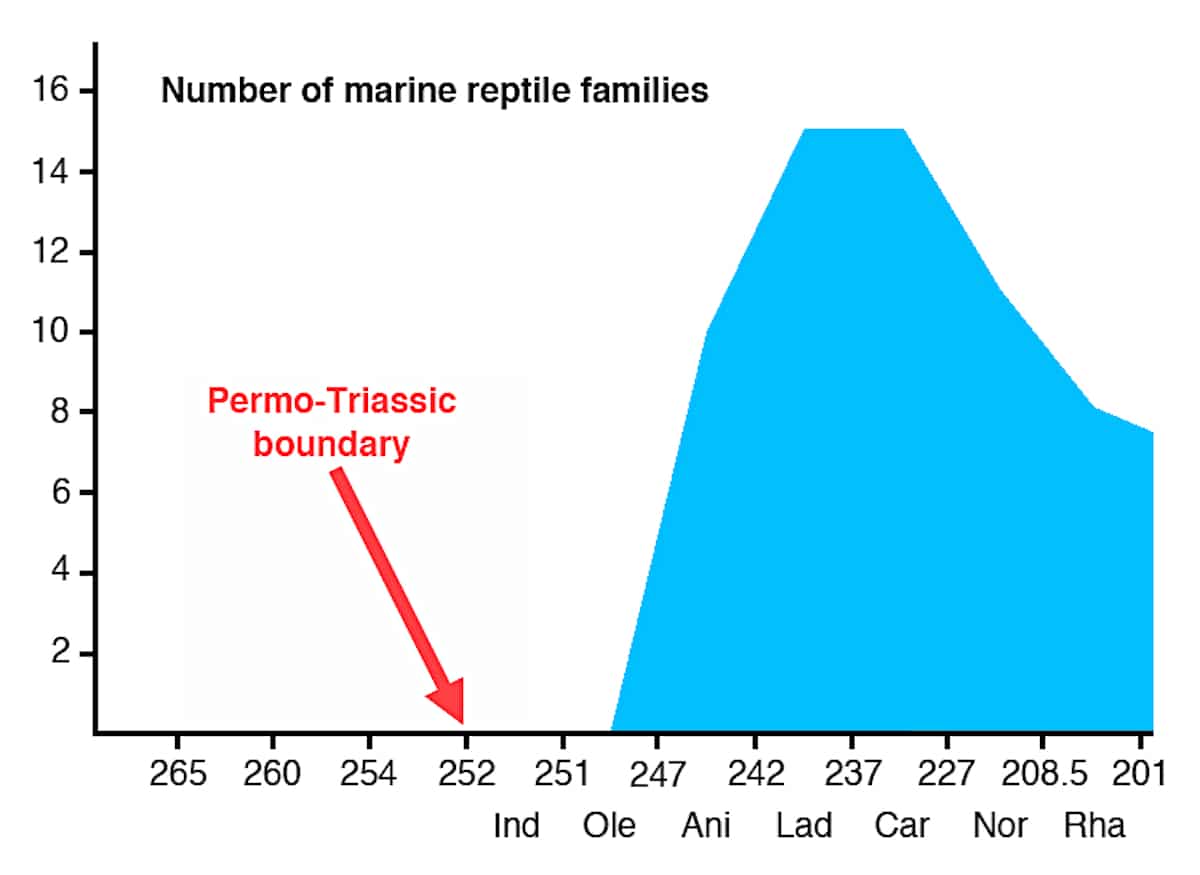
The new marine reptile groups appearing in the Triassic include, for example, plesiosaurs, placodonts (like the featured Psephoderma), nothosaurs, thalattosaurs, hupehsuchians, nasorostrians, ichthyopterygians, pleurosaurids, and enigmatic forms like Atopodentatus as well as marine turtles and marine crocodiles (thalattosuchians) (Motani 2009). Twitchett & Foster (2012: fig. 5) showed that these 15 families appeared within 9 million years “from obscure origins in the Early Triassic.” It is not like we Darwin critics make this stuff up. We just look at all the evidence and draw our conclusions from conflicting data that Darwinists prefer to ignore or explain away with ever more ad hoc hypotheses.
References
- Laurin M & Piñeiro GH 2017. A Reassessment of the Taxonomic Position of Mesosaurs, and a Surprising Phylogeny of Early Amniotes. Frontiers in Earth Science 5:88, 1–13. DOI: https://doi.org/10.3389/feart.2017.00088
- MacDougall MJ, Modesto SP, Brocklehurst N, Verriere A, Reisz RR & Fröbisch J 2018. Response: A Reassessment of the Taxonomic Position of Mesosaurs, and a Surprising Phylogeny of Early Amniotes. Frontiers in Earth Science 6:99, 1–5. DOI: https://doi.org/10.3389/feart.2018.00099
- McMenamin M 2019. Permian Aquatic Reptiles. PaleoXiv July 11, 2019. DOI: https://doi.org/10.31233/osf.io/wb6h7
- Motani R 2009. The Evolution of Marine Reptiles. Evolution: Education and Outreach 2, 224–235. DOI: https://doi.org/10.1007/s12052-009-0139-y
- Twitchett RJ & Foster WJ 2012. Post-Permian Radiation. eLS 2012, 1–6. DOI: https://doi.org/10.1002/9780470015902.a0001643.pub3