






































“Intelligent design theory is sometimes said to lack any practical application,” writes Eric Holloway over at Mind Matters. If intended as a criticism of ID, this is actually one I don’t think I’ve heard before. But never mind. Dr. Holloway goes on to meet the challenge with a great insight:
One straightforward application is that, because intelligence can create information and computation cannot, human interaction will improve computational performance. Addressing this observation, there is a growing field known as “human computation” which investigates whether human-in-the-loop computation is more effective than a purely computational approach. It turns out that the answer is yes.
There are numerous tasks that humans find trivial but are extremely difficult or impossible for algorithms to perform. This phenomenon is known as Moravec’s paradox. Combining human and computational approaches allow the computers to “amplify” the humans’ capabilities, and vice versa. The big tech companies such as Microsoft, Google, Facebook, and Amazon all use forms of human computation to power their search and recommendation algorithms. Incidentally, a number of artificial intelligence companies have been caught faking their AI with human workers posing as bots.
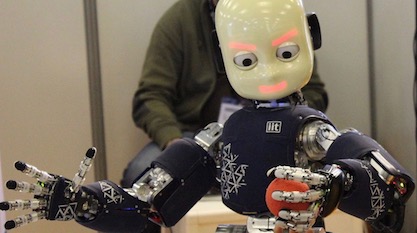
Or as Denyse O’Leary asks, “Why is it comparatively easy to develop a program to play chess, as opposed to teaching a robot to walk freely?”
Because evolution by natural selection is itself a kind of algorithm, Moravec’s paradox, if it continues to hold true, would suggest the need for “amplification” in the evolutionary process by an outside intelligent agent. In other words, this would seem to be part of the accumulating evidence for ID, as well as for an unbridgeable gap between man and machine.