Science and Culture Today Discovering Design in Nature
Topic

Meet the Materialists

Meet the Materialists, part 9: Clotaire Rapaille, Marketing Guru

Note: This is one of a series of posts adapted from my new book, Darwin Day in America. You can find other posts in the series here. When Kellogg needed advice about Tony the Tiger, Seagrams wanted to know more about whisky, and Samonsite wanted to understand the deeper meaning of luggage, they all called one man: Clotaire Rapaille, Boca Raton marketing guru extraordinaire. A native of France, Rapaille has parlayed a master’s degree in psychology and a doctorate in medical anthropology from the Sorbonne into a lucrative career in high-stakes world of corporate advertising. Featured by such news outlets as CNN, The New York Times, and Newsweek, Rapaille has assembled an elite client list straight from the Fortune 100. Read More ›

Meet the Materialists, part 8: John Watson, the Father of Modern Advertising

Note: This is one of a series of posts adapted from my new book, Darwin Day in America. You can find other posts in the series here.

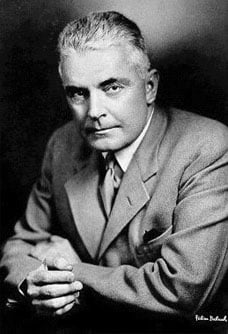
John B. Watson, founder of the behavioral school of psychology, believed that human beings were on par with animals, and so he insisted that they should be studied just like animals. Indeed, he defined behaviorism as “an attempt to do one thing—to apply to the experimental study of man the same kind of procedure and the same language of description that many research men had found useful for so many years in the study of animals lower than man.” He compared opposition to behaviorism to the “resistance that appeared when Darwin’s ‘Origin of species’ was first published.” In his view, the root of the resistance to Darwin and behaviorism was the same: “Human beings do not want to class themselves with other animals.” Watson attributed the rejection of behaviorism by some psychologists to their unwillingness to accept “the raw fact” that “to remain scientific” they “must describe the behavior of man in no other terms than those [they]… would use in describing the behavior of the ox [they]… slaughter.”

Read More ›

Meet the Materialists, part 7: Katherine Blackford, M.D., and the “Scientific” Selection of Employees

Note: This is one of a series of posts adapted from my new book, Darwin Day in America. You can find other posts in the series here.

During the early decades of the twentieth century, Katherine Blackford , M.D., urged America’s businesses to reinvent their employment policies by drawing on the discoveries of modern science, especially Darwinian biology. Employment selection procedures, in short, needed to be based on the facts of natural selection.

Read More ›

Meet the Materialists, part 6: Lydston, Hoyt, and the Miracle Cure of Castration

Note: This is one of a series of posts adapted from my new book, Darwin Day in America. You can find other posts in the series here.

From the 1890s into the early years of the twentieth century, a growing number of American doctors advocated castration as a solution for habitual criminals as well as rapists and murderers. Proponents of castration like Frank Lydston derided the failed rehabilitation efforts of the “sentimentalist and his natural ally, the preacher,” and argued that “asexualization” surgery would produce results by preventing criminals from passing down their criminal tendencies to their children, by striking fear into non-castrated criminals, and by changing the personality of the castrated criminal. “The murderer is likely to lose much of his savageness; the violator loses not only the desire, but the capacity for a repetition of his crime, if the operation be supplemented by penile mutilation according to the Oriental method.” Lydston’s views were grounded forthrightly in scientific materialism. “The attempt to reduce criminology to a rational and materialistic basis has constituted a great step in advance — one which marks a distinct epoch in scientific sociology,” he proclaimed in 1896.

Read More ›

Meet the Materialists, part 5: Clarence Darrow

Note: This is one of a series of posts adapted from my new book, Darwin Day in America. You can find other posts in the series here.

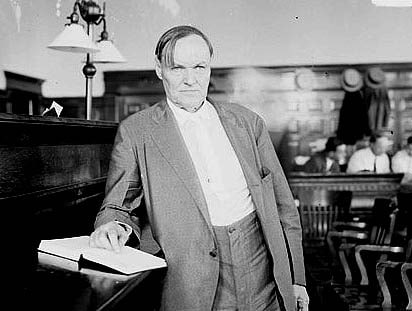
Perhaps the most celebrated defense attorney in the first half of the twentieth century, Clarence Darrow is best known for his role at the Scopes “monkey trial” in the 1920s. But he also was an early champion of the idea that criminals should not be held responsible for their crimes. Darrow’s debunking of criminal responsibility was based squarely on his worldview of deterministic materialism.

Darrow once told prisoners in a county jail that there was no difference whatever in the moral condition between themselves and those still in society. “I do not believe people are in jail because they deserve to be,” he declared. “They are in jail simply because they cannot avoid it, on account of circumstances which are entirely beyond their control, and for which they are in no way responsible.” According to Darrow, “there ought to be no jails, and if it were not for the fact that the people on the outside are so grasping and heartless in their dealing with the people on the inside, there would be no such institutions as jails.” He added that he knew why “every one” of the prisoners committed their crimes, even if they did not know the reason themselves: “You did these things because you were bound to do them.” Those prisoners who thought they made a choice to commit a crime were simply deluded. “It looked to you at the time as if you had a chance to do them or not, as you saw fit; but still, after all, you had no choice.”

Read More ›

Meet the Materialists, part 4: Cesare Lombroso and the New School of Criminal Anthropology

Note: This is one of a series of posts adapted from my new book, Darwin Day in America. You can find other posts in the series here.

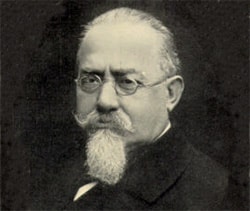
By the end of the nineteenth century, American scholars were already talking with excitement about the “new school of criminal anthropology” that sought to use modern science to identify the causes of crime. Leading the way was Italian criminologist Cesare Lombroso (1835-1909), whose book Criminal Man (1876) remains a landmark work in the field of criminology. Lombroso and his disciples contended that criminal behavior could be explained largely as a throwback to earlier stages of Darwinian evolution.

According to Lombroso, infanticide, parricide, theft, cannibalism, kidnapping, theft and anti-social actions can all be found throughout the animal kingdom, as well as among human savages. In earlier stages of development such behaviors aided survival and were therefore bred into animals by natural selection. As William Noyes, one of Lombroso’s American disciples, explained, “in the process of evolution, crime has been one of the necessary accompaniments of the struggle for existence.” While crime no longer served a necessary survival function in civilized societies, many modern criminals could be considered atavists—reappearances of characteristics from earlier stages of evolutionary development. According to Lombroso, such atavists were “born criminals,” exhibiting from birth the physical as well as behavioral characteristics of savages. Physical markers of such individuals included “abundant hair,” “sparse beard[s],” “enormous frontal sinuses and jaws,” “broad cheekbones,” a “retreating forehead,” and “volumnious ears.”

Read More ›

Meet the Materialists, part 3: Frankenstein, Giovanni Aldini, and the Reanimation of the Dead

Note: This is one of a series of posts adapted from my new book, Darwin Day in America. You can find other posts in the series here.

This week’s installment of “Meet the Materialists” is particularly fitting for the week of Halloween.

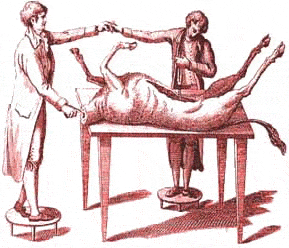
By the turn of the nineteenth century, Italian scientist Giovanni Aldini was performing macabre experiments on decapitated oxes, horses, lambs… and humans. “The unenlightened part of mankind are apt to entertain a prejudice against those… who attempt to perform experiments on dead subjects,” Aldini later acknowledged, but he maintained that such experiments were justified because the object was to improve human welfare. “It is… an incontrovertible fact, that such researches in modern times have proved a source of the most valuable information.”

Determined to understand the workings of what he called “the human animal machine,” Aldini knew that he needed to procure bodies while they were still fresh and “retained… the vital powers in the highest degree of preservation.” His solution? “I was obliged, if I may be allowed the expression, to place myself under the scaffold, near the axe of justice, to receive the yet bleeding bodies of unfortunate criminals, the only subjects proper for my experiments.”

Read More ›

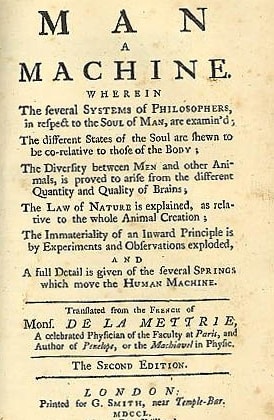
Meet the Materialists, part 2: Julien LaMettrie and Man a Machine

Note: This is one of a series of posts adapted from my new book, Darwin Day in America. You can find other posts in the series here.

A key point of my book Darwin Day in America is that materialism did not begin (or end) with Charles Darwin.

One of the pre-Darwin champions of materialism I cover in my book is physician Julien Offray de la Mettrie (1709-1751), author of the provocative tract Man a Machine (L’Homme Machine), published in 1748. According to La Mettrie, “the human body is a machine which winds its own springs” and the “the diverse states” of the human mind “are always correlative with those of the body.” In other words, human beings are mechanisms whose rational life is completely dependent on physical causes. Those causes include everything from raw meat to heredity.

In what has to be one of the more interesting passages in culinary analysis, La Mettrie opined:

Raw meat makes animals fierce, and it would have the same effect on man. This is so true that the English who eat meat red and bloody, and not as well done as ours, seem to share more or less in the savagery due to this kind of good.

Read More ›

Meet the Materialists, part 1: Eugenie Scott, “Evolution Evangelist”

Modern Darwinists like Richard Dawkins notwithstanding, there is nothing new in the effort to offer completely materialistic explanations of human beings and human culture. For more than two millennia various thinkers have been trying to reduce human beings to mere meat in motion. Many of these thinkers figure prominently in my new book Darwin Day in America, and over the next several weeks, I will be describing some of them here.

I start today with Eugenie Scott, executive director of the National Center for Science Education, and self-proclaimed “evolution evangelist.”

Read More ›

© Discovery Institute