Ada Lovelace Type post Author Robert J. Marks II Date June 28, 2022 CategoriesIntelligent DesignNeuroscience & Mind Tagged , Ada Lovelace, Alan Turing, chatbot, computer science, computers, creativity, English, Eugene Goostman, Go (game), Lord Byron, machines, Non-Computable You, programmers, Selmer Bringsjord, software, The Imitation Game, Turing test Can Artificial Intelligence Be Creative? Robert J. Marks II June 28, 2022 Intelligent Design, Neuroscience & Mind 6 Lady Ada Lovelace (1815–1852), daughter of the poet George Gordon, Lord Byron, was the first computer programmer. Read More ›
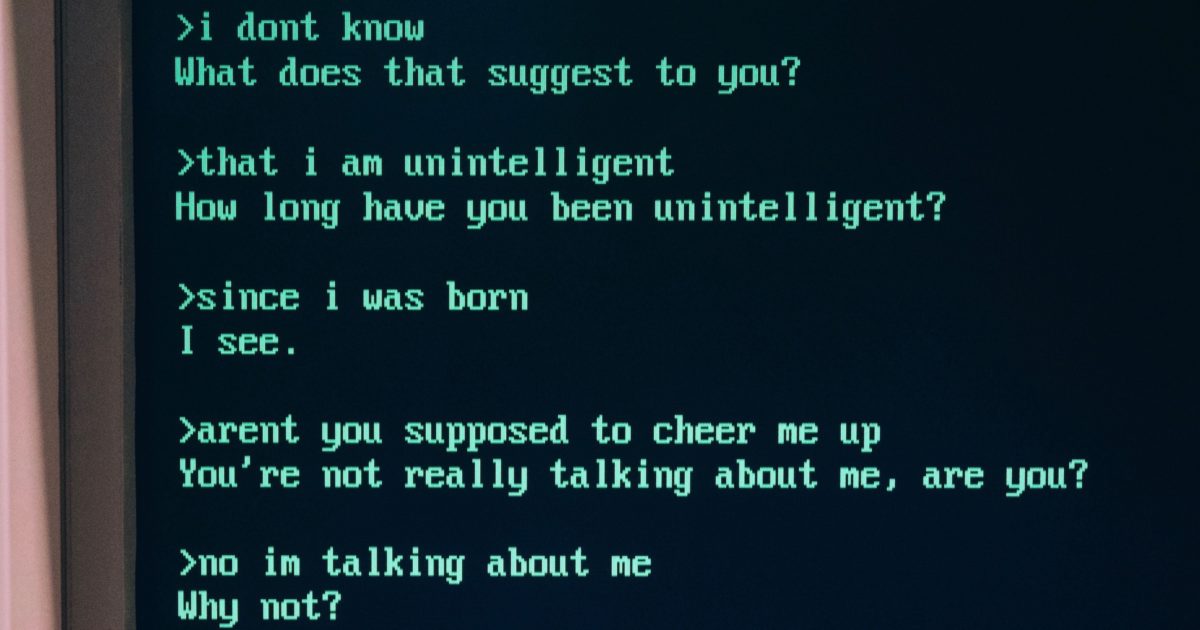
ELIZA Type post Author William A. Dembski Date April 21, 2021 CategoriesNeuroscience & MindPsychology Tagged , artificial intelligence, computer programming, ELIZA program, Erik Larson, Eugene Goostman, humans, Joseph Weizenbaum, psychologists, relationships, The Myth of Artificial Intelligence, University of Illinois Artificial Intelligence Understands by Not Understanding William A. Dembski April 21, 2021 Neuroscience & Mind, Psychology 3 The ELIZA program, acting as a Rogerian therapist, simply mirrors back to the human what the human says. Read More ›
self-driving car Type post Author William A. Dembski Date April 20, 2021 CategoriesNeuroscience & MindPhilosophy Tagged , artificial intelligence, automation, Big Tech, computer science, deep learning, Erik Larson, Eugene Goostman, Google, gorillas, machine learning, self-driving cars, The Myth of Artificial Intelligence, traffic Automated Driving and Other Failures of AI William A. Dembski April 20, 2021 Neuroscience & Mind, Philosophy 3 It would be interesting to see what fully automated driving would look like in a place like Moldova. Read More ›
Artificial Intelligence Type post Author William A. Dembski Date April 19, 2021 CategoriesNeuroscience & MindPhilosophy Tagged , abduction, artificial general intelligence, artificial intelligence, chatbot, Chinese Room, computers, Elon Musk, Erik Larson, Eugene Goostman, Google, intelligence, John Searle, machine learning, machines, Michael Denton, Microsoft, Nick Bostrom, Ray Kurzweil, Seattle, The Myth of Artificial Intelligence, The Singularity is Near, Thomas Ray Artificial Intelligence: Unseating the Inevitability Narrative William A. Dembski April 19, 2021 Neuroscience & Mind, Philosophy 10 World-class chess, Go, and Jeopardy-playing programs are impressive, but they prove nothing about whether computers can be made to achieve AGI. Read More ›