






































Science and Culture Today Discovering Design in Nature
Author

Logan Paul Gage

How Not to Defend Free Will

Friday in Washington, D.C. The American Enterprise Institute (AEI) hosted an event titled “Genes, Neuroscience, and Free Will.” The panel, which discussed whether new findings in neuroscience and genetics have destroyed our notion of free will, consisted of James Q. Wilson (Pepperdine), David Brooks (New York Times), Charles Murray (AEI), Sally Satel (AEI), and moderator Christina Hoff Sommers (AEI). I won’t bother to record the differing views of the panelists, for their differences were very few and very far between. Essentially, they all argued that we have an innate sense of free will and that findings in genetics and neuroscience have not undermined it because: (1) sure, genes determine behavior, but not 100%; often the environment contributes to our behavior Read More ›

Save the Privileged Planet!

Today is Earth Day. And it is worth pondering once again how marvelous Earth really is. Yet I find my mind today asking why anyone should care for Earth. From the materialist perspective, we are not really “supposed” to be here. And, we’re the late-comers to the party! So it always amazes me that many materialists are such avid environmentalists. But maybe this should not be surprising; after all, if one is a materialist, the earth is all there is, so we better keep it going! This response, however pragmatic, doesn’t satisfy me, though. For why should we keep anything going? For if the materialist is saying that the Earth is of intrinsic value, we can (indeed we must!) ask, Read More ›

The End of Morality

Recently, David Brooks published a column titled “The End of Philosophy” in The New York Times (April 7, 2009). Brooks, long one of the most thoughtful writers in public life, addresses an ages-old tension over whether reason controls our moral intuitions and passions, or whether moral intuition/feeling is king and reason is only rationalization.

In the latter view, Brooks says,

Read More ›

New Administration Displays Old, Naïve Understanding of Science

In a stunningly biased headline this week, The Washington Post said “Obama Aims to Shield Science from Politics.” Well that is certainly one interpretation of the Administration’s announcement that it will fund new embryo-destructive research! Of course, this is nothing new. It has been an anti-Bush mantra of the hard Left for some years now that there is “A Republican War on Science,” to borrow Chris Mooney’s delightfully fatuous phrase.

In the debate over how to teach evolution in public schools, we often hear Darwinists cry, “Science is not democratic.” To which I’ve heard John West sagely reply a thousand times, “But public policy is!”

The recent headlines, and the Administration’s own rhetoric, regarding the President’s decision to have taxpayers (many of whom are morally opposed) fund new embryo-destructive research display the same naiveté in demarcating politics and science. It seems not to occur to certain folks that the answer to the question, “Is it good policy to Federally fund embryo-destructive research?” is not a scientific one. Rather, this sort of answer involves questions of a moral and prudential (political) nature.

As Robert George and Eric Cohen note, the new President’s position is itself highly political:

Read More ›
vibrant-chameleons-colorful-reptile-trio-closeup-stockpack-a-1274962553-stockpack-adobestock
Vibrant Chameleons Colorful Reptile Trio Closeup
Image Credit: Narongsag - Adobe Stock

Making Hash of Evolutionary Psychology

Stuart Derbyshire, senior lecturer in psychology at the University of Birmingham, has an absolutely scathing review (at Spiked) of the latest nonsense emanating from evolutionary psychologists. As Derbyshire has it in the first line: Sex and War: How Biology Explains Warfare and Terrorism and Offers a Path to a Safer World is an unbearably stupid book. The authors, Malcolm Potts and Thomas Hayden, ‘explain’ war and violence by treating human beings as machines programmed by evolution to grab resources, form in-groups and pass on their genes. Women, according to the authors, are naturally more passive because they must invest more effort into rearing offspring, and men are naturally more aggressive because they can produce lots of offspring by being dominant. Read More ›

illustration-of-man-playing-tennis-with-his-shadow-surreal-a-363822258-stockpack-adobestock
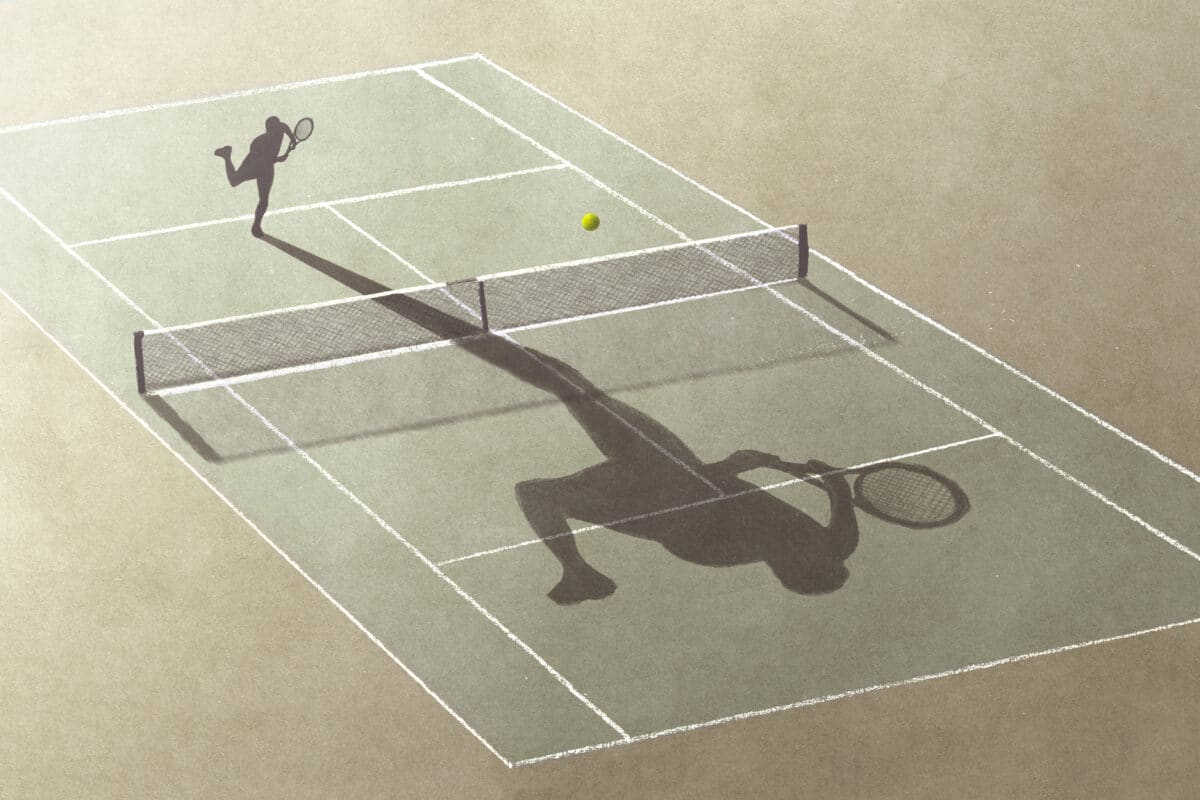
illustration of man playing tennis with his shadow, surreal abstract concept
Image Credit: fran_kie - Adobe Stock

Ayala Plays Both Sides

Many readers of Scientific American Magazine have recently written me about the new article, “The Christian Man’s Evolution: How Darwinism and Faith Can Coexist.” Most have pointed out how fatuous Ayala’s view of God comes across. As author Sally Lehrman writes, seeming to think this very clever, Ayala (and “science-savvy Christian theologians”) “present a God that is continuously engaged in the creative process through undirected natural selection.” (bolding added)This line, of course, prompted much talk of square circles and Christian atheists, as well it should. Writes one reader, “You mean: ‘a God who is continuously engaged’ by being completely unengaged?” But apart from the clear contradiction in this thinking, Ayala demonstrates an inconsistency we find repeatedly from Darwinists who are Read More ›

Behe’s Critics Fail to Understand Analogies and Design Detection

Whenever biochemist Michael Behe’s argument for design from “irreducibly complex” molecular machines appears, there is a Darwinist waiting in the wings with a devastating critique (or so he thinks).

Take as an example the following passage from biologist Craig M. Story. He recently reviewed Fazale Rana’s new book The Cell’s Design for Christianity Today (see “Same Song, Second Verse“). In his review, he critiques Behe’s argument, because according to Dr. Story, Rana merely regurgitates Behe.

Rana, like Behe before him, may be commended for providing a layman’s description of a number of astonishingly intricate cellular processes. But his portraits of cellular workings will fail to convince most mainstream scientists for the same reason that Behe’s book has been roundly dismissed: The analogy between manmade machines and cells is a poor one at best. Cellular components, although machine-like in some respects, do not behave like manmade machines. They self-assemble and self-manufacture, and they are able to transform available energy sources such as light to fuel metabolic activity.

Now what’s wrong with this reply? Didn’t we all learn from Hume that arguments from analogy are inherently weak?

Read More ›

On Non-Nihilistic “Scientific” Atheism

Nobel laureate in physics Steven Weinberg recently revamped his 2008 Phi Beta Kappa Oration at Harvard University for an essay entitled “Without God” in The New York Review of Books. As the essay moves toward a close, Weinberg tells us:

the worldview of science is rather chilling. Not only do we not find any point to life laid out for us in nature, no objective basis for our moral principles, no correspondence between what we think is the moral law and the laws of nature, of the sort imagined by philosophers from Anaximander and Plato to Emerson. We even learn that the emotions that we most treasure, our love for our wives and husbands and children, are made possible by chemical processes in our brains that are what they are as a result of natural selection acting on chance mutations over millions of years. And yet we must not sink into nihilism or stifle our emotions. At our best we live on a knife-edge, between wishful thinking on one hand and, on the other, despair.
What, then, can we do?

Answering his own rhetorical question, Dr. Weinberg believes

Read More ›

Nature Comments on Evolution and the U.S. Presidential Election

Nature recently had this to say in an editorial regarding our upcoming election:

The most worrying thing about a McCain presidency is not so much a President McCain as a Vice-President Palin. Sarah Palin, Alaska’s governor and McCain’s running mate, opposes all research into human embryonic stem cells. She is a creationist….

Contrast that with Obama’s statement on page 448, in which Nature asked him about the teaching of intelligent design in science classes. It is not easy to address students’ questions about evolution without falling prey to the false
notion of ‘teaching the controversy’, as the Royal Society’s director of education discovered last week in a public-relations meltdown (see ‘Creation and classrooms’). But Obama could not be more clear: “I do not believe it is
helpful to our students to cloud discussions of science with non-scientific theories like intelligent design that are not subject to experimental scrutiny,” he wrote.

Now those who have been following the issue know that Gov. Sarah Palin’s position is a bit more complicated than being “a creationist.” In fact she has explicitly said that she does not want to teach only creationism. So I guess if she is a creationist she is a creationist in a sense different than Darwinists at the NCSE are Darwinists, as they want to teach only Darwinism.
Other Brits have been more thoughtful,

Read More ›

© Discovery Institute