



































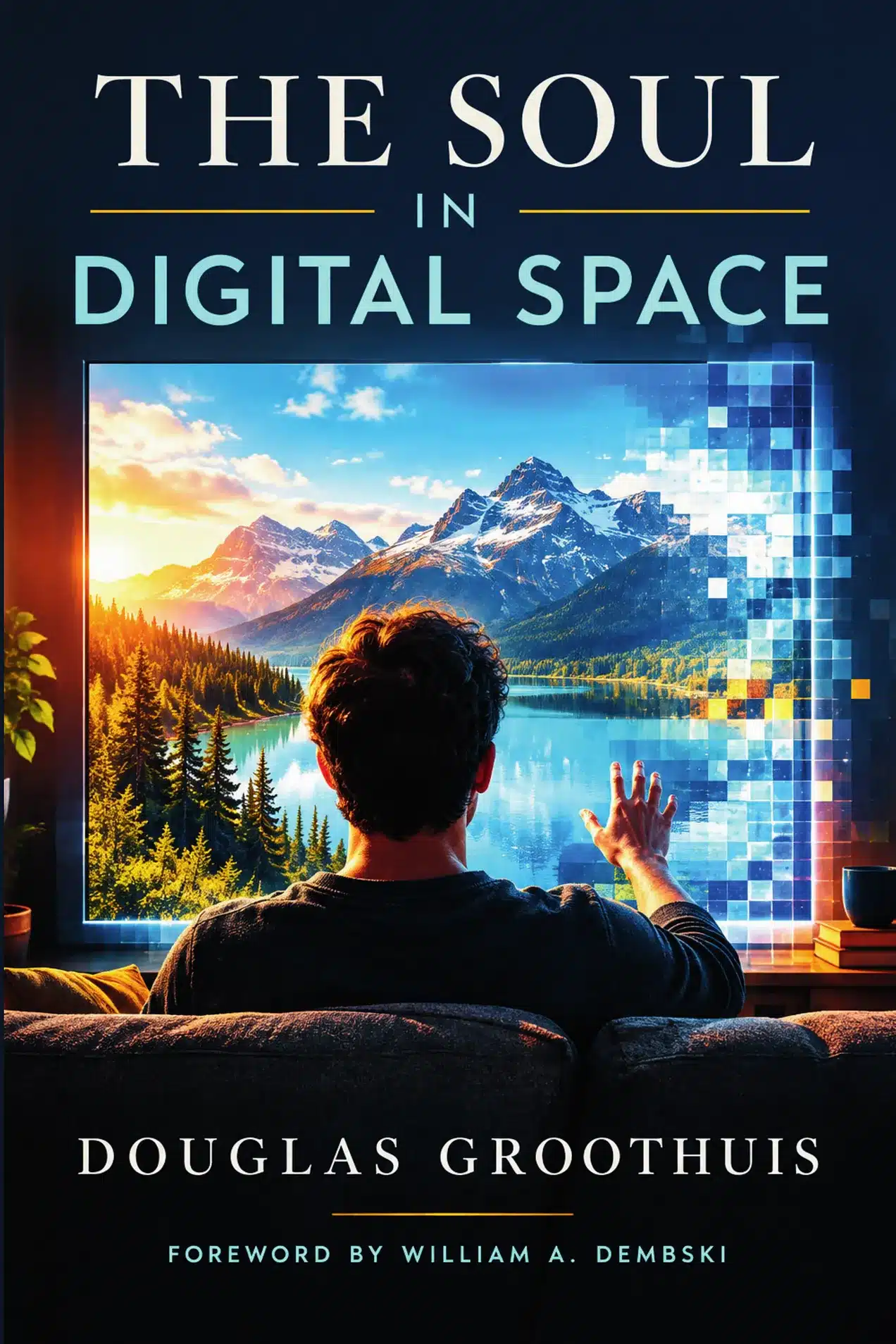
Inkwell Press has just released Douglas Groothuis’s The Soul in Digital Space, an update of his classic The Soul in Cyberspace. Besides a new foreword by me, the new edition also includes a new preface as well as annotations that engage and update material in the original. The Soul in Digital Space is available at Amazon. Below is my foreword. Here are the endorsements on the back cover:
- “Douglas Groothuis has done more than most philosophers in the past three decades to bring real wisdom into people’s lives.” — Thomas V. Morris, former professor of philosophy, University of Notre Dame
- “Doug Groothuis is one of the ablest apologists speaking and writing today. Brilliant but humble, knowledgeable and experienced but practical, Doug has a heart for the Gospel and an ear for contemporary people and issues.” — Os Guinness, social critic and founder of the Trinity Forum
- “Dr. Groothuis’ academic scholarship, teaching and mentoring, publishing and service achievements in advancing apologetics and Christian worldview are extraordinary. He is an exemplary Christian public intellectual and scholar.” — Gerson Moreno-Riaño, PhD, President, Cornerstone University
Foreword by William A. Dembski
Douglas Groothuis and I have been friends and colleagues for 25 years. Our professional lives have intersected in philosophy, apologetics, technology, and the question of what it means to be human. Currently we find ourselves on the faculty of Cornerstone University, where Doug serves as Distinguished University Research Professor of Apologetics and Christian Worldview and I as Distinguished Scholar of Mathematics and Philosophy of Science.
Beyond our shared interests and history, I was the one to put the bug in Doug’s ear to take his 1997 book The Soul in Cyberspace and update it (at last!) for a new generation of readers. The earlier edition was strikingly prescient, and its warnings have since been overwhelmingly vindicated. It therefore seemed high time for Doug to revisit this earlier work and clarify where his thinking on digital technologies had gone in the intervening years.
I’m therefore honored to write the foreword to this book on what it means to be human in a digital world that tempts us to seek salvation in technology (i.e., the work of human hands) rather than in the one who created a world that makes technology possible. Or, to quote Maximus the Confessor (580–662) from his Four Centuries on Love, “If all things have been made by God and for his sake, then God is better than what has been made by him. The one who forsakes the better and is engrossed in inferior things demonstrates a preference for the things made by God to God himself.”
When The Soul in Digital Space first appeared under a different title in the late 1990s, people still reached the Internet through modems that announced themselves with a dial-up screech. Primitive as the technology back then might seem to us now, Doug astutely observed where things were headed. He saw that technologies are not tools we can easily keep at a safe distance. They quickly become immersive environments. They refocus our attention, alter our expectations, reshape our relationships, and in the end retrain our imaginations. When interpreted by a secular technological priesthood (today’s “tech bros”), they tell us what counts as knowledge, community, and even reality.
Hugh of St. Victor (1096–1141) argued that technology reaches its highest use when it mitigates the effects of the Fall. We live in a fallen world, where the effects of sin bring great suffering. By God’s grace, technology can help alleviate that suffering. Medical science demonstrates this point, provided it is not corrupted by utilitarian ideologies.
Doug does not argue in this book that technology is evil. Instead, he argues that technology won’t and can’t save us — not even close. The cloud is not heaven. Broadband is not a pipeline into the beatific vision. A chatbot, however fluent and seemingly empathetic, is not another soul. We cannot upload our essence, much less thereby attain resurrection or immortality.
Digital culture dresses up its artifacts with hype and glitz, but in the end it always offers cheap substitutes for what truly matters. It substitutes data for knowledge, connectivity for community, simulation for reality, speed and performance for wisdom. Artificial intelligence has amplified the temptations and pitfalls. A machine can beat us at chess, imitate a dead author, or queue up the next video we didn’t know we needed.
Yet a machine lacks conscious awareness that it has performed any of these actions. It does not know. It remains clueless about what matters most. Human beings remain embodied, conscious, and morally accountable persons. Machines remain artifacts, the work of human hands.
No other gods. No graven images. These are the first two of the Ten Commandments. They maintain their primacy especially in our age. It is perhaps not coincidental that computer chip manufacturing depends on micro-scale engraving.
Doug rightly places great weight on defending embodiment. Christianity has never taught that matter is merely a dispensable wrapper around an otherwise real person. That was the gnostic heresy, which denied Jesus’ full humanity. It was a heresy the early church had to deal with. In a slightly different idiom, it is today’s transhumanist heresy. Distill ourselves into software and replace the hardware. Christian teachings on creation, incarnation, and resurrection say otherwise.
We are not minds trapped in meat, waiting for Silicon Valley to arrange our escape. Real bodily presence is essential to who we are. Touch, place, conversation, worship, friendship, and shared meals are indispensable to our well-being and thriving. Digital media can gesture at these realities, but they cannot replace them.
This book teaches that technology is useful when it serves human goods, but becomes absurd when those goods are redefined to serve technology. Christians need not fear the digital world, nor must they flee from it. But Christians are called to put technology in its place, as with all works of human hands. And, as with all human works, when they become idols, we are called to topple them.
Humans are irreplaceable. Machines can be mass produced and their software can be copied and re-copied at will. Humanity occupies a completely different and higher order of being than machines. To put ourselves at the same level as machines is a profanation. It is not to elevate machines but to sink our humanity.
In the digital world, filled with its imposters of human souls, we confront the most pernicious idol of our age. I therefore commend The Soul in Digital Space in affirming our full and glorious humanity, created as it is in the image of the eternal, immortal, invisible, and only wise God (1 Timothy 1:17).
William A. Dembski
Cornerstone University and Discovery Institute
August 2026