












In headlines at the Daily Mail, science reporter Wiliam Hunter offers several “current events tops sci-fi” doomsdays to ponder:
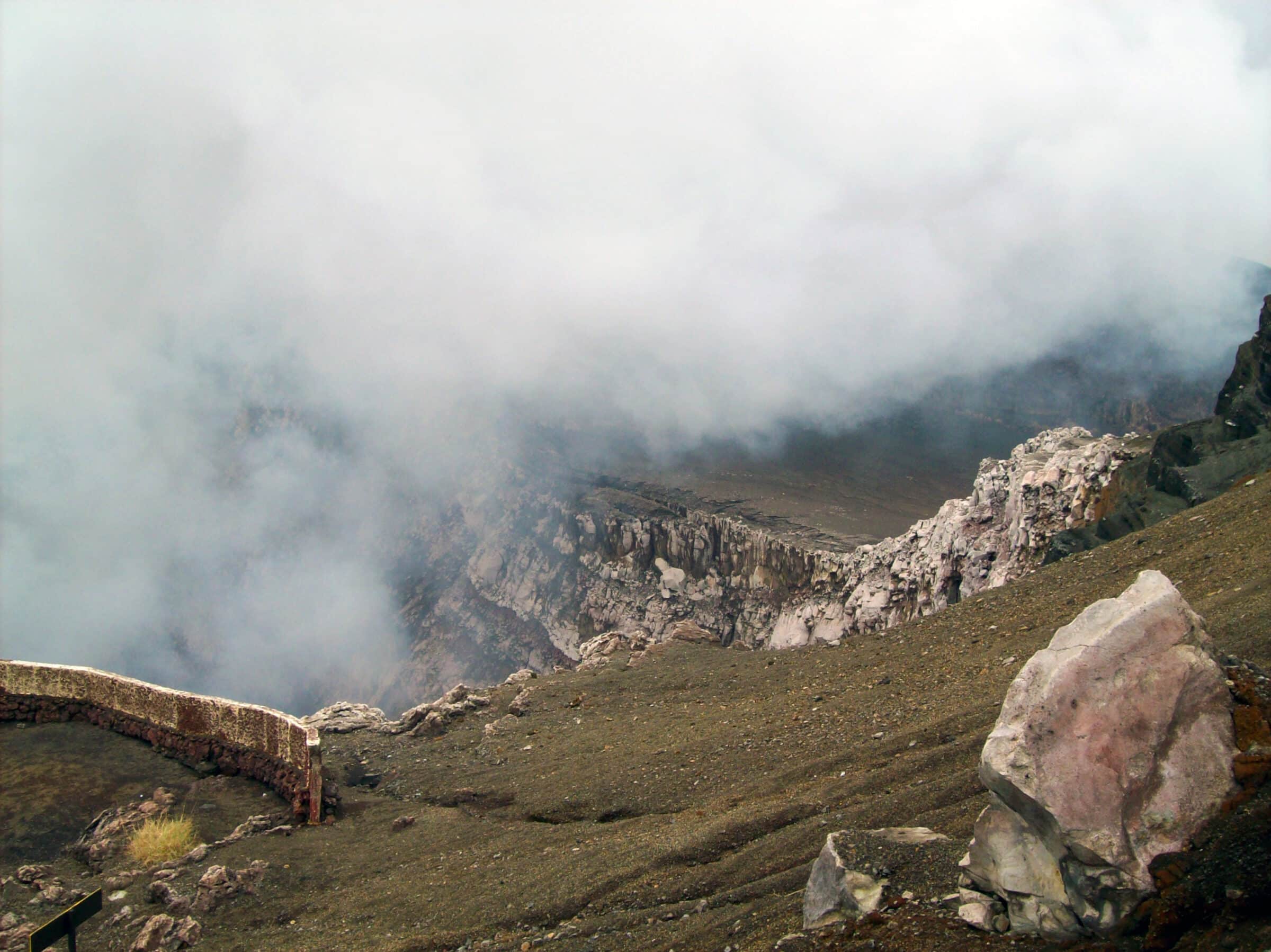
- “‘Mouth of Hell’ volcano is waking up: Scientists warn magma is building beneath one of Earth’s most dangerous craters”
- “Antarctica’s ‘Doomsday Glacier’ is even more dangerous than we thought: Study says sea levels could rise TWICE as much as previous estimates”
The “Mouth of Hell” crater, Volcán Masaya in Nicaragua, is pictured at the top. Oh, but never mind all that. Look at this!
- “Is this how the world will end? Scientists warn our dying sun will ‘kick’ the planets out into space — and it could happen 100 times sooner than previously thought”
Thanks for the tips, scientists.
Oh, Never Mind…
Or maybe the AI apocalypse will come first. And if so, perhaps it’s a relief. Hunter reports that at least one of the many experts predicting an AI apocalypse thinks might be good for us:
Writing in The Conversation, Dr Hunt describes AI as a ‘global disrupter’ but not one that should be viewed as ‘inherently negative’.
Instead, the potential power of AI to radically re-order our world could be something that unlocks new possibilities for a ‘technological future’.
He says: ‘In fact, disruption is generally considered a form of positive change.
‘It offers new tools, systems and processes that displace the current methods and structures available to humans in everyday life.’
But then we find out why Kevin Hunt of Nottingham Trent University thinks it might not be an inherently negative thing…
At The Conversation, he reflects on a 2018 sci-fi film, Annihilation:
Termed the Shimmer, because it radiates energy, the AI steadily expands its reach (starting from Florida swampland) by operating as a networked entity beyond human control. It changes everything within its domain. People, animals, and plants mutate in unpredictable ways, seemingly infected by a strange parasite…
The Shimmer is interfering with the fundamental patterns of life, redefining evolutionary code. Among other things, the Shimmer learns to clone humans. This enables it to exist within human-type bodies anywhere on Earth.
Annihilation toys with different types of human extinction. Terminal extinction refers to humanity dying out while leaving a successor species, a bit like the concept of a human’s consciousness being uploaded onto a machine. Final extinction is when humanity ends, full stop.
He sees all this destruction as positive because “What Annihilation tells us is that becoming a disruptor can change our future visions and current realities in a positive way.”
Okay, Professor. If you say so.
But What if It Turns Out, We Don’t Even Exist?
Well, not like we thought, anyway. At Skeptic Magazine, editor Michael Marshall reminds us that AI philosopher Nick Bostrom has argued as follows:
According Bostrom, given that computing power and availability is always expanding, we could hypothesise that a society in the future might be keen to make use of the computing to create a perfect simulation of how people used to live in the past. With a sophisticated enough computer — which will eventually inevitably exist — you could even make those simulations so complex that the people created within them have consciousness. After all, consciousness is not a function of souls or spirits, and we aren’t imbued with consciousness by god, we assume it arises out of the firing of electrical signals through the meat that is our brains, and thus there should be no clear reason why a sufficiently advanced computer simulation couldn’t also imbue its creations with consciousness.
Given that, Bostrom has laid out a scenario where future civilisations can use technology to create a computer simulation of the universe, filled with people who think they’re real. So… how can we be sure that’s not true?
On this view, we don’t — and never did — really exist.
It’s not hard to see the attraction that this AI simulation hypothesis has for Big Tech types like Elon Musk, who also espoused longtermism. If everything is just a simulation (and the soul is a myth), they can mold anything any way they want.
But for the rest of us?
Fatal Logical Problem with the AI Sim Universe
Marshall points out:
Logically, the simulation theory tells us we are statistically most likely to be within an infinity of nested universes, which is an illogical conclusion to reach, and as such the thought experiment collapses [on] itself. It’s a pretty big flaw for your thought experiment that you are more likely to be living in a simulation nested within infinite other simulations than you are in reality.
Indeed. It’s saner, as well as simpler, just to assume that the world out there is real. It is also saner and simpler to assume that we really do have souls (minds) that can apprehend it.
And that we should take our apocalypses in small doses.
Note: If you want to learn more about AI without the doomsday — from top AI people — come to COSM, November 18–20, in Scottsdale, Arizona.
Cross-posted at Mind Matters News.