







































Editor’s note: We are delighted to present a new series by William Dembski, adapted from his Substack. This is the fifth post. Find the full series so far here, “My Personal History with Information.”
In 1988, I shared my dissertation with Stanford statistician Persi Diaconis, whom I had gotten to know in 1986. When I sent him my dissertation, he urged me to attend a conference on randomness that he was putting together at Ohio State University with logician Harvey Friedman and himself as the conveners (fun fact: Friedman in 1967 was listed in the Guinness Book of World Records as the world’s youngest professor, teaching at Stanford at age 18). New York Times science reporter James Gleick, who had written the fantastically popular book at the time simply titled Chaos, covered the conference and on April 19, 1988, reported on it in a NYT article titled “The Quest for True Randomness Finally Appears Successful.”
But that title of the article oversold the reality. When the conference ended, all the speakers and participants sat around in a circle and Persi Diaconis delivered what he took to be the upshot of the conference. He put it this way: “We know what randomness isn’t, we don’t know what it is.” His point was that in talk after talk at this interdisciplinary conference (disciplines represented included mathematics, statistics, computer science, economics, psychology, and philosophy), the point was to identify where randomness was defeated, not to make clear what it actually was.
A Provisional Designation
Thus, with random number generation, for instance, we could never be sure just how good any such generator was at mimicking chance because it proceeded by a purely deterministic algorithm and so was inherently hiding nonrandomness. Perhaps some pattern would be discovered in its output that would make clear it was not truly random. Randomness was always a provisional designation until such time as a pattern would be found that made clear it was not random. Thus, we always got at randomness by what revealed itself to be nonrandom.
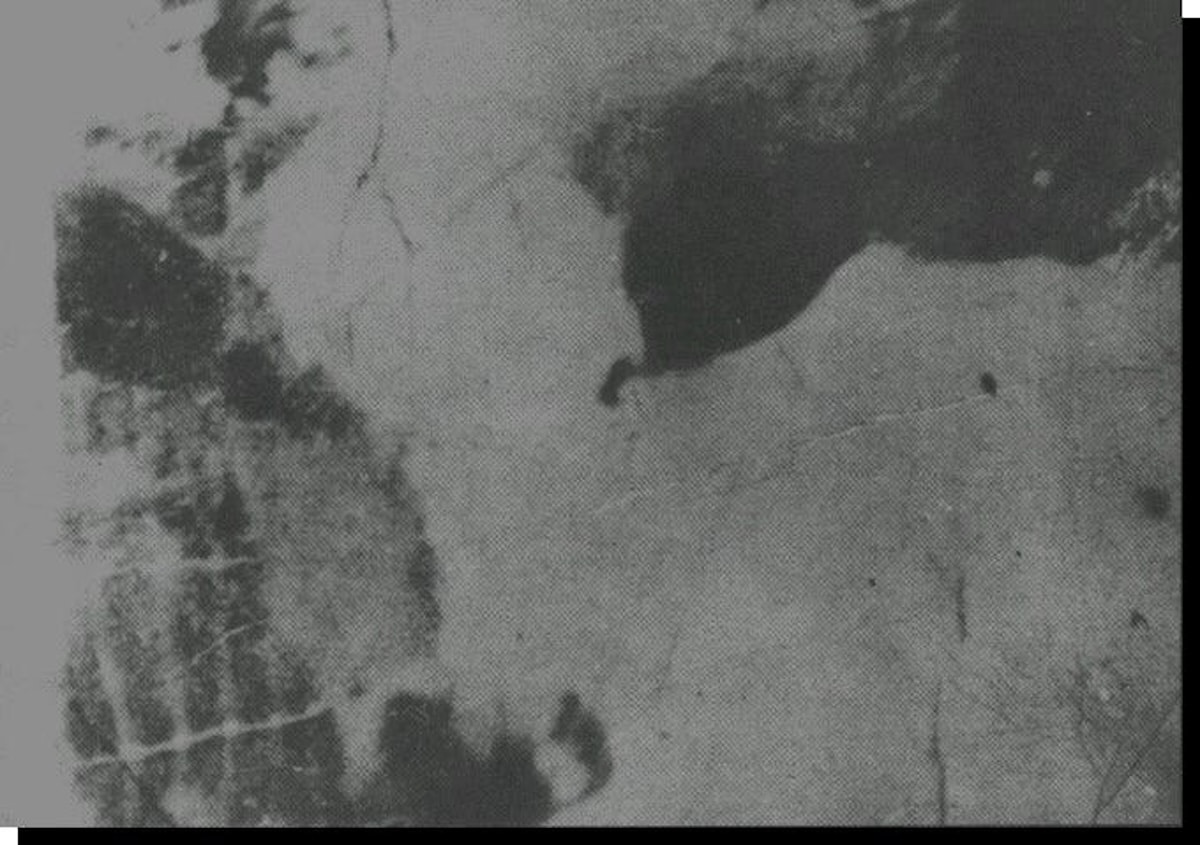
We all have had the experience of looking at some image that seems devoid of any salient pattern (i.e., it seems random) only suddenly to see something clearly nonrandom in it. In my public talks on intelligent design, I often used the following image (I got it from Harold Booher, who has since passed on). It looks like a random inkblot until you see what is actually there. Moreover, once you see the pattern, you’ll never unsee it (short of amnesia). There is thus a fundamental asymmetry between randomness and nonrandomness, with randomness flipping to nonrandomness but not vice versa.
Landing with a Thud
To sum up then, this 1988 Ohio State randomness conference ended on a thud: We know what randomness isn’t, not what it is. But in my intellectual journey, this unpromising conclusion was the catalyst for much fruitful thinking on my part. In the process of discovery, my Christian faith was indispensable here. From the vantage of naturalism or materialism, randomness is fundamental. Material entities have no mind to oversee them, so there is nothing intentional about their arrangement. Their arrangement may be regarded as resulting from a combination of randomness and self-organization, and any mind or intelligence then becomes a byproduct of such arrangements. Alternatively, on materialistic grounds these arrangements of matter result from some combination of chance and necessity for which mind or intelligence is then causally downstream.
Within my Christian worldview, however, the mind of God is real and the creation of the world is upstream of any causal powers (secondary causation) expressing themselves in the creation and thus characterized by chance and necessity. Given my Christian worldview, it therefore made perfect sense that nonrandomness should have priority (conceptually and causally) over randomness. Accordingly, patterns would come to define nonrandomness (this being how randomness was always defeated in practice, namely by identifying a salient pattern), in consequence of which randomness would be defined as violating a set of patterns. I therefore flipped the problem of randomness. Nonrandomness became the basic concept, randomness the derivative concept.
I wrote this idea up in a paper titled “Randomness by Design,” which was published in 1991 with the philosophy journal Noûs. It was the easiest peer-reviewed paper I ever got published. The Noûs editor, Héctor-Neri Castañeda, accepted it as is without the need to change a thing. The very title, and the article itself, stressed that design is the fundamental idea, and randomness the derivative idea. I wrote this paper the fall of 1989, my first term as a philosophy graduate student at the University of Illinois at Chicago. It was for a seminar in which I was pursuing a second doctorate, this time in philosophy. The article got me a lot of good attention.
An Entry on Randomness
In consequence, Arthur Fine at Northwestern University, who was at the time helping to edit the big eight-volume Routledge Encyclopedia of Philosophy, published in 1998, invited me to contribute the entry on randomness. David Malament, a well-known philosopher of physics, loved it and thought I deserved a position in a good philosophy department because of it. Bill Wimsatt, a philosopher of biology at the University of Chicago, endorsing my later book The Design Inference, alluded to it by writing in that endorsement, “Dembski’s analysis of randomness is the most sophisticated to be found in the literature and his discussions are an important contribution to the theory of explanation and a timely discussion of a neglected and unanticipatedly important topic.”
Next, “Precursors to the Design Inference — And a Nod to Dawkins.”