






































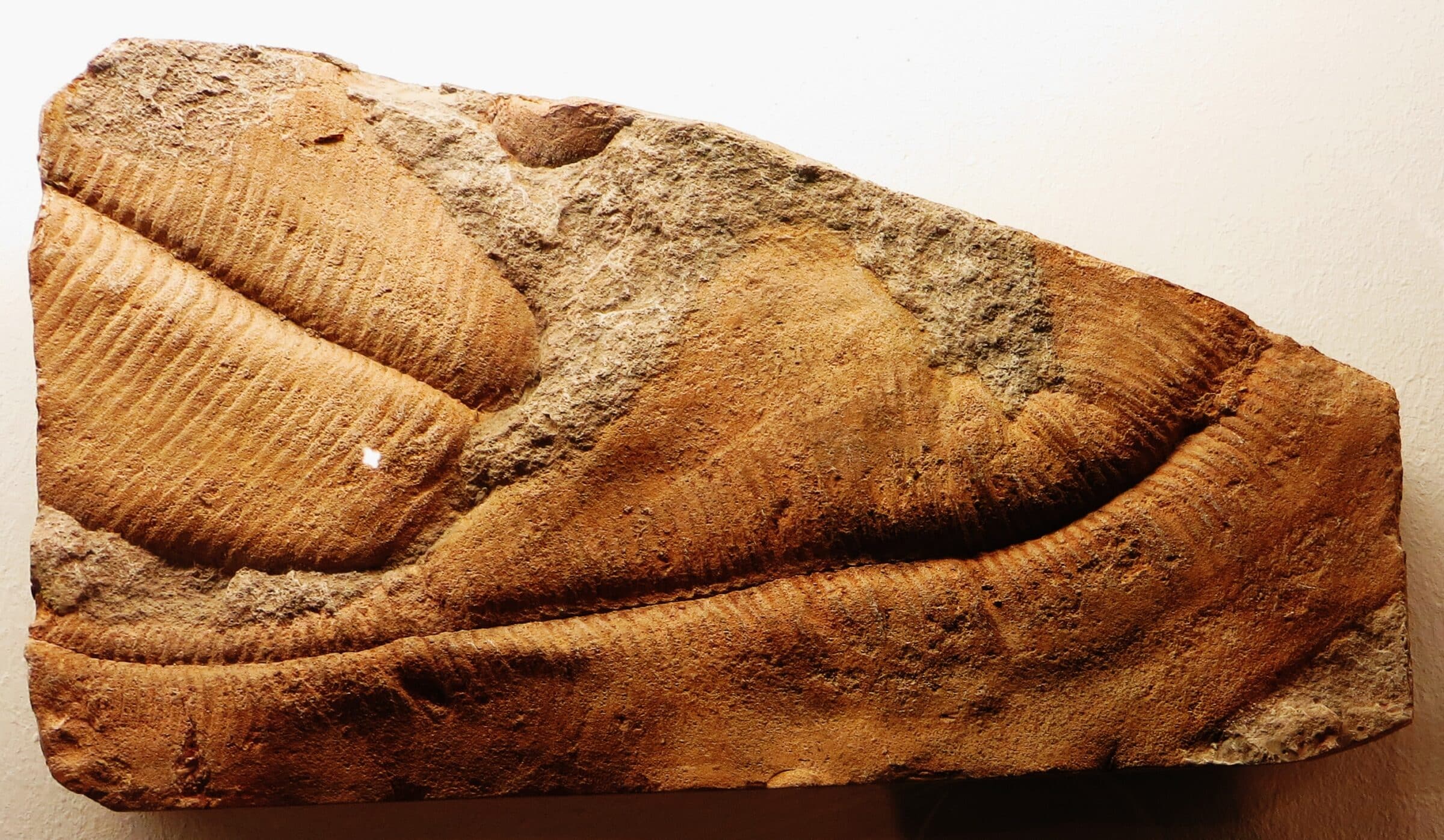
Diagnosing Charles Darwin’s chronic stomach aches has fueled much speculation. One cannot discount the role of worrying about his evolutionary theories. In his own words, “The sight of a feather in a peacock’s tail, whenever I gaze at it, makes me sick!” (Letter to Asa Gray, April 3, 1860). Another worry that certainly sickened him was the abrupt appearance of complex organisms at the base of the Cambrian. If he were alive today, seeking to eliminate that trigger, it is doubtful that debates, interpretations, and promissory notes could offer lasting relief.
The Nama Group
“Debate” is one of the most frequent words found in a new review paper about exceptionally well-preserved (Lagerstätten) Ediacaran fossils in Namibia. Seven leading experts from five countries contributed to this paper in the Journal of the Geological Society. The Nama Group, extending over 1000 kilometers, should have clinched the evolutionary story of the transition from Ediacaran to Cambrian. Uncertainties that perpetuate debate, however, are evident starting in the Abstract itself:
The Nama Group of Namibia and South Africa preserves an extraordinary record of marine ecosystems existing in the last c. 15 myr of the Ediacaran, comprising enigmatic and soft-bodied fossils that are part of the first major radiation of macroscopic life. Since their description at the beginning of the 20th century these fossils have played an important role in debates surrounding the affinities of iconic Ediacaran fossil groups, and ash beds preserved throughout the succession have been crucial to understanding rates and patterns of early animal evolution. [Emphasis added.]
Despite this “extraordinary record” covering a vast area, the wished-for “understanding” has not arrived. There are still debates about nearly everything:
- “debates surrounding the timing and duration of key Ediacaran evolutionary events, and the age of the Ediacaran–Cambrian boundary (‘ECB’) itself….” If the ECB lies higher in the stratigraphy at Nama, it “would require substantial revising of the age of the base of the Cambrian.” They add, “At the time of writing, the position of the ECB in the Nama Group is still unresolved.”
- “We instead focus the bulk of this review on key fossils and the role they have played in debates surrounding early animal evolution.” (The paper mentions “novelties” and “innovations” but no account of how they might have appeared by mutation and natural selection; no transitional forms are documented.)
- Two scientists are mentioned “who used Nama fossils to help erect the Rangeomorpha and Petalonamae. These two proposed groupings from over 50 years ago continue to be important in debates surrounding Ediacaran fossils into the present day.”
- “Owing, in large part, to the paucity of morphological characters shared with extant clades, the inferred position of Erniettomorpha and Rangeomorpha on the metazoan phylogenetic tree has historically been the subject of debate.”
- “Since their discovery at the beginning of the twentieth century, the interpretation of these fossils has changed frequently, mirroring broader debates regarding the affinities of Ediacaran fossils as a whole.”
- “Given the biostratinomic context of fossils in several key localities…, these taxa [Erniettomorpha and Rangeomorpha] are preserved in better detail and greater abundances than anywhere else in the world, and thus have played an outsized role in debates surrounding the ‘Ediacara biota’ and its relationships to extant metazoans.”
- “Lastly, fossils from the Nama Group, specifically the low species richness of assemblages, have played a large role in debates surrounding putative late Ediacaran extinction pulses, and in particular the source(s) of ecological stress….”
- “Comparatively little has been done on taphonomy in the Nama Group…. This is despite the fact that, in the broader field of Precambrian palaeontology, debate surrounding these taphonomic pathways has been active….”
Another Common Word
Nowhere in the paper can one find words indicating certainty. Another common word is “interpret” in various forms (interpretation, interpreted, etc.). Indeed, creative interpretation is a required skill to connect evolutionary dots, as here:
The Erniettomorpha and Rangeomorpha are two clades of sessile macroscopic fossils that apparently lacked a gut, muscles or a nervous system, and that are united by a repeated (or ‘modular’) growth pattern (Fig. 2a–e). At the time of writing there exists little systematic consensus surrounding either the Erniettomorpha or Rangeomorpha (see Text Box 1), even while the metazoan status of other iconic Ediacaran soft-bodied morphogroups has begun to crystallize (e.g. Gehling et al. 2014; Hoekzema et al. 2017; Evans et al. 2021). Dunn et al. (2021) used developmental characters to support interpretation of the rangeomorphs as stem-group eumetazoans, raising further questions that could be answered with exceptional 3D specimens. For example, in the absence of a gut or any other openings, how did organisms such as Rangea feed? (see also Narbonne 2004). Still less is known about the affinities of the erniettomorphs, although an analysis of Pteridinium by Darroch et al. (2022) suggested that both the indeterminate growth pattern and reconstructed fluid flow patterns (Fig. 3) around the organism would be consistent with interpretation as a colonial metazoan, wherein each tubular element hosts an individual. This hypothesis echoes earlier work on Nama fossils (e.g. Jenkins 1985), and so brings some of the thoughts surrounding Nama fossils full circle.
Their interpretations have been running in circles for decades, with no consensus. As for “metazoan status” of other Ediacarans beginning to “crystallize,” one can think of crystallization in this context as “solidified opinion” or consensus dogma. How can Ediacarans be interpreted as metazoans without a gut, muscles, or nervous system? These authors understand the issue when they ask how could organisms such as Rangea feed without a gut or any other openings.
A Circular Notion
The best description they came up with is to picture them as sessile suspension feeders, taking advantage of whatever organic matter passes their way in water currents. (This is different from metazoan filter feeders that can actively move tentacles or other organs with their muscles and nerves, or beat cilia and flagella, to capture food.) Ediacaran suspension feeders would most likely resemble colonies of cells gaining their nutrients passively and independently, as shown in artist conceptions in the paper. The authors speculate that “the increasing number (and ‘styles’) of suspension feeders over the course of the late Ediacaran may have significantly enhanced the retention of food in continental shelf environments, and thus helped to ‘fuel’ some aspects of the subsequent Cambrian radiation.” This is a circular notion that assumes evolution. It does not follow that the availability of nutrients causes consumers to emerge.
The only Nama fossil mentioned with potential eumetazoan affinities is Ausia, a “rare and enigmatic fossil” that some have interpreted as an early coral or urochordate (sea squirt) or cup-shaped reef-building organism. How certain is that? Here comes the promissory note: “Morphologically unique taxa such as Ausia have the potential to significantly expand our knowledge of the ecological diversity of Nama-aged communities, and extend the range of extant phyla back into the late Ediacaran.” Let them call back when the promissory note comes due. From the photographs, Ausia fenestrata (resembling a cone with regular perforations) shows no resemblance to an active animal, and no metazoan organs are mentioned inside it.
Other familiar Ediacarans make cameo appearances in the paper, including cloudinamorphs and a “possible dickinsoniid”; these were previously addressed by Günter Bechly in these pages (here and here). The only putative “organs” in any of the creatures are holdfasts in Aspidella or central vanes in Pteridinium — very simple passive structures compared to the active organ systems like eyes, jointed appendages, guts, and swimming fins that appear at the Cambrian explosion.
A “Sleepy” World
In this latest review paper, a century after the Nama Group was brought to the attention of the scientific community, the ecology of Ediacaran creatures remains as Simon Conway Morris described them in the Illustra film Darwin’s Dilemma: a “sleepy” world of simple, passive creatures bearing no resemblance to what was to come. Nothing has changed since I wrote in 2016 about similar fossil sites in Australia and Death Valley, California.
This detailed report by seven top paleontologists about one of the largest, richest exposures of Ediacaran fossils in the world, with exceptionally preserved specimens, adds nothing new to evolutionary theory. As such, it would not be able to alleviate Darwin’s aches and pains were he alive today. The Ediacaran mystery remains as Stephen Meyer described it 12 years ago: “the gap in complexity as measured by the number of cell types alone, to say nothing of the specific anatomical structures and distinct mode of body plan organization that are present in later animals but not in sponges [or in Ediacarans] leaves a massive discontinuity in the fossil record that requires explanation” (Darwin’s Doubt, p. 86).