






































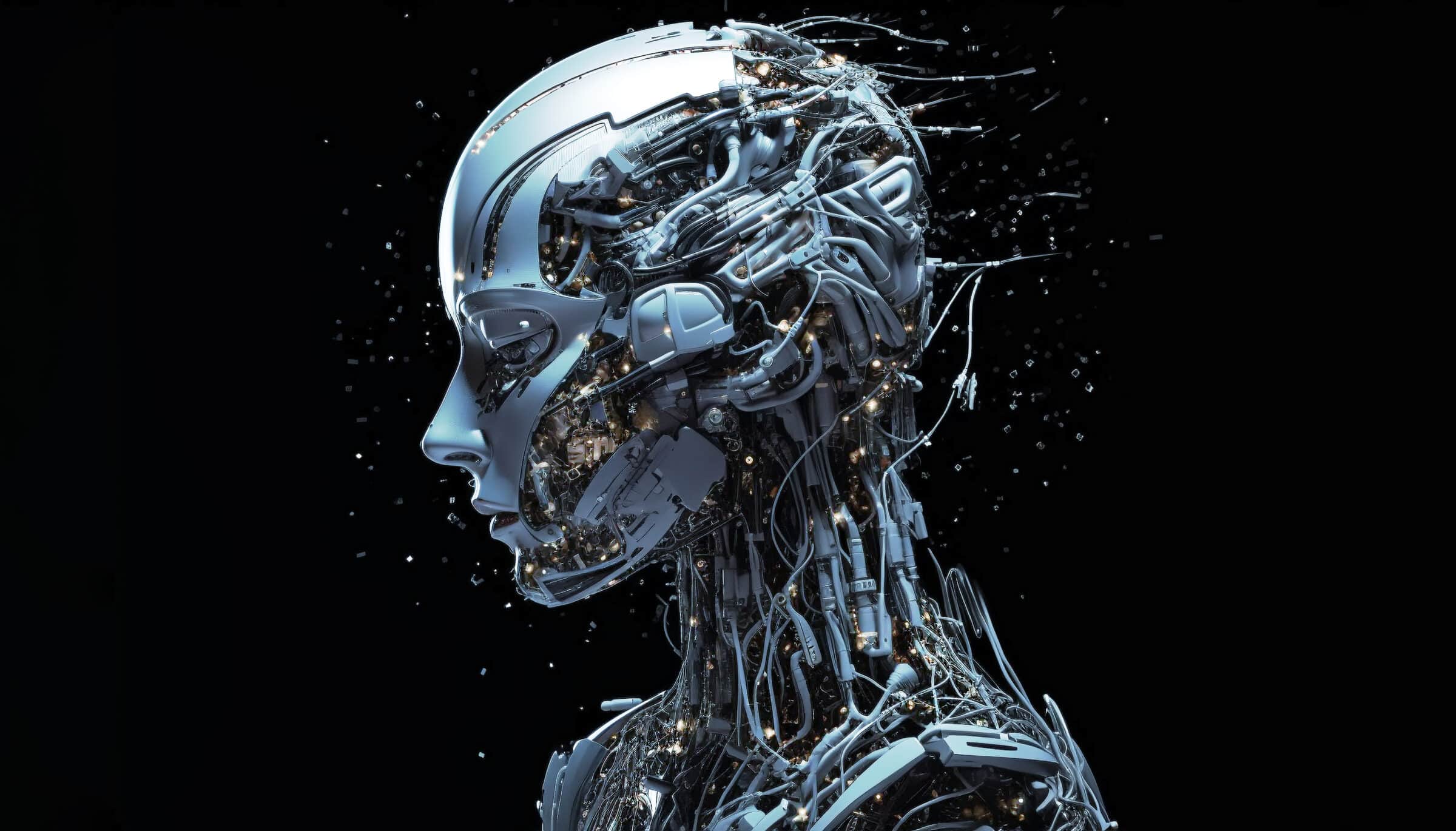
COSM 2025 included a debate between neurosurgeon Michael Egnor and well-known skeptic Michael Shermer on the question of “Are Human Beings Machines?” The debate centered on the nature of the mind and brain and whether the mind is distinct from the brain or whether we’re nothing more than chemicals and firing neurons.
A Neurosurgeon’s Experience
Egnor presented first. As a neurosurgeon he has treated numerous patients over the years and has seen many kinds of unique cases. In one instance, a girl was missing two-thirds of her brain, but she now is a successful businesswoman. In another case, a child was born with hydranencephaly, where the brain case is mostly filled with fluid and virtually no brain matter is present. True, Egnor explained, this young girl is “quite disabled” and has cerebral palsy. However, she’s a person who smiles when she’s with her family, expresses emotion, and is clearly conscious — despite the fact that she has no frontal cortex.
It was this sort of evidence, Egnor explained, that helped take him from his former materialistic worldview to believing in God and the immaterial soul. He felt that the evidence he was seeing simply did not fit with what his textbooks taught, such as the standard view that consciousness is generated in the frontal cortex.
Another key piece of evidence for the immaterial mind is the origin of our free will and capacity to engage in abstract reasoning. Egnor noted that over the past two hundred years humans have experienced some 250 million seizures which produce all kinds of chaotic misfirings and disturbed neural patterns in the human brain. But, he argued, never has there been a seizure that can evoke “free will or conceptual thought.” That doesn’t mean that seizures can’t have an effect on us, Egnor explained, because they certainly do evoke movement, sensations, memories, and emotions. But never free will, and never conceptual thought.
His point was this: Seizures can evoke all kinds of effects in our brain, but if they can’t evoke free will or conceptual thought then maybe free will and conceptual thought don’t originate in the brain.
Egnor made similar arguments about brain mapping surgeries and people who have deep brain stimulators. Both also represents attempts to induce the brain to do things — muscle movement, seeing flashes of light, or memories or emotion. But for some strange reason these techniques never induce things like abstract thought, mathematics, logic, or complex reasoning. Again, these types of thoughts just don’t seem to originate in the brain.
Another case Egnor recounted involves two patients (not Egnor’s) who are twin girls whose brains are fused through a “thalamic bridge.” They can see out of each other’s eyes, and share sensations or emotions or memories. But what they don’t share is abstract thoughts. Egnor explained that each girl must learn multiplication tables separately for herself — despite all the other things their brains can share, abstract conceptual thoughts cannot be shared. He proposed that this suggests such thoughts don’t originate in the brain!
Egnor also recounted corpus callosotomy surgeries, which sever the links between the two hemispheres of the brain to diminish the effects of seizures. In theory, the two halves of the brain should no longer be communicating. Yet Egnor recounted experiments which found that when one side of the brain is shown an idea that involves abstract reasoning, the other side of the brain could still have access to that idea. This suggests that there was still a way for the two halves of the brain to communicate — though it could not be through a physical link. Perhaps the connection still existed through the immaterial mind, which is where he proposed that our abstract reasoning takes place.
Near Death Experiences
Lastly, Egnor briefly covered near-death experiences (NDEs) as strong evidence for the existence of the immaterial mind. This powerful evidence shows the existence of the mind after the death of the brain. NDEs are compelling to Egnor for four reasons:
- “They are clear, coherent, hyper-real experiences.”
- They are “accurate out-of-body experiences.”
- Strangely, people having NDEs “only encounter dead friends or relatives” — even in cases of car accidents where the person experiencing the NDE doesn’t know who died and who lived in the crash!
- They are “transformative” — suggesting something powerful happened to the person.
A Paradigm of Mind-Brain Relationships
All these lines of evidence converged on a model that Egnor put forth for the relationship between the mind and the brain. Of course, the brain is necessary for many basic functions — it seems to be directly necessary for things like movement, perception, sensation, arousal, homeostasis (e.g., controlling heart rate), emotion, and memory. But when it comes to “higher” functions like abstract reasoning and conceptual thought — things like mathematics or logic — or our free will, these sorts of involve our minds, which are separate from the brain, and ultimately immaterial.
Shermer Responds
Next came Dr. Michael Shemer, the famous skeptic who studied psychology and holds a PhD in the history of science. One definitely gives Shermer much credit for participating in an event hosted by Discovery Institute, a group that he knows takes a very different view of the mind-brain relationship than he does. That said, based upon the Q&A session, I don’t think the audience was wholly hostile towards him. Quite a few questions seemed sympathetic towards Shermer’s perspective. This was not surprising: Shermer was affable, good natured, and charismatic. He’s a very good communicator who is clearly open to civil conversation over deeply important topics. I respect that about him.
Shermer’s position was that “Humans are biological machines that evolved from previous biological machines going back billions of years.” Under this paradigm, “There’s no reason to think that a designer intervened to push natural selection in a particular direction.” Shermer thinks that the “easy problem of consciousness” — what he defined as understanding “how the [brain’s] wiring works” — is basically solved and that is sufficient to show that we are machines.
I don’t think that Egnor would contest that we have achieved great understanding about how the brain’s writing works — in fact Egnor fully acknowledged that the brain is using these mechanisms to regulate many important things for our bodies. Even Egnor noted that “The brain is an organ. It does things that come from matter. It makes action potentials.” Yet Egnor raised evidence suggesting that certain thought processes don’t take place solely in the brain itself — that they must be occurring in the immaterial mind.
For the most part, Shermer did not even try to refute the evidence that Egnor raised. Rather focused on trying to give epistemological reasons why the “soul” is not a valid or convincing explanation of this evidence for an immaterial mind. He asked lots of questions about how the “soul” works — but none of these seemed as if they would be impossible to answer. But he rarely dealt directly with the evidence that Egnor presented. Shermer was essentially protecting his materialistic perspective through the safeguard of methodological naturalism.
Shermer did give a try at a materialistic explanation for terminal lucidity — where a person with severe neurological degeneration suddenly becomes able to think clearly right at the end of life. This was a bit strange since Egnor had not raised this point in his portion of the debate, although presumably he could have. In any case, Shermer proposed that terminal lucidity could be the result of a highly complex brain experiencing altered consciousness, perhaps due to oxygen-starved neurons leading to delirium, or food-starved patients having lower cranial pressure which somehow leads to more functioning neurons. I’m not trying to diminish Shermer’s explanation but it was hard to follow and did not seem to readily account for the strange phenomenon that even people with serious neurological diseases are known to become lucid just before death. It seemed like explaining away the data rather than explaining it. Noticeably, Shermer barely attempted to tackle NDEs, although presumably he would resort to a similar type of explanation as he did for terminal lucidity.
Does Bayes Support Shermer or Egnor?
At one point, Shermer started to say that Egnor has “no evidence” but then he stopped himself and said “OK, Michael [Egnor] thinks we do. We can talk about that.” He was referring to NDEs. That was interesting, because I think it was Shermer who focused less on the evidence and more on attacking the explanatory value of the soul.
But there might be a way to see who has the better model. At the beginning of his presentation, Shermer mentioned that he likes a Bayesian approach. Bayesian logic basically asks which explanation would lead you to better anticipate the observed evidence. We could apply this to NDEs: on which model — one where there is an immaterial soul, or one where our brain is all there is — would we expect to find evidence of a mind that exists after the brain has ceased to function? Clearly a Bayesian approach would favor the immaterial soul.
And what about terminal lucidity? Again, Egnor did not raise this as an argument, but we could ask which explanation better explains this phenomenon. Shermer’s vague comments really provided no coherent biological explanation for how a malfunctioning brain that has experienced severe neurodegeneration could somehow come back and start functioning normally at the very end of life, allowing the person to say goodbye to loved ones. A model where a person — an immaterial mind — that interacts with the brain, breaks through at the end to say goodbye, makes a lot more sense.
Did Anyone Change Their Mind?
As I said, during the Q&A it was clear that Shermer had some supporters in the audience. But so did Egnor, and, nothing personal, but I think that Egnor unquestionably had the better argument — he presented multiple cases and evidence indicating the presence of an immaterial mind which Shermer did not explain, and at best barely attempted to explain away. But Shermer was right that there is still much we don’t know about consciousness and the brain, and so undoubtedly this debate will continue long into the future.