






































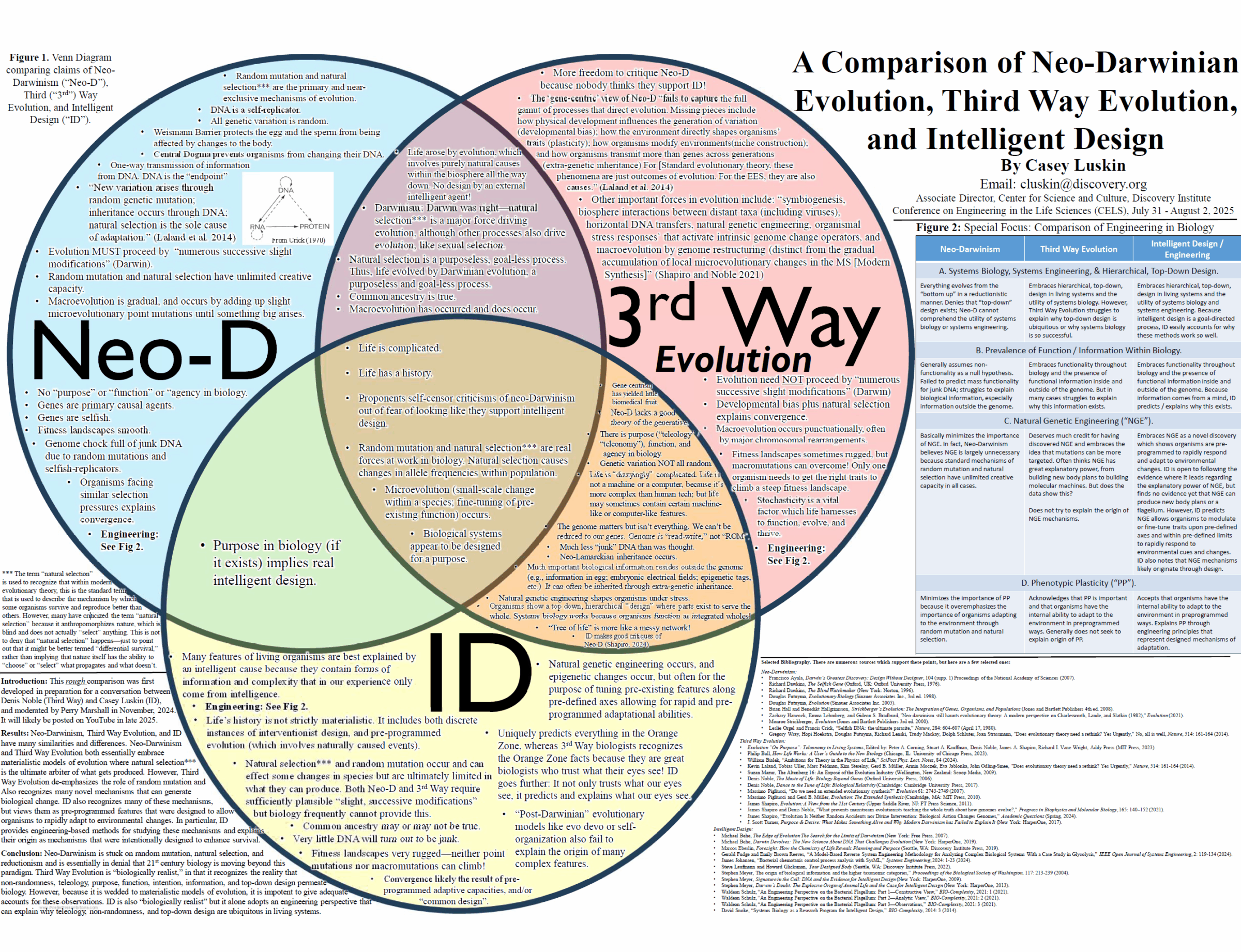
Since Perry Marshall recently posted the conversation we had with Denis Noble about Neo-Darwinism, Third Way Evolution, and ID, I’ve received a few requests for the Venn diagram I created. As I previously noted, while preparing for the conversation, I created the diagram comparing the similarities and differences among the three viewpoints. However, the initial draft of the diagram shown in the video was more like my own personal preparatory notes and it’s fairly rough and may even have a few typos. That’s the bad news. The good news is that last weekend Discovery Institute hosted its third Conference on Engineering in Living Systems (CELS), and I cleaned up the Venn diagram a bit and turned it into a poster that was presented at the conference.
The Venn Diagram
The original “Neo-D-Third Way-ID” Venn diagram remains the focus of the poster, which adds a figure comparing how the different viewpoints interact with certain relevant engineering questions. The poster also includes some introductory prose which I reproduce below.
I don’t claim that this diagram is an exhaustive or perfect treatment of the subject, but it’s a first stab and hopefully will make a good starting point for thought. If you’d like to see the full poster with the Venn diagram, click here.
Introduction: This rough comparison was first developed in preparation for a conversation between Denis Noble (Third Way) and Casey Luskin (ID), and moderated by Perry Marshall in November 2024.
Results: Neo-Darwinism, Third Way Evolution, and ID have many similarities and differences. Neo-Darwinism and Third Way Evolution both essentially embrace materialistic models of evolution where natural selection is the ultimate arbiter of what gets produced. However, Third Way Evolution de-emphasizes the role of random mutation and recognizes many novel mechanisms that can generate biological change. ID also recognizes many of these mechanisms, but views them as pre-programmed features that were designed to allow organisms to rapidly adapt to environmental changes. In particular, ID provides engineering-based methods for studying these mechanisms and explains their origin as mechanisms that were intentionally designed to enhance survival.
Conclusion: Neo-Darwinism is stuck on random mutation, natural selection, and reductionism and is essentially in denial that 21st century biology is moving beyond this paradigm. Third Way Evolution is “biologically realist,” in that it recognizes the reality that non-randomness, teleology, purpose, function, intention, information, and top-down design permeate biology. However, because it is wedded to materialistic models of evolution, it is impotent to give adequate accounts for these observations. ID is also “biologically realist” but it alone adopts an engineering perspective that can explain why teleology, non-randomness, and top-down design are ubiquitous in living systems.
Back to CELS
While we’re on the topic, CELS 2025 was a fantastic conference. We had three days of presentations before an audience of over 60 engineers, biologists, and other scientists who agree that because life is designed, the best way to understand how life works is through an engineering lens. This project has now produced multiple peer-reviewed papers showing the way to apply engineering to study biology — many of which we’ve written about in the past (for example, see here, here, here, here, here, here, here, or here). Many good things are happening in the Engineering Workgroup, an ID 3.0 project, which hosted the conference — stay tuned for more!
In any case, if you haven’t yet watched the conversation between Denis Noble, Perry Marshall, and myself, it can be found here: