






































Last year I was contacted by Perry Marshall, author of the book Evolution 2.0 and an interesting thinker in the origins conversation, who very kindly proposed the idea of his moderating a friendly discussion between Denis Noble and myself. If you’re not familiar with Professor Noble, he is a well-known biologist and physiologist at Oxford University and one of the leading founders of the “Third Way” school of evolutionary biology. I was excited to talk with Noble, as I had followed his work for years and had written about it in the past. The interchange is now posted on Perry’s YouTube channel, Evolution 2.0:
I want to thank Perry Marshall for hosting the conversation, and I want to thank Denis Noble for participating in it. It was a lot of fun and I hope you enjoy it!
Let’s now explore some more background about this conversation.
“Neo-Darwinism Is Dead”
If you’re not familiar with Noble, he is not a supporter of intelligent design, but he is a vocal critic of neo-Darwinian evolution. Last year I wrote about the fact that he said quite plainly in an interview that “neo-Darwinism is dead.” Last year he also wrote an article in Nature titled “It’s time to admit that genes are not the blueprint for life,” where he said “Classic views of evolution should also be questioned” and urged scientists to consider new ideas about how life works:
It’s time to stop pretending that, give or take a few bits and pieces, we know how life works. Instead, we must let our ideas evolve as more discoveries are made in the coming decades. Sitting in uncertainty, while working to make those discoveries, will be biology’s great task for the twenty-first century.
In a post covering his article, I noted that part of Noble’s vision for the future of biology is the role played by teleology or teleonomy:
Noble also thinks there’s a place for “agency and purpose” in biology. He’s not talking about the intelligent design of life by an external agent, but he is acknowledging that much in biology is purposeful, noting that multiple experts now “argue that agency and purpose are definitive characteristics of life that have been overlooked in conventional, gene-centric views of biology.” Again, this isn’t the modern theory of intelligent design, but once we begin to allow agency and purpose into our understanding of how life works, we’re taking important steps towards being able to recognize design in biology.
Obviously, Noble is an innovative and vanguard thinker.
Technical Difficulties
The conversation with Perry and Denis took place in November 2024, but was hit with technical difficulties from the start.
For one, the conversation took place right after my wife and I went multiple days without power after a bomb cyclone hit Seattle. Perhaps this was a blessing in disguise, because with no Internet at home I had the opportunity to read (sometimes by flashlight) various books on “Third Way” evolution in preparation. These readings inspired me to create a rough Venn diagram comparing the similarities and differences between Neo-Darwinism, Third Way Evolution, and Intelligent Design which Denis, Perry, and I discussed during the conversation.
The second technical difficulty was that for some reason the video element did not record. The good news is that the audio came out fine, and so Perry has now posted an audio version of the conversation, with video overlain showing images of the speakers as well as the aforementioned Venn diagram for the viewer’s reference.
Programming in Biology
One final note about the conversation: There was one point where I inartfully addressed the question of whether cells contain “programming.” My exact words were that they don’t necessarily contain “programming” but what I should have said is that they “don’t contain programming that’s exactly like human software.” Now context is key because in that section we were discussing whether DNA contains “conditional logic” like you find in computer programming. It’s true that you won’t find an explicit “if-then” programming statement in the DNA itself. That’s all I was saying. Yet DNA does unmistakably contain programming: it contains commands and instructions that are read, interpreted, and executed by cellular machines (e.g., the ribosome) much like the hardware of a computer reads, interprets, and executes the instructions in software. This shows that DNA contains properties very similar to computer programs.
I’m not a professional computer programmer, but I do know a bit about programming, having, among other things, written over 30,000 lines of Python code during my PhD. Though you won’t find an explicit “if-then” statement in DNA, that doesn’t mean that there isn’t programming in DNA, or conditional logic in biology. What is really going on in cells is that the programming in DNA encodes the parts to build cellular machinery which produce protein and RNA molecules, and these molecular products of DNA’s programming then go out into the cell and perform chemistry-based logical operations that frequently amount to nothing less than conditional logic. Many examples could be discussed, but let’s consider a famous one: the lac operon.
An operon is a group of genes expressed together to produce a single RNA transcript with stop codons separating protein-coding regions. The lac operon regulates production of enzymes that help many bacteria species break down and use lactose as a food source. Here’s roughly how it works in E. coli:
Glucose is E. coli‘s preferred sugar. The bacterium thus only wants to turn on the lac operon when two logical conditions are met: (1) glucose is depleted; and (2) lactose is present.
When glucose is present, E. coli doesn’t need to use lactose. But when glucose is depleted, this initiates a cascade which ultimately recruits the RNA polymerase to bind to the promoter sequence on the bacterial chromosome.
And when lactose is absent, the bacterium doesn’t want to waste resources transcribing and translating the genes which produce the enzymes that metabolize lactose (lacZ, lacY, and lacA). So when lactose is absent, a repressor molecule binds to the bacterial chromosome in just the right place to prevent the RNA polymerase from transcribing those genes. But when lactose is present, this allows the production of a derivative (allolactose) which binds to the repressor, causing the repressor to release from the chromosome — clearing the way for transcription to occur.
When both conditions are met — glucose is depleted and lactose is present — this allows the genes for metabolizing lactose to be transcribed and lactose to be used as a food source in the cell.
This is conditional logic, and if we were to express it in pseudocode, it might look something like this:
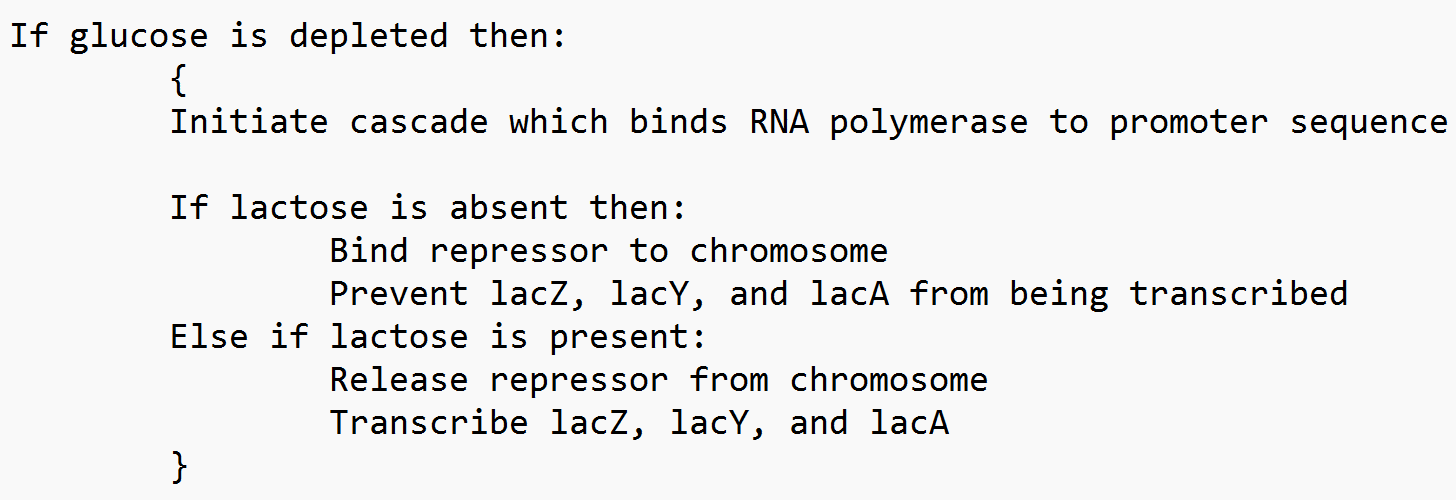
That, essentially, represents a form of conditional-logic-based programming in biology. But if that wasn’t clear, here’s a rough home-made graphical representation of how the lactose-portion of the conditional logic works (please note: this image assumes that glucose is already depleted, and the RNA polymerase is binding to the promoter):
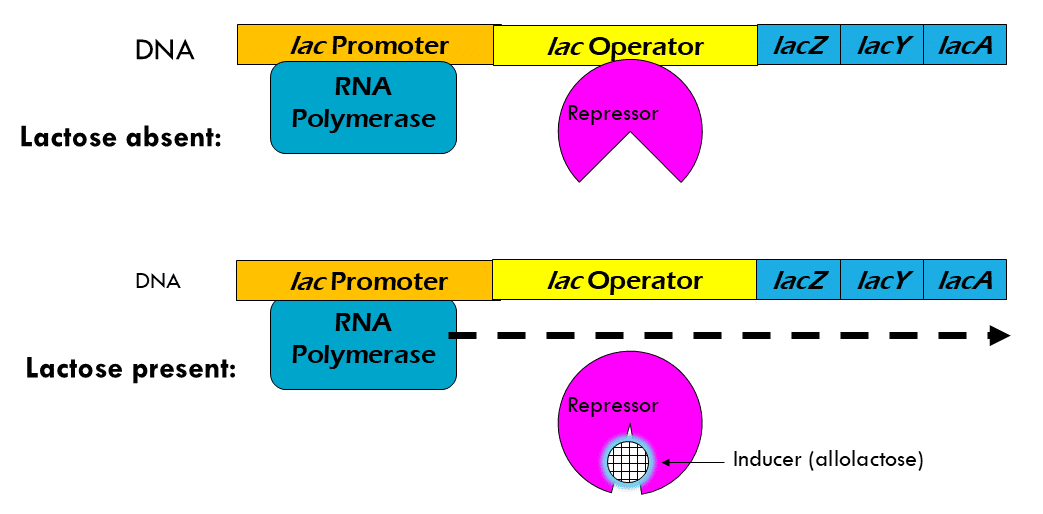
This is one of numerous examples of how cells use chemistry-driven conditional logic to respond to environmental cues. These conditional logic circuits are algorithmic and very similar to computer programming logic, even though they aren’t directly found “in” the nucleotide sequence of the DNA molecule itself. Yet, the DNA does contain programming to build the molecular parts needed for this logic circuit to work, and those parts then go out into the cell and do their jobs — using chemistry to perform conditional logic and allow the cell to algorithmically respond to inputs that it receives.
In fact, Jonathan McLatchie recently wrote a very nice article about the “Recurring Design Logic in Operon Regulation” and a follow-up on “Recurring Design Logic in Attenuation Mechanisms.” According to Jonathan, not only do these represent conditional logic circuits, but virtually identical forms of conditional logical control circuits are found repeatedly re-used throughout gene regulation in many diverse biological systems. Of course, different systems usually deploy different enzymes and molecules which execute the logic circuits. But the basic forms of conditional logic circuits repeat over and over. So we have both conditional logic control circuits and re-usage of the logic of these algorithmic control circuits over and over. Isn’t that interesting?
Bill Gates was exactly right when he said that “DNA is like a computer program but far, far more advanced than any software ever created.” What Mr. Gates didn’t say is that there’s also programming-like conditional logic at work throughout living cells that’s beyond the DNA. And here’s my present point: This conditional programming logic is frequently performed by components that are not necessarily “in” the DNA sequence itself, but rather by components that are themselves encoded by the programming in the DNA. These components go out into the cell and execute conditional logic to control gene regulation and many other systems.
And how are we to explain this? Is it just repeated convergent evolution of similar conditional-logic control circuits throughout biology? We must ask this question: In our experience, what cause generates conditional logic circuits, and then what cause re-uses those algorithmic programs over and over in different systems? The field of computer programming teaches us that it’s not blind evolution; it’s intelligence.