







































In Plato’s Revenge, David Klinghoffer’s exposition of biologist Richard Sternberg’s research provides a fascinating and accessible narrative. The topic — Sternberg’s conclusion pointing to the immaterial genome — urgently calls for attention. The book’s allusion to Plato’s theory of forms, avenging itself upon dogmatic reductionistic materialism, appropriately reminds us that the validity of philosophy is sometimes not apparent until we attain sufficient awareness of reality.
The reality in this instance is the ongoing realization that the molecular coding within DNA, rich and vast as it is, falls impossibly short of being able to supply the informational guidance needed to supervise the development and moment-by-moment cellular activities of living organisms.
Even Beyond Plato
More remarkably, evidence from genomic studies suggests that something even beyond Plato’s forms is at work within living things. As a contemporary philosopher summarizes:
Plato’s theory of Forms is based on the idea that there is a realm of perfect, unchanging, and eternal Forms that exist beyond the physical world.
Rather than seeing biological life as deriving from perfect but static forms, studies reveal a fluid, dynamic, responsive intervention from beyond the fabric of our universe. Or, as the late, renowned paleontologist Günter Bechly phrased it, “spatiotemporal instantiation of non-material and eternal templates (Platonic forms)…downloaded from the cloud.” (Plato’s Revenge, p. 120)
Our body’s biochemical activities, operating steadily within each of our cells, don’t manifest a once-and-done infusion of programming, but instead exhibit real-time decision-making in response to our physiological needs. Klinghoffer summarizes it as “a purposive infusion of form as an ongoing activity.” (p. 48) Using a modern technological illustration, cloud-controlled software may come closest to exemplifying, in a modest way, the reality of the ongoing immaterial interactions within the genome.
“The Breath of Life”
However, it is worth noting that references pointing to an immaterial basis for life are found in literature that predate even Plato.
…then the Lord God formed the man of dust from the ground and breathed into his nostrils the breath of life, and the man became a living creature.
Genesis 2:7, ESV
Or, as the Apostle Paul said, citing a statement attributed to Epimenides of Crete (6th – 7th century BC), “In him we live and move and have our being.” (Acts 17:28, ESV) The implication is that a living being exists as more than a robot made of organic material. To live, we need constant contact with the immaterial Creator.
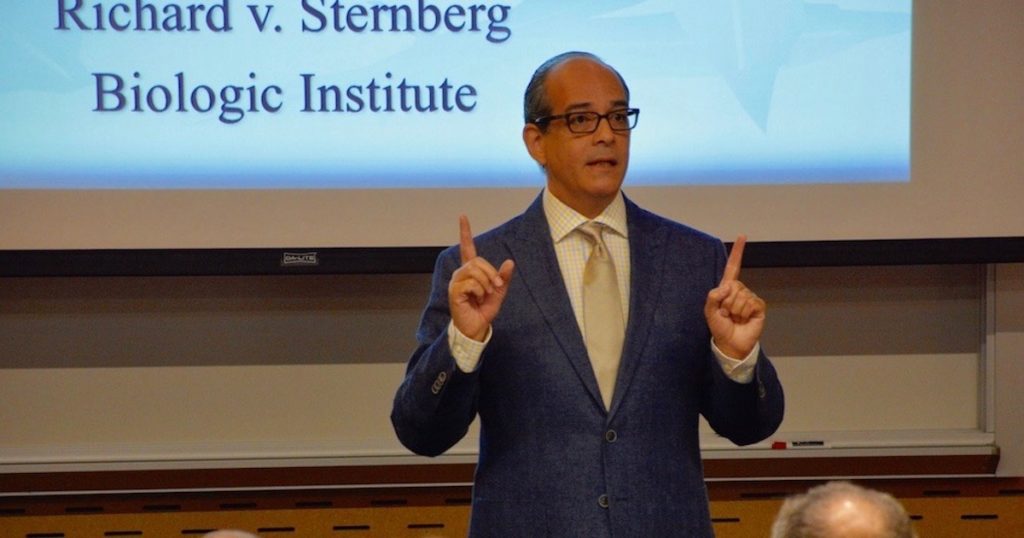 Photo: Evolutionary biologist Richard Sternberg teaching at the 2017 Summer Seminars on Intelligent Design, by Daniel Reeves.
Clues from Genomic Studies
As Klinghoffer summarizes, Sternberg offers four clues from genomic studies that support the conclusion of the immaterial genome (even though its “eeriness” may deter some from admitting it).
- If DNA represents a library of information, then “For the cell’s needs, something is reading and revising the information in this library on the fly. But how?” Or, as Sternberg suggests, the evidence points to “purposeful agency acting right now.” (p. 64) Life requires a non-static source of information, vital to the cell.
- DNA using part of its sequence to code for RNA (transcription) is not a rigid one-to-one transfer of information. Cellular processes can modify the code. Topology of the RNA can supersede the sequence. If the analogy used is a magnificent orchestra, who or what is the conductor, and what provides the musical score that is in a constant state of flux, but never in chaos? (Chapter 9)
- Where does the pattern of “non-conserved ‘junk’ sequences” visible in chromosome banding come from?” (p. 73) Sternberg and his University of Chicago collaborator, James Shapiro, conclude that similar patterns of DNA sequences in chromosomes across species cannot be attributed to common descent. The language-like patterns suggest purposive agency. (p. 74)
- Chromosomes within the nucleus of a cell encode more than the manufacture of proteins. For example, their “topologically associated domains” (sections of chromosomes in proximity to one another) exhibit specific functionality, even within sections of non-coding (previously referred to as “junk”) DNA. The gene takes on the nature of a “poly-functional entity,” guided by dynamic software as an expression of immaterial information. (Chapter 11)
The forms instantiated as living things manifest a stability that persists throughout multiple generations. Contra-Darwinism, an apt description of living things seems to be “survival of the status quo,” rather than “survival of the fittest.” Sternberg summarizes the work of French mathematician René Thom as saying that one cannot explain stable, self-replicating, living forms “by a standard materialistic notion.” (p. 59)
With the limitations of naturalism forming a boundary for what unguided forces can do with matter, logic points towards the conclusion of an immaterial basis for the origin and development of life. Nature cannot explain the functional information coded in the material genome, and that genome cannot explain the functionality of even one living cell. Self-replication, needed for the stability of biological forms, defies naturalistic explanations (see here and here).
Gödel’s Incompleteness Theorem
Additional support for the plausibility of the immaterial nature of the genome can perhaps be found from implications of Gödel’s Incompleteness Theorem, regarded by Roger Penrose as “the most important theorem in mathematical logic of all time.” (p. 56) In a previous article, I wrote,
Gödel’s incompleteness theorems allow and even demand that within the physical reality of this universe there exist truths that cannot be derived from physical reality.
After studying Gödel’s personal writings, researcher Alexander T. Englert of the Institute for Advanced Study in Princeton wrote,
From [his Incompleteness Theorem], Gödel concluded that the human mind transcends any finite formal system of axioms and rules of inference.
Considering that immaterial truths necessarily exist upon which our mathematical systems depend, it should come as no surprise that a system as complex as biological life is found to be incomplete apart from the existence of immaterial truths.
The truths that give life, however, are more than axioms and logical relations. As Klinghoffer reports concerning Sternberg’s research, these living truths manifest themselves as intimately connected with cellular life, providing responsive supervision of myriads of biochemical interactions for the ultimate benefit and survival of the living organism. In Klinghoffer’s own words (p. 127), these truths reach us “within space and time but from beyond their confines — with care, with love, as I picture it, a touch that is more beneficent than the gentlest caress.”