






































How did this slip through? John Horgan with Scientific American interviewed a physicist colleague, Christopher Search. The physicist is appealingly direct in rejecting the atheism associated with Stephen Hawking and other venerated names in the field. More than that, he says it was physics that brought him to a recognition of the “truly divine” in the universe:
Over the years my view of physics has evolved significantly. I no longer believe that physics offers all of the answers. It can’t explain why the universe exists or why we are even here. It does though paint a very beautiful and intricate picture of the how the universe works. I actually feel sorry for people that do not understand the laws of physics in their full mathematical glory because they are missing out on something that is truly divine.
The beautiful interlocking connectedness of the laws of physics indicates to me how finely tuned and remarkable the universe is, which for me proves that the universe is more than random chance. Ironically, it was by studying physics that I stopped being an atheist because physics is so perfect and harmonious that it had to come from something. After years of reflecting, I simply could not accept that the universe is random chance as the anthropic principle implies.
More on the anthropic principle and on multiverse theory:
Like string theory, this is not science. How do you test the existence of other universes? The universe is everything out there that we can observe. Another universe would therefore be separate from our own and not interact with it in any manner. If we could detect other universes, that would imply that they are observable by us but that leads to a contradiction since our universe is everything that is observable by us.
The anthropic principle is something I discuss in my freshmen E&M class actually. However, I think it is a total cop-out for physicists to use the anthropic principle to explain why the laws of physics are the way they are. The anthropic principle implies the existence of other universes where the laws of physics are different. But the existence of these other universes is untestable. It also implies that our existence is mere random luck.
At the end of the day, the existence of multiverses and the anthropic principle are really religious viewpoints wrapped up in scientific jargon. They have no more legitimacy than believing that God created the universe.
He came to these conclusions after breaking with “dogmatic” atheism:
I was always curious about how things work. When I was young, physics seemed to offer answers to all of the mysteries of the universe. It felt authoritative and unequivocal in its explanations of nature and the origin of the universe. In that sense it was the perfect religion for my teenage self as I went through an atheist phase, which admittedly was probably provoked by all the popular physics books that I was devouring at that age such as A Brief History of Time. Those books were always so dogmatic like the Catholic Sunday school I went to as a kid.
As it happens, these are all themes that are developed with great rigor and depth in Center for Science & Culture director Stephen Meyer’s next book, The Return of the God Hypothesis.
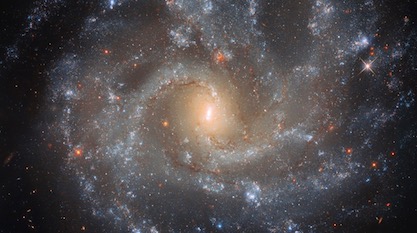
Photo credit: “Hubble Spots Galaxy’s Dramatic Details,” by ESA/Hubble & NASA, W. Li et al.