






































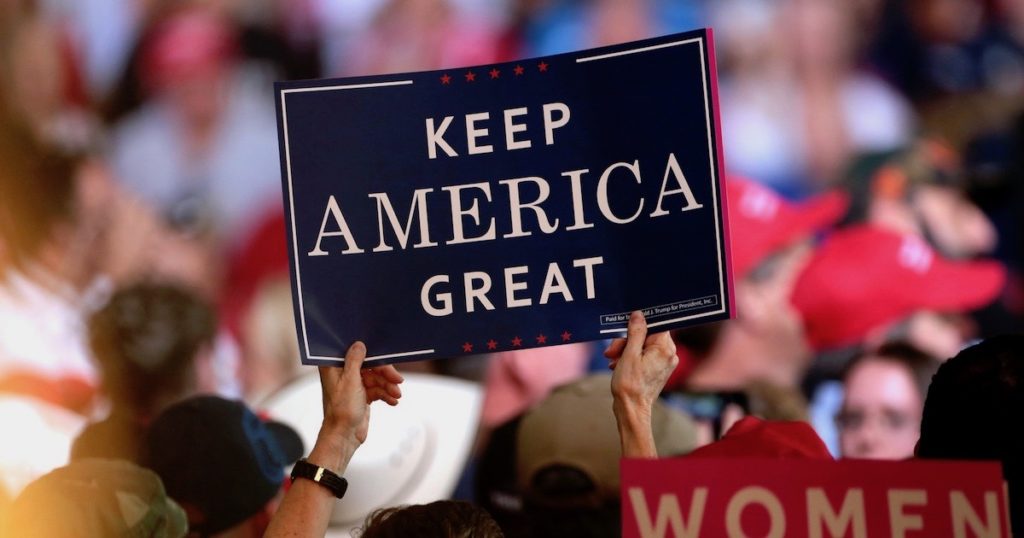
I watched a bit of President Trump’s campaign launch rally in Orlando last night. I found it interesting to see him crowd-testing campaign slogans: “Make America Great Again” versus “Keep America Great.” He asked people to applaud for their favorite, and they went decisively for the latter.
You probably wouldn’t bother doing that with the most advanced available AI. As Brendan Dixon notes at Mind Matters, artificial intelligence is not much help in coming up with winning tag lines. Now isn’t that interesting.
Just Do It
He gives example like “Just do it” (Nike) and “Think different” (Apple):
Creating catchy tag lines is a billion-dollar business that drives many more billions of dollars to a brand. And, says a prominent ad exec, it’s not something AI does well. Trevor Robinson identifies two elements that are difficult to replicate: contingency and connection.
Perhaps more often than ad agencies admit, serendipity or being in the right place at the right time, matters. The winning strategy of an ad — the tag line, the script, the visuals — often flows from unpredictable interactions between team members or even unexpected events.
The agency is worth its fees if it recognizes the dead-on right phrase when it crops up. Their value is knowing a good line when they hear it.
Yes, and that may be why a study a couple of years ago found that people who are frequently distracted, who often daydream, tend to be the creative types. Serendipity, letting the mind wander, not the ability to focus (which of course has its own value), can be the key to coming up with fresh ideas.
A Unique Human Gift
Call it what you want — creativity, insight, inspiration — it is peculiarly human and not computable. Dixon observes:
I have no doubt that, fed enough slick lines, a machine learning algorithm can spew variants. I also don’t doubt that buried among those variants may be lines worth using.
AI can “spew variants.” That’s what all the computer-generated art and music we hear about comes down to. Human imagination, like human insight, doesn’t operate by algorithm, and hence is untouchable by AI. Now and probably forever. Read the rest at Mind Matters.