







































Last night Americans across the continent were treated to a most beautiful and informative natural phenomenon — a total lunar eclipse. I witnessed the event with my family in Indiana, enduring single-digit temperatures. My children (the youngest is eight years old) knew that the curved shape of the Earth’s shadow falling on the Moon during the partial phases revealed a simple truth about the shape of the Earth (it helps that their dad is an astronomer, but I give them most of the credit). It’s spherical, not flat!
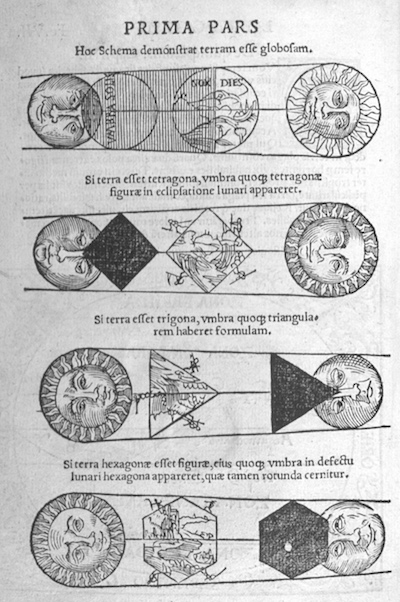
This conclusion doesn’t depend on any special assumptions. You don’t even have to be a heliocentrist to accept it. You only need to understand that the Earth is between the Sun and the Moon during a lunar eclipse and that it casts its shadow on the Moon. Ancient Greek scholars, including Aristotle and Ptolemy, who were geocentrists, were convinced of Earth’s sphericity in part because of lunar eclipse observations.
As Michael Keas reminds us in his wonderful new book, Unbelievable: 7 Myths About the History and Future of Science and Religion, this knowledge was neither lost nor suppressed by Christians during the medieval period. Only a handful of Christian scholars during this period believed in a flat Earth, and their ideas had very little influence (see also here and here). Yet virtually every cultural outlet still pushes this false narrative. Science popularizers like Neil deGrasse Tyson and college astronomy textbook writers misinform millions of people on this topic.
This Flat Earth myth is often placed within the larger Dark Ages myth. It holds that achievements of the classical world came to an end as Christianity gained prominence in the Roman world. Keas adds his voice to the historians who have debunked this myth.
Image: A page from Peter Apian’s Cosmographia textbook (1540 ed.) meant to illustrate how the shape of Earth’s shadow on the Moon during a lunar eclipse shows that it is round.