






































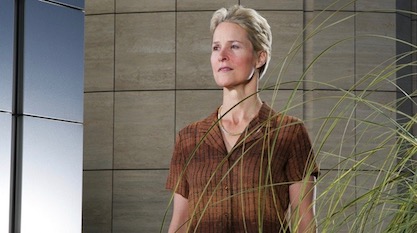
Reports the New York Times, “Nobel Prize in Chemistry Is Awarded to 3 Scientists for Using Evolution in Design of Molecules.” It’s not every day that you see the words “evolution” and “design” in the same headline. Nor, in my experience, does a Nobel Prize go to two people you know, on a typical day.
Frances Arnold of Caltech and Greg Winter of the Laboratory of Molecular Biology in Cambridge now share the 2018 Chemistry Nobel with George Smith of the University of Missouri. I don’t know George, but I well recall the days when Frances first arrived on the scene at Caltech, starting a lab on the same floor as the one where I was completing my PhD work.
In a conversation in her office one day, I said that I wanted to do work on protein evolution. She was skeptical, for pragmatic reasons. “Is that the kind of work that people will want to fund?”, she asked. I smile recalling that, but up to that point she had been trying to modify enzymes (proteins that do chemistry) by thinking carefully about the effects certain changes to their amino-acid sequences ought to have.
She and the graduate students working with her soon found that it was much harder to anticipate the effects of designed changes than they had thought. That’s when she made the shift to what is known as directed evolution. The idea here is that by applying carefully designed biological selection to huge collections of variant genes that came from a suitably designed starting point, we should be able to find the one-in-a-billion variant that does what we want. If we do, then we can make a billion variants of that one and repeat the process.
On the Floor Below
Meanwhile, on the floor below where I was now working in Cambridge, Greg Winter’s group was doing pioneering work on a version of selection that doesn’t require any cells at all — selection by binding to target molecules that have been anchored to beads in a column, over which billions of hopeful binders can be poured.
Both scientists pushed their respective technologies to the limits, and highly significant accomplishments came from both of their research groups. Both did Nobel Prize-worthy work, so it’s fitting that they have been chosen for this highest of scientific honors.
It’s also fitting that words like “design” and “directed” be attached to their work. The truth is that by much hard work and careful thought, they accomplished what accidental processes would never accomplish on their own.
Equally true is that even these stellar scientists have not found a way to invent from scratch proteins that rival the ones we see by the thousands in living cells. As Frances Arnold once said with admirable candor: “[E]fforts to date to generate novel catalysts have primarily demonstrated that we are getting good at making bad enzymes. Making good enzymes will require a whole new level of insight, or new methodologies altogether.”
The problem these efforts face in the lab is exactly the problem faced by Darwin’s evolutionary mechanism in the wild: Nothing can be selected until it already exists. The fact that some clever thing would be enormously beneficial if it existed has no power to make that thing exist.