






































In discussions with materialists and evolutionists, the idea comes up all the time that there’s something hubristic about asserting the exceptional status of human beings. The notion goes back to Charles Darwin, as Tom Bethell notes in Darwin’s House of Cards.
Already twenty years before the publication of The Origin of Species, Darwin wrote in a notebook:
Man in his arrogance thinks himself a great work, worthy [of] the interposition of a deity. More humble & I believe truer to consider him created from animals.
Addressing this “hubris” has been an obsession among his followers ever since then, putting humans in their place by minimizing the vast chasm separating us from animals. Bethell makes a brilliant point, though: the complaint about hubris is itself evidence of human exceptionalism:
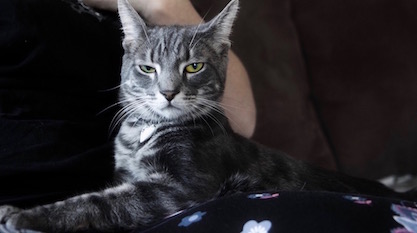
The accusation of arrogance is self-defeating on its face. Only humans are capable of arrogance or of seeing themselves as superior to other animals. Animals cannot rise to that level of abstraction. Do cats or dogs think themselves superior to humans? (Well, dogs don’t, but I’m not so sure about cats.) The criticism of arrogance itself rests on human exceptionalism.
Yes. The remark about cats is a joke, obviously. Some cats appear haughty to us because we read our own feelings into their way of carrying themselves. This is the error of anthropomorphizing: “to ascribe human form or attributes to (an animal, plant, material object, etc.).”
But to anthropomorphize, by definition, is strictly a human mental habit. There is no parallel expression to denote, for example, a cat “ascribing feline form or attributes” to other creatures or objects. In other words, to see cats as “arrogant” that way is itself evidence of human exceptionalism, as I think Bethell would agree.
He goes on to score a telling point against evolutionist David Barash at the University of Washington, who famously delivers a yearly lecture to students revealing to them, in oracular fashion, that science has blown away all their cherished beliefs about the existence of God and about the special place of human beings in the universe.
Writing in the New York Times, Professor Barash pointed out:
[N]o literally supernatural trait has ever been found in Homo sapiens; we are perfectly good animals, natural as can be and indistinguishable from the rest of the living world at the level of structure.
Tom Bethell replies:
But at the level of structure, what would a good materialist like Barash expect to find? Seraphic wings?
Did his editor not think to ask Professor Barash that question? Of course not. When you’re writing as an atheist in a revered publication like the NY Times, you can get away with a startling level of obvious fatuousness.
Bethell observes, “Looking for supernatural traits at the natural level is as illogical as hunting for the mind in brain cells.” Yet materialists do that too.