






































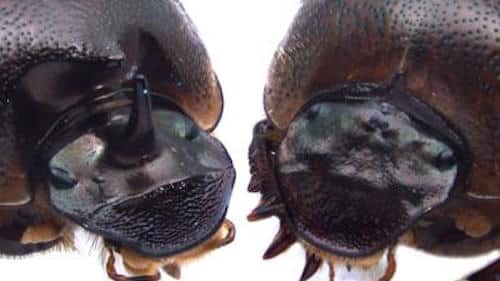
Evolution is beset by chicken-and-egg problems: How to get A and B when A requires B and B requires A? Scientists at Indiana University think they’ve solved one such dilemma in explaining how novel features evolve.
From EurekAlert, “‘Cyclops’ beetles hint at solution to ‘chicken-and-egg’ problem in novel trait evolution“:
“These studies provide a solution to an important ‘chicken-and-egg problem’ of modern evolutionary developmental biology,” [Eduardo] Zattara said. “For a gene to carry out a new function, it needs to find a way to be activated at the right time and location. But it is hard to come up with a good reason why a gene would become active in a new context without already carrying out some important function.”
In short, as Dr. Zattara and his team write in Proceedings of the Royal Society B, by turning off a gene, otd1, they induced dung beetles to grow, instead of a horn, a compound eye in the top of their head.
The discovery was made after switching off orthodenticle genes in horned beetles of the genus Onthophagus, also known as dung beetles. Knocking out these genes caused drastic changes in the insects’ head structure, including the loss of horns — a recently evolved structure used for male combat over access to females — as well as the growth of compound eyes in a completely unexpected place: the top center of the head.
The results were specific to Onthophagus; the same changes did not produce the same effects in Tribolium, or flour beetles, which do not have horns.
“We were amazed that shutting down a gene could not only turn off development of horns and major regions of the head, but also turn on the development of very complex structures such as compound eyes in a new location,” Zattara said. “The fact that this doesn’t happen in Tribolium is equally significant, as it suggests that orthodenticle genes have acquired a new function: to direct head and horn formation only in the highly modified head of horned beetles.”
From reading this, a few things stand out.
First, it has been an evolutionary talking point that the major roadblocks in evolutionary theory are already cleared, leaving only details, however intriguing, to work out. The evolution of novelties at all levels is a pretty major problem for any theory of unguided evolution. I can’t think of anything more major. From this, however, it seems the problem wasn’t solved, after all, even in the view of evolutionists. And even now what we’re offered is only a “hint” at a “solution.”
Second, this solution hinges on turning off genes, not generating new ones. Biologist Ann Gauger observes:
What does [Michael] Behe’s first rule of adaptive evolution say about evolution in general? If most “beneficial” mutations are due to the loss of something rather than a gain of something, we are losing information when most adaptations occur, sometimes irreversibly.
…
The process of innovation is the opposite of the first rule of adaptive evolution. In the biological world, the quickest road to adaptation may be to delete or inactivate genes that are not necessary. But you don’t get new features by deleting information. Building something new, which is what is required to explain the diversity around us, requires more than the happenstance and selection of Darwinian evolution. It requires foresight, planning, and a clear picture of the goal. It requires intelligent design.
Third, compound eyes for beetles are not “something new.” Beetles already have them, where you’d expect eyes to be most useful.
Fourth, what’s “new” here is the location of the eye — on top of the head. But this oddity doesn’t seem very helpful or adaptive. It’s hard to imagine that many parents would be delighted to learn their new baby was born with such a feature. Indeed, the EurekaAlert article notes, “they aren’t normally found [there] in insects,” which makes sense. Does the eye even work?
Functioning or not, an eye on top of your head seems more like a pitiable deformity than a big, beneficial innovation. That’s the kind unguided evolution needs to explain, after all, but setting aside instances of minor tinkering, evidently cannot.