






































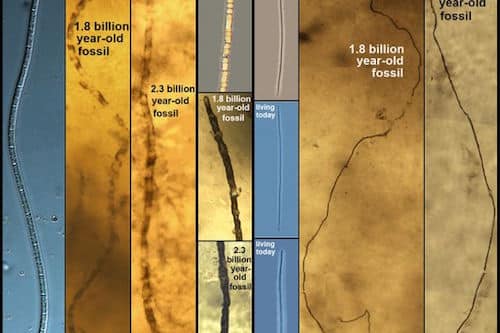
I can’t decide whether my favorite organism in the news today is King Abdullah, for his righteous wrath and quoting of Clint Eastwood — or those Australian sulfur bacteria that have stayed stubbornly, exactly the same for two billion plus years, defying what would seem to be evolutionary expectations.
I referred to the latter earlier. They are trending in evolution news currently and generating some priceless headlines. The Los Angeles Times chirps, “By not evolving, deep sea microbes may prove Darwin right“:
Researchers say these microscopic organisms are an example of “extreme evolutionary stasis” and represent the greatest lack of evolution ever seen.
They may also, paradoxically, prove that Darwin’s theory of evolution is true.“If evolution is a product of changes in the physical and biological environment, and there are no changes in the physical and biological environment, then there will be no evolution,” said J. William Schopf, a paleobiologist at UCLA.
He calls it the null hypothesis required of Darwin’s equation.
The Washington Post agrees, touting “The mysterious 2 billion-year-old creature that would make Darwin smile.” He would smile!
In what researchers call the “greatest absence of evolution ever reported,” these deep-sea creatures have taken a pass on the chaos of biological progress for the past 2.3 billion years. Leave it to other organisms to battle with the forces of natural selection — to mutate and change, to prove their fitness in order to survive. The dinosaurs tried it, and where are they now?
A study published this week in the Proceedings of the National Academy of Sciences said these communities offer evidence of “extreme evolutionary stasis” — a total lack of evolution in response to a lack of change in the surrounding environment. Populated by sulfur-cycling bacteria that derive energy from processing dissolved sulfate in the surrounding water, the communities were found in nearly identical forms at two distinct points in the fossil record and still exist today.
Live Science is more leery, “2 Billion Years Unchanged, Bacteria Pose an Evolutionary Puzzle.”
Meanwhile at Why Evolution Is True, Jerry Coyne denies that there are sufficient grounds to conclude that the bacteria remain unchanged (“A new paper claims that evolution has stopped in a bacterial species. Is it true?“):
The lesson is that it’s dangerous to use fossils — even bacterial fossils — to conclude that evolution hasn’t occurred. And the “null hypothesis of Darwinism” is a bit dubious anyway. Yes, species probably change most rapidly when the environment is changing, but there’s no reason why environmental change is a sine qua non for evolution.
The paper by Schopf et al. does show an intriguing case of morphological and metabolic stasis over billions of years, and it probably does reflect a lack of environmental change. But what it doesn’t show is that evolution hasn’t occurred in these bacteria. To know that, we’d have to have them all alive to sequence their DNA and look at their physiology, reproduction, and so on –and that’s impossible for the fossil species.
So running through the options, it either is a puzzle for evolutionary theory when things fail to evolve over billions of years; or it isn’t a puzzle — in fact it confirms the theory; or we can’t really know whether it’s a puzzle or not. It either “seems astounding” in an evolutionary perspective (the words of UCLA’s Dr. Schopf ), or it “fits perfectly with [Darwin’s] ideas” (again, Dr. Schopf). Darwin would smile, or he would grimace, or perhaps neither.
Here’s the question. For those claiming non-evolution as a victory for Darwinism, would they be saying it was a black eye if the bacteria had, in fact, changed a little or a lot over all that time? Of course not. Darwinian theory is confirmed, it all “fits perfectly,” no matter what evidence turns up.
Image credit: UCLA Center for the Study of Evolution and the Origin of Life.