






































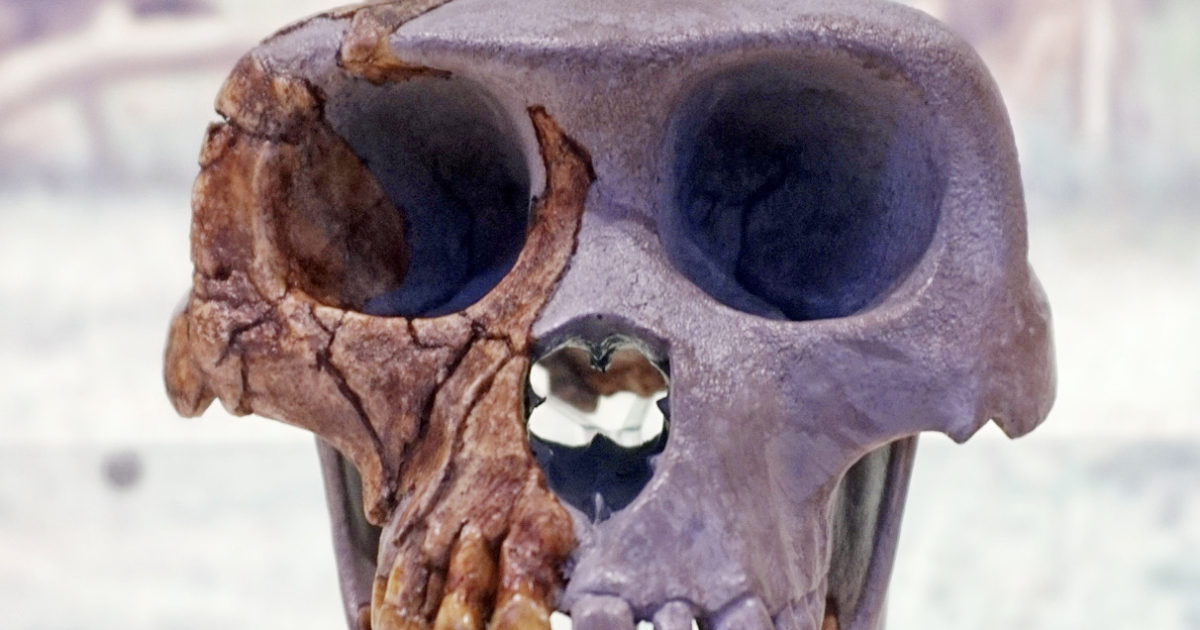
Ardipithecus ramidus
Study: Hands of “Ardi” Indicate a Chimp-like Tree-Dweller and Knuckle-Walker
Neo-Darwinism and the Big Bang of Man’s Origin
Human Origins: Out of Africa, or Out of Germany?
On Human Origins, the Need for Theory Evaluation
The Fragmented Fossil Record of Early Hominins
Another Scientific Paper Challenges Ardi’s Place as a Bipedal Human Ancestor
Is “Ardi” All Washed Up? (Updated)
In some ways, the career of a missing link mirrors the career of the celebutante. They break onto the scene with much fanfare and hype. Everyone is wowed–or at least, everyone pretends to be wowed so nobody can be accused of ruining the party. Besides, she’s useful for advancing lots of agendas. After a little while, people realize that the star doesn’t have all the talent everyone hoped for. Nobody wants to feign excitement anymore. Eventually, people are sickened of the original hype and become eager to see the celebutante fall. And then it’s the fallen celebutante that starts making headlines. Substitute the word “missing link” for “celebutante” and this is something like what we’re now seeing with “Ardi,” the Read More ›
Artificially Reconstructed “Ardi” Overturns Prevailing Evolutionary Hypotheses of Human Evolution
The missing link presently being touted in the media, Ardipithecus ramidus, has had more reconstructive surgery than Michael Jackson. Assuming that their “extensive digital reconstruction” of its “badly crushed and distorted bones” is accurate, what does A. ramidus (or “Ardi” as the fawning media is affectionately calling it) really show us that we didn’t already know? We already knew of upright walking / tree-climbing, small-brained hominids–that’s what Lucy, an australopithecine, was. We already knew that there were australopithecine fossils dating back to before 4 million years, and this fossil is only a little bit older. So what does this fossil teach us? Assuming all the reconstructions of Ardi’s crushed bones are objective and accurate, this fossil teaches us at least Read More ›
Bones of “Ardi,” New Human Evolution Fossil, “Crushed Nearly to Smithereens”
Another new alleged missing link has been found, if you consider something discovered in the early 1990’s new. This fossil seems to have spent almost as much time under the microscope at Berkeley as it did in the ground in Ethiopia, when it was first buried about 4.4 million years ago. Why did it take over 15 years for the reports on this fossil to finally be published, besides the fact that it allowed more time for planning the now-customary PR campaign? A 2002 article in Science explains exactly why: the bones were so brittle, “squished,” “chalky” and “erod[ed]” when cleaned such that many of the bone fragments had to be “reconstruct[ed]”–and that took a long time. Here’s the story Read More ›