Science and Culture Today Discovering Design in Nature
Category

Bioethics

New TV Documentary Links Darwinian Theory with Poisonous “Social Darwinism”

In the debates sparked recently by the New Atheist writers, bashers and defenders of faith have been united at least on one point: Ideas have consequences. The consequences of a particularly controversial idea — Darwinian evolution, a pillar of atheism — will be the subject of a provocative new documentary on cable TV.

What Hath Darwin Wrought? shows the relationship of the founding father of evolutionary theory to eugenic, racist, and even Nazi ideologies. Discovery Institute scholars John West, Richard Weikart, and David Berlinski provide the historical background in interviews with television personality Todd Friel

Read More ›

Darwinian Morality: How the Truth Refreshes

Assurances that we have nothing to fear from Darwinism are a familiar species of evolutionary apologetics. We’re told that Darwinian thinking doesn’t threaten morality, religion, or belief in life’s having an ultimate meaning. On the contrary, it enhances all things good and fair. Karl Giberson’s recent column in the Huffington Post, “How Darwin Sustains My Baptist Search for Truth,” deserves to be pinned under glass and put up on a wall as a near-perfect specimen of the genre.

Anyone who’s honest with himself knows this is all propaganda and wishful thinking, but it refreshes us nevertheless to hear Darwinists themselves confess — even trumpet — the truth.

Darwinian scholars and journalists have been writing with what must seem, to their brethren, an alarming frankness. One occasion for the flurry of articles is the recent sensational book Sex at Dawn by Christopher Ryan and Cacilda Jetha, who present the picture of our evolutionary human ancestors as enjoying polyamory as their standard reproductive practice. Group sex was the rule for them, so there’s no reason to expect marital fidelity from us, their heirs.

On the Scientific American website, psychologist Jesse Bering throws out the whole structure of sexual right and wrong with one blog post:

There are of course many important caveats, but the basic logic is that, because human beings are not naturally monogamous but rather have been explicitly designed by natural selection to seek out “extra-pair copulatory partners” — having sex with someone other than your partner or spouse for the replicating sake of one’s mindless genes — then suppressing these deep mammalian instincts is futile and, worse, is an inevitable death knell for an otherwise honest and healthy relationship.

Dr. Bering concedes with some feeling that in evolutionary psychological terms, empathy for the jilted sexual partner also plays a role. But in general:

Right is irrelevant. There is only what works and what doesn’t work, within context, in biologically adaptive terms.

In the current issue of Philosophy Now, Joel Marks declares himself a born-again amoralist. He used to be a moral atheist, but now, having divested himself of earlier illusions, he chirpily goes for what he calls “hard atheism” and, “In fact, I have given up morality altogether!” On the science backing up his position, he comments:

Read More ›

James Lee Was Disturbed, but What Happens When an Entire Culture Embraces Social Darwinism?

There is little doubt that hostage-taker James Lee’s virulent Social Darwinism was the product of a tragically disturbed man. But can an entire culture fall for the pernicious ideology of Social Darwinism, especially its scientific and political elites? Unfortunately, the answer to that question is an unequivocal yes, as I have documented in my book Darwin Day in America, and as the new documentary “What Hath Darwin Wrought?” persuasively shows. Perhaps the most jarring fact about the troubling views of James Lee is that similar views have been espoused over the past century by leading scientists, politicians, and thinkers. Ideas do have consequences, and not just for seriously disturbed individuals like James Lee.

Major Media Spike Discovery Channel Gunman’s Darwinian Motivations

If someone opposed to abortion were to take hostages at an abortion clinic, you can be sure the newsmedia would tenaciously track down and publicize every anti-abortion association and comment of the criminal in question. But when a gunman inspired by Darwinism takes hostages at the offices of the Discovery Channel, reporters seem curiously uninterested in fully disclosing the criminal’s own self-described motivations. Most of yesterday’s media reports about hostage-taker James Lee dutifully reported Lee’s eco-extremism and his pathological hatred for humanity. But they also suppressed any mention of Lee’s explicit appeals to Darwin and Malthus as the intellectual foundations for his views. At least, I could find no references to Lee’s Darwinian motivations in the accounts I read by the New York Times, the Los Angeles Times, the Washington Post, ABC, CNN, and MSNBC. Read More ›

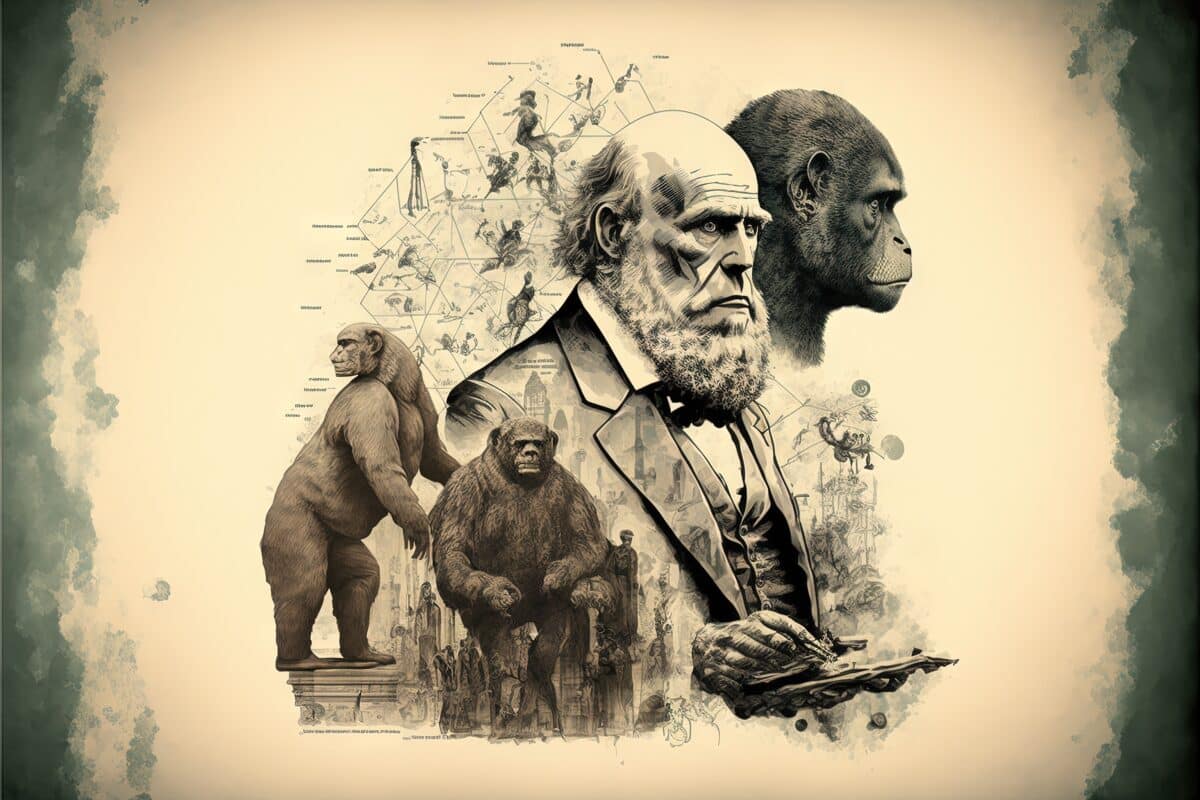
world-darwin-day-representing-the-evolotuion-theory-illustration-generative-ai-stockpack-adobe-stock
World Darwin Day representing the evolotuion theory illustration generative ai
Image Credit: Andrea Izzotti - Adobe Stock

How Not to Defend Darwin on “Survival of the Fittest”

Evolutionary biologists make poor historians, especially when it comes to Charles Darwin. So intent on preserving the reputation of St. Charles, evolutionists typically do their best to paper-over Darwin’s less-than-savory views on issues like race or the application of natural selection to society. British biochemist and theistic evolutionist Denis Alexander runs true to form in a newly posted interview at BioLogos. In the interview, Alexander does his best to disassociate Darwin from the idea of “survival of the fittest,” noting that the phrase was coined by Herbert Spencer rather than Charles Darwin, and that it was then picked up by nasty politicians like Kaiser Wilhelm and Adolf Hitler, who used it to promote their noxious views.

Alexander is correct that Spencer coined the phrase “survival of the fittest,” and that the idea was adopted by the Kaiser and by Hitler. But he neglects to mention one other important figure from history who embraced the term: Charles Darwin himself. As I point out in my book Darwin Day in America, Darwin eventually described “survival of the fittest” as “more accurate” than his own term of “natural selection,” and he employed the phrase repeatedly in the fifth and sixth editions of On the Origin of Species as well as in other works.

Read More ›

When Evolutionary Psychology Collides With Morality

In 2006, the New York Times published an exceedingly long book review titled “An Evolutionary Theory of Right and Wrong,” covering Harvard evolutionary psychologist Marc D. Hauser’s theories of the evolution of human morality. “Religions are not the source of moral codes,” stated the review when describing Hauser’s ideas, further noting that this claim, “if true, would have far-reaching consequences.” The review observed that “[m]atters of right and wrong have long been the province of moral philosophers and ethicists,” but after Hauser’s work, “[m]oral philosophers may not welcome a biologist’s bid to annex their turf.” So who has authority over morality: evolutionary psychologists, or theologians? In his book, Moral Minds: How Nature Designed Our Universal Sense of Right and Wrong, Read More ›

Manliness, Human Dignity, and All That Darwin Can’t Explain

The failure of Darwinism to account for our human experience is something many people know intuitively — but few can articulate it so well as Harvard philosopher Harvey Mansfield and novelist Tom Wolfe. Peter Lawler, who blogs over at First Thing’s Postmodern Conservative, wrote a wonderful essay detailing the ways “America’s two most astute social commentators… have weighed in on the debate over the neo-Darwinian view of evolution.” In “Real Men Prove Darwin Wrong (Again),” Lawler synthesizes how these two masters illustrate that there are more things in heaven and earth than can be explained by Darwin:

They agree that the real controversy in our country is not between rationalists who preach evolutionism and fundamentalists who live in Darwin-denial, but between those who still believe that evolution can account for the whole of human behavior and those who see with their own eyes that it does not. The Darwinians, they observe, cannot properly account for the natural human quality that Mansfield calls “manliness” and that Wolfe, following the sociologists, describes as each individual’s concern for his own status or ranking. The Darwinians do not recognize what genuinely distinguishes the human individual from everything else in nature, so they cannot account for such admirable phenomena as Carson Holloway’s defense of transcendent human nobility against Darwinian reductionism.

Lawler’s essay is incisive and enlightening, reflecting on the denial of manliness (that character trait that drives an individual to believe that she is someone worth championing) inherent in the Darwinian fight against individualism:

Darwinians criticize the human tendency toward championism, and they fight against both our individualism and our speciesism. Science, they think, promises to free us from the illusion that there is anything special about me or mine. It frees us from our religious tendency to think God gave us a privileged place in the nature which, in truth, treats all life forms with equal indifference. The theory of evolution, according to Wolfe, is both a denial of, and a replacement for, religion. It replaces the older “championism” with the proudly dogmatic atheism of those who style themselves special enough to know that there is nothing at all special about us.

Read More ›

Gould’s Fatal Flaw: The Thirtieth Anniversary of Wallace’s Encounter with Darwinian Newspeak

Precisely thirty years ago this month the late Stephen Jay Gould published an article in volume 89 of Natural History purporting to demonstrate Alfred Russel Wallace’s “fatal flaw.” Wallace, who co-discovered natural selection in his now-famous Ternate Letter of 1858, first startled Charles Darwin and then prompted him after years of ponderous delay to finally complete his Origin of Species and rush it to press. By November of the following year his magnum opus was in the hands of the English public. But Wallace would break with Darwin over the source of the human intellect. While Darwin thought man and animal different in degree not kind, Wallace felt that the special attributes of the human mind, its facility for abstract reasoning, mathematics, music, even wit and humor was inexplicable by Darwin’s own principle of utility, namely, the idea that no attribute in any species would arise and be maintained unless it afforded it a functional advantage in its struggle for survival. Admitting that none of these most human of traits promoted survival, Wallace instead suggested that these qualities were explicable only through some “Overruling Intelligence.” Darwin and his disciples have been horrified ever since. Pointing to Wallace’s insistence that natural selection can only “fashion a feature for immediate use,” Gould issued his indictment: Wallace’s so-called “fatal flaw” was his “hyperselectionism.” But does this charge hold up?

Read More ›

What Climategate Tells Us About “Consensus Science”

The parallels between the CRU email scandal (aka “Climategate”) and the abuse of science perpetrated by those who want to keep Darwin-skeptics out of their universities, journals, and way, are clear to those closely involved in the debate over evolution. Today Stephen Meyer explains in an article at Human Events how familiar it is to have “scientists from various academic institutions hard at work suppressing dissent from other scientists who have doubts on global warming, massaging research data to fit preconceived ideas, and seeking to manipulate the gold standard ‘peer review’ process to keep skeptical views from being heard.” Does this sound familiar at all? To me, as a prominent skeptic of modern Darwinian theory, it sure does. For years, Read More ›

A New Tradition for the Darwinian Holiday

Quick question: What upcoming holiday would have priests in white vestments admonishing you to turn off your TV and take comfort in hearing an old story? “If you’re tired of watching It’s a Wonderful Life yet again”?! Clearly these people are barbarians.

© Discovery Institute