






































American farmer, poet, author, and conservationist Wendell Berry died recently at 92 years old. I took the opportunity to do a fresh reading of one of his most famous essays, “Why I Am Not Going to Buy a Computer,” written in 1987. His “little dissent” was reprinted in Harper’s Magazine in 1988 along with a handful of letters from readers and a response to the letters from Berry.
What’s interesting is that most if not all of the reasons Berry offers for choosing not to buy into the personal computer craze of the late ’80s are equally good reasons not to give into the AI craze of the mid 2020s that we are currently experiencing. Here, I review each of his reasons and explore how it connects to our choices about artificial intelligence and modern technology.
First, it’s important to note that Berry was not resistant to technology of any kind. He gave us a great example of how to master technology. In his farming work, he used tools he could purchase locally and repair himself, including manual tools or equipment he could harness to horses. For his writing work, he kept it simple: “I work with a pencil or a pen and a piece of paper.”
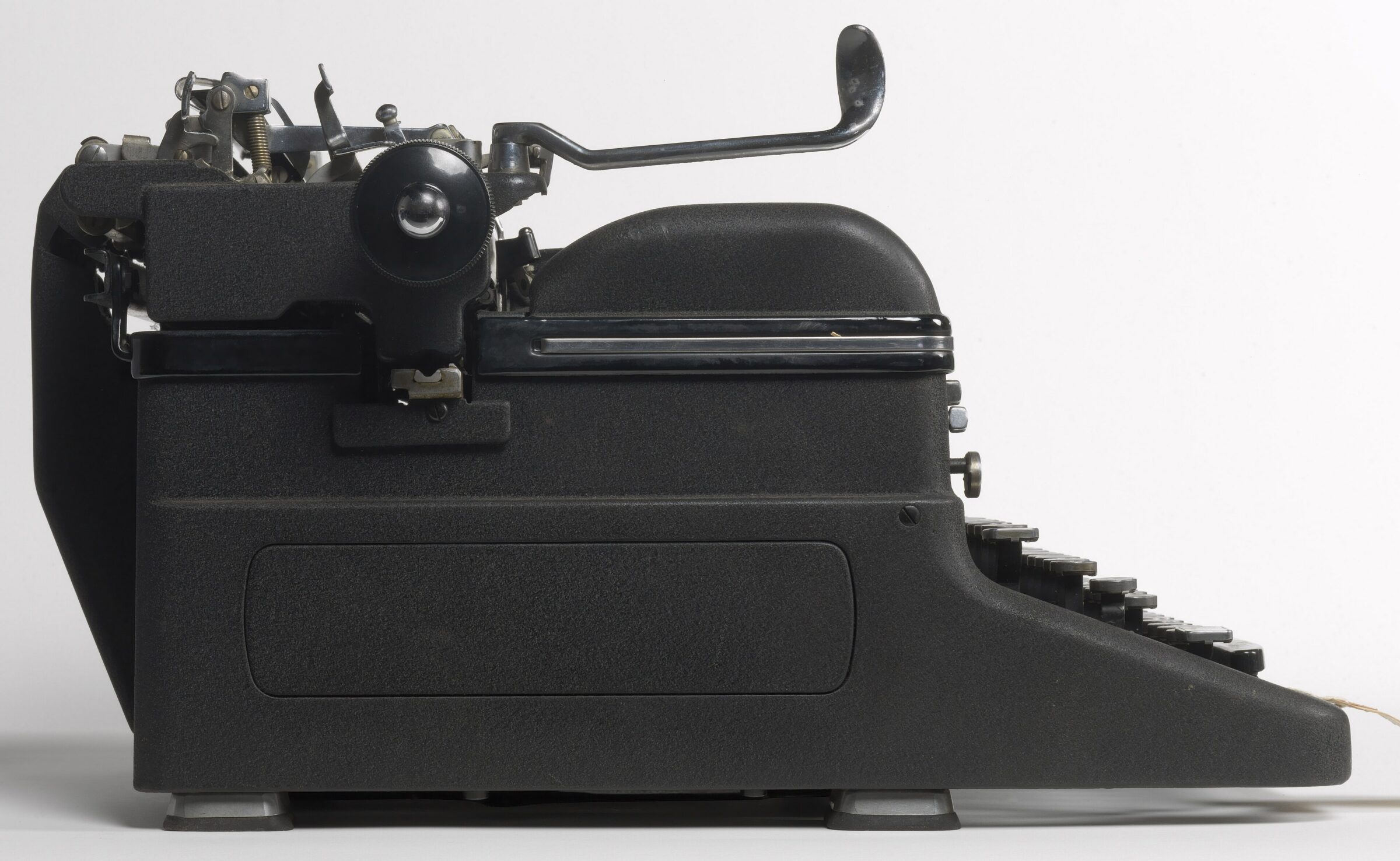
In his essay, Berry describes the beautiful working relationship he had with his wife, Tanya. She typed his work on a Royal standard typewriter, flagging edits as she worked. “She is my best critic,” wrote Berry, “because she is the one most familiar with my habitual errors and weaknesses.” He notes that people have often told him he could improve things if he bought a computer. He then briefly lays out several good reasons why he chooses not to buy one.
The Rape of Nature
First, Berry writes that he doesn’t want his work as a writer to have a direct dependence on companies that use environmentally destructive methods to generate electricity or energy. He mentions strip mining of coal in particular, which involves the removal of large amounts of soil and rock that disrupts landscapes and results in air and water pollution. He details the damaging effects of such methods in his written response to the letters generated by his essay:
But virtually all of our consumption now is extravagant, and virtually all of it consumes the world. It is not besides the point that most electrical power comes from strip-mined coal.
Today, AI companies are striving to meet current and future AI demand by building large data centers to house the material equipment that fuels AI-driven computing. And just like strip mining, data centers exact a significant environmental cost, including high energy consumption, water usage, noise and air pollution, land requirements, and other adverse effects on communities. A single AI-focused data center (100MW), for example, can consume as much electricity as a small city and more water per day than an average town (five million gallons every day).
Little wonder, then, that many are concerned about the effects of building more data centers to power AI. Later in his response, Berry asks what we can do as individual consumers to solve our share of the problem:
That I live every hour of every day in an environmental crisis I know from all my senses. Why then is not my first duty to reduce, so far as a I can, my own consumption?
Closer to What Matters
A second reason Berry offers for why he chose not to buy a computer is that he doesn’t see that such a device would bring him one step nearer to the things that matter to him: “peace, economic justice, ecological health, political honesty, family and community stability, good work.” I’m betting Berry gave some concentrated thought as he wrote that list in an effort to make clear what really matters in life. We might think that our computers, smartphones, TV sets, and other digital gadgets actually do bring us closer to the things that matter. After all, we can reach family and friends through social media. We get updates on all the latest news of the world. We get entertained with movies and TV shows. We can word process and photoshop, access websites, and see the world virtually.
But take a closer look at Berry’s list and you’ll see that those things are not so easily attained through gadgets. Peace, for example. I’m not sure about you, but it seems to me that the more I use my computer, smartphone, or TV, the less peaceful I become. Why is that? Perhaps in opening a pandora’s box of information, entertainment, and personal control, I lose connection to the inner peace I can get organically through connection to nature, communion with God, face-to-face interaction with others, and reflective thinking.
How about family and community stability? Berry doesn’t say mere connection with family or community but stability in those areas. Virtual connection with others across computers, smartphones, and other gadgets pales in comparison to real-time, in-person interaction. To learn and remember how to live well, we need to physically be around others who have that same goal. And stability comes when we do that regularly.
Discarding the “Old Model”
Next, Berry points out that technological innovation almost always encourages or requires the discarding of the “old model” in favor of the new one. Berry notes that in his case, it’s not just a typewriter he’d be discarding, it would be a person.
Thus what would be superseded would be not only something, but somebody. In order to be technologically up-to-date as a writer, I would have to sacrifice an association that I am dependent upon and that I treasure.
That person, of course, would be his wife, critic, closest reader, and fellow worker. Wendell and Tanya were willing to accept any extra work and effort it would take to produce work through a typewriter together than the loss of relationship, dependability, and intimacy that would have come from the introduction of a keyboard and screen into their arrangement.
When a screen gets between us and our world, something is lost, and in many cases, it’s someone. When we turn to AI chatbots for answers, therapy, or companionship, who are we NOT turning to? Family members? Friends? Qualified knowledgeable people in our communities who can help us? When I pull out my phone around my kids or my wife or my friends, and get drawn into its content, I’m sending the message that whatever is in my device is more interesting or important than they are.
Fooling Ourselves with Technology
The final reason Berry offers for not buying a computer? He doesn’t buy the hype that it will make him a better writer.
…I do not wish to fool myself. I disbelieve, and therefore strongly resent, the assertion that I or anybody else could write better or more easily with a computer than with a pencil.
In his response to the letters about his essay, Berry acknowledges that his little missive had “scratched the skin of a technological fundamentalism” that seeks to monopolize society and doesn’t tolerate difference of opinion. This idea is not only encouraged by the technology companies themselves but by the consumers who eagerly buy up all their products and services. It’s the lie that Berry says suggests “[t]he past was gloomy, drudgery-ridden, servile, meaningless, and slow” and that thanks only to purchasable products, the present can be “meaningful, bright, lively, centralized, and fast.” Thus, continues Berry, “consumers become salesmen, and the world is made safer for corporations.”
There’s plenty of hype surrounding AI today. When they’re not warning about the apocalyptic doom that could stem from their creations, the leaders of the major AI companies are happy to expound on the promised benefits of AI in every area of life. And while they’re quietly working on the next big AI advancement, they’re content to leave us hooked on their chatbots. Are we buying the hype that we can think better, work faster, and live better by immersing ourselves in AI? Some of us are, and we are already reaping the consequences. A 2026 study in the journal Science found that interactions with sycophantic AI (AI chatbots that are built to flatter, please, and affirm their users) decrease prosocial intentions and increase dependence.
The lure is real, and the advertising for these AI bots and services is working. Look at recent ads for Anthropic’s Claude AI, for example. “There’s never been a better time to have a problem,” one ad boasts. If you’re feeling stuck, overwhelmed, restless, impatient, or insignificant, turn to Claude to get the answer you need. Keep creating, researching, learning, and thinking, the ad suggests. But turning to AI to solve problems actually stops your personal journey of problem solving. It stops your own thinking and brainstorming. You can’t keep thinking if you let AI do your thinking for you.
Love and Freedom
For Berry, a good life boils down to love and freedom. In a 2019 interview, Berry was asked about the impact of his essay on computers thirty years after he wrote it. His response? After all the hype and marketing, we’ve got a choice to use these products or not.
The idea that you’re free if you buy everything that’s marketed to you is absurd. You’ve become free only when you begin to choose. Take it — or leave it. That’s our freedom, that’s real freedom.
And when asked his opinion of the robots of the near future that could automate many human tasks, he brought it back to love, an advantage we have that machines don’t.
The only motive that’s worth anything is love. If you don’t do the work that you love, and if you don’t do it for love, your artistry is not informed by love. It can’t be any good. So there’s the argument, as far as I’m concerned, against robots. You can’t make a robot that will work from love. It doesn’t work from anything; it doesn’t have any motives. Or its motive is electricity, you could say.
So my little essay about the computer, why I’m not going to buy a computer, was just a part of my strategy to try to keep myself whole as a human being. I don’t want my life to be lived for me by a machine.
Berry will be missed, but in his work, he has left us with more than enough to help us stay whole and fully human in our technological age.
Purchase copies of Wendell Berry’s books at Counterpoint Press.
Cross-posted at The Human Adventure.