






































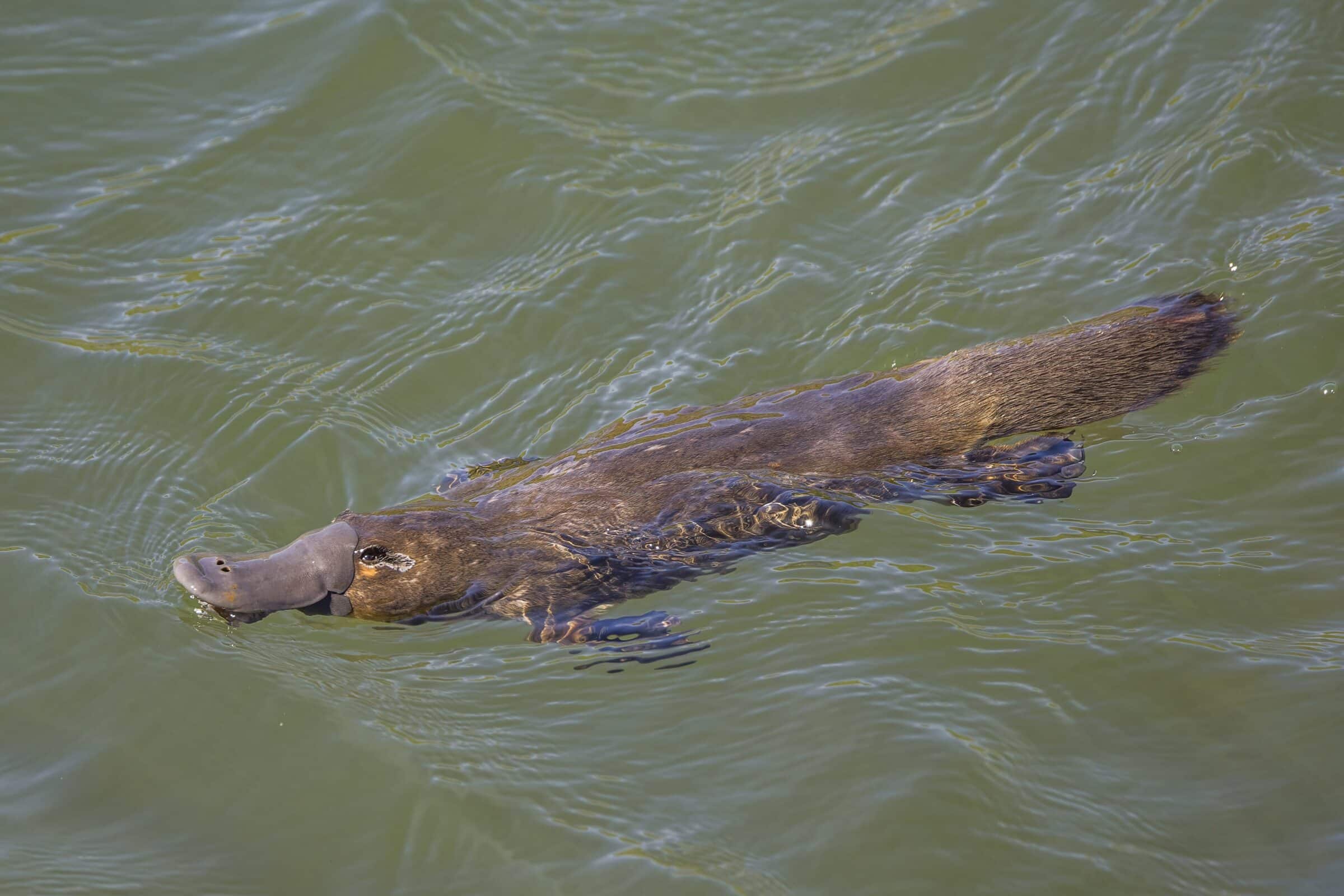
Author’s note: The following is from my paper light-heartedly titled, “The Platypus (Ornithorhynchus anatinus): An Ancestor of Humans?”
Abstract
First, I show Ernst Haeckel’s chart (1871/1876) depicting the evolution from protoplasm to humans, including the platypus and kangaroo as direct ancestors of mankind. Haeckel was, of course, the most important and most celebrated Darwinian of the 19th century in the German-speaking countries.
Second, a brief overview is given on the history and the extravagant combination of several of the mosaic features of the platypus, quoting biologists from Cuvier in 1817 to Darwin in 1836 to Warren et al. in 2008, as well as some scientific and popular sources up to the present. See the extensive footnotes on these points.
Third, AI provides an accurate summary of the present assessment of Haeckel’s chart according to the current evolutionary view. Today no evolutionary biologist follows Ernst Haeckel anymore on his “groundbreaking,” “highly influential” linear “ladder of progress.”
Fourth, the basics of the present neo-Darwinian theory of evolution are repeated because often even excellent researchers are not fully aware of them.
Fifth, the main characteristics of the platypus are listed — “an egg-laying, semi-aquatic, milk-sweating, knuckle-walking, duck-billed, electroreceptive, stomach-lacking, prehensile-tailed, venomous-footed mammal with skin that glows under UV light” — and shown and discussed in the pages that follow.
Sixth, the bill is “the most remarkable organ for sensory perception found in the animal kingdom.” The platypus “must be considered a highly evolved animal and not just a primitive transition between reptiles and mammals” (Ann Moyal 2010). Moreover, “‘bill sensitivity’ is backed up by a large territory of the cortex devoted to processing information from the bill” (Roger B. Mars 2026, referring to a paper by Lea Kubitzer 1998).
Seventh, the theory of gradual evolution or neo-Darwinism is applied in detail to the questions of the origin of the platypus bill/beak and cortex and is shown to be inadequate.
Eighth, following this point, neo-Darwinism is applied to the origin of the platypus’s vomeronasil organ and is found equally wanting. The same is true for the series of altogether 15 of the animal’s main characteristic structures and organs, chosen for this article: webbed feet; eyes, ears, and nostrils shut when swimming; thick waterproof fur; cheek pouches for storing food; wide flat tail; the spurs, which can produce “snake-like venom released from back claws of males,” including five putatively new toxins; lactation and lactation genes; sex determination; complex sex chromosomes; and biofluorescence.
Ninth, the multicomponent spur receives extended attention. This organ is without function during the first 9 to 12 months of the male platypus’s development. How could the extensive genetic code, the many genes for that multifunctional anatomical and physiological system (including the information for new polypeptides and enzymes), have arisen independently of each other by “infinitesimally small changes,” “infinitesimally slight variations,” “insensibly fine steps,” and “insensibly fine gradations,” for according to Charles Darwin, “natura non facit saltum”? Let’s recall Ernst Mayr’s doubtful assertions that “The smaller the effect of a mutation, the greater the probability that it will be advantageous” and “…indeed there is no difference between mutations and the so-called small variations which Darwin and the naturalists had regarded as the principal material of evolution.” Now, population genetics has shown the exact opposite: most mutations “with slight or even invisible effects on the phenotype” (also according to Mayr) are either neutral or slightly deleterious (see Tomoko Ohta 1973, John C. Sanford 2015, and many others). How can natural selection select anything that has no function at all?
Tenth, the revision of outdated views on the monotremata, the order to which the platypus belongs, is summed up in the words of Jack Ashby (2026) as follows: “They [the Australian mammals] are considered fondly but not fairly. It is extremely common to see phrases such as ‘weird and wonderful,’ ‘bizarre,’ ‘strange,’ and ‘peculiar’ being used.” One example is a recent cover-story about platypuses in BBC Wildlife magazine which was headlined, “Stranger things / Up close with nature’s weirdest mammal” (Vergnani, 2019). Meanwhile, the New York Times reported a story relating to monotreme genomes, describing the platypus as “a Frankencreature” (2021). Additionally, in a slightly different way, platypuses and echidnas — but also marsupials — are regularly described as “primitive.” However that is simply nonsense.
Eleventh, Casey Luskin’s article “A Positive, Testable Case for Intelligent Design” is cited. Note in this context, please, that all the new specific platypus features, for which there is not even a starting point in any of its hypothetical ancestors or which appear only later in mammals and birds, must have arisen either totally de novo — involving at least 3,284 protein-coding orphan genes, not to speak of the regulatory “rest” of the its genome — or by “convergence.” According to the ENCODE project, some 80 percent of the human genome is functional. So, what about ID, which predicted years before this discovery that non-protein-coding DNA — formerly thought to be “junk” — would be instrumental in regulating gene expression and more?
Twelfth, since the synthetic theory of evolution has proven to be systematically inadequate for its task of explaining the origin of the platypus, and since, in contrast to this, the scientific theory of ID has proven its worth (see the many articles linked to in my article up to April 15, 2026), for the time being I would like to invite my readers to apply the theory of intelligent design, as articulated by Luskin and many others, to the 15 structures and organs discussed above.