






































This past weekend I went with Discovery Institute colleagues and other friends to see the new film Disclosure Day. Following Steven Spielberg’s previous “aliens” classics like Close Encounters of the Third Kind (1977), E.T. (1982), and War of the Worlds (2005), our expectations were high.
Without giving away too many spoilers, the basic plot is as follows: An Edward Snowden-like whistleblower who works for a secret government agency investigating UFOs steals classified videos and documents and “discloses” them to the public. Given that the U.S. government has been releasing its own purported UFO / UAP files over the past couple of months, there’s been a public debate about whether Spielberg’s film is an exercise in art imitating life, or (more conspiratorially) life imitating art. Whatever the case, the question of UAPs, UFOs, and the existence of alien life is in the air now.
Would ET Life Support Blind Evolution or Intelligent Design?
For my part, as Science and Culture Today followers may know, I’ve been doing some exposition on this topic lately, writing op-eds in The Epoch Times, Townhall, and The Daily Wire and doing interviews on the Sean McDowell Show, Larry O’Connor Show, Point of View with Liberty McArtor, In the Market with Janet Parshall, and of course ID the Future. I’m hardly a UFO expert, or “Ufologist,” though I’ve loosely followed this issue for years. I consider myself agnostic on whether physical extraterrestrial life exists. I’m also a skeptic on whether what the government is releasing demonstrates that such extraterrestrials are visiting earth.
As a Christian, meanwhile, I have no problem with the idea that alien life might exist. The Bible is silent on whether God created life elsewhere and I feel very free to just follow the evidence. In that regard, I try to approach the question scientifically (and philosophically), and what I can say is that if alien life were shown to exist, that would only bolster the scientific case for intelligent design and, philosophically speaking, the case for belief in God.
Our Vast, Beautiful Universe
Why? Here’s how I have put it:
First, a popular argument for aliens holds that the universe is “so vast” that “statistically speaking” aliens “must exist.” In fact, that argument, directly made in Disclosure Day, is loaded with false evolutionary assumptions. It assumes that life arose and evolved on earth through natural chemical processes alone, and if the conditions are right then life “must” chemically evolve elsewhere. But even the “simplest” form of single-celled life is far too complex to arise and evolve naturally anywhere, whether on earth or some other far-away planet with liquid water. Even if alien life weren’t exactly like life on earth, life always requires a high-energy / high-order system, and in our universe those kinds of systems don’t arise through blind, natural chemistry. The incredible complexity of life dictates that if aliens do exist elsewhere — and that’s still a very big “if” — then just like life on earth, they must have been intelligently designed.
Second, some people invoke aliens as the potential creators of humankind. I’m not just talking about the infamous Ancient Aliens guy from the History Channel. Richard Dawkins expressed openness to this idea in the documentary Expelled and even Francis Crick appealed to “directed panspermia,” the idea that aliens seeded the universe with life. Quite suspiciously, this shows that even atheists are amenable to intelligent design but only provided that it isn’t God. But this just kicks the can down the road: it doesn’t explain where the aliens came from. Panspermia itself faces many scientific problems, and it never tells us how life first arose. Philosophically speaking, ultimately there should be an initial transcendent designer that wasn’t just an evolved alien.
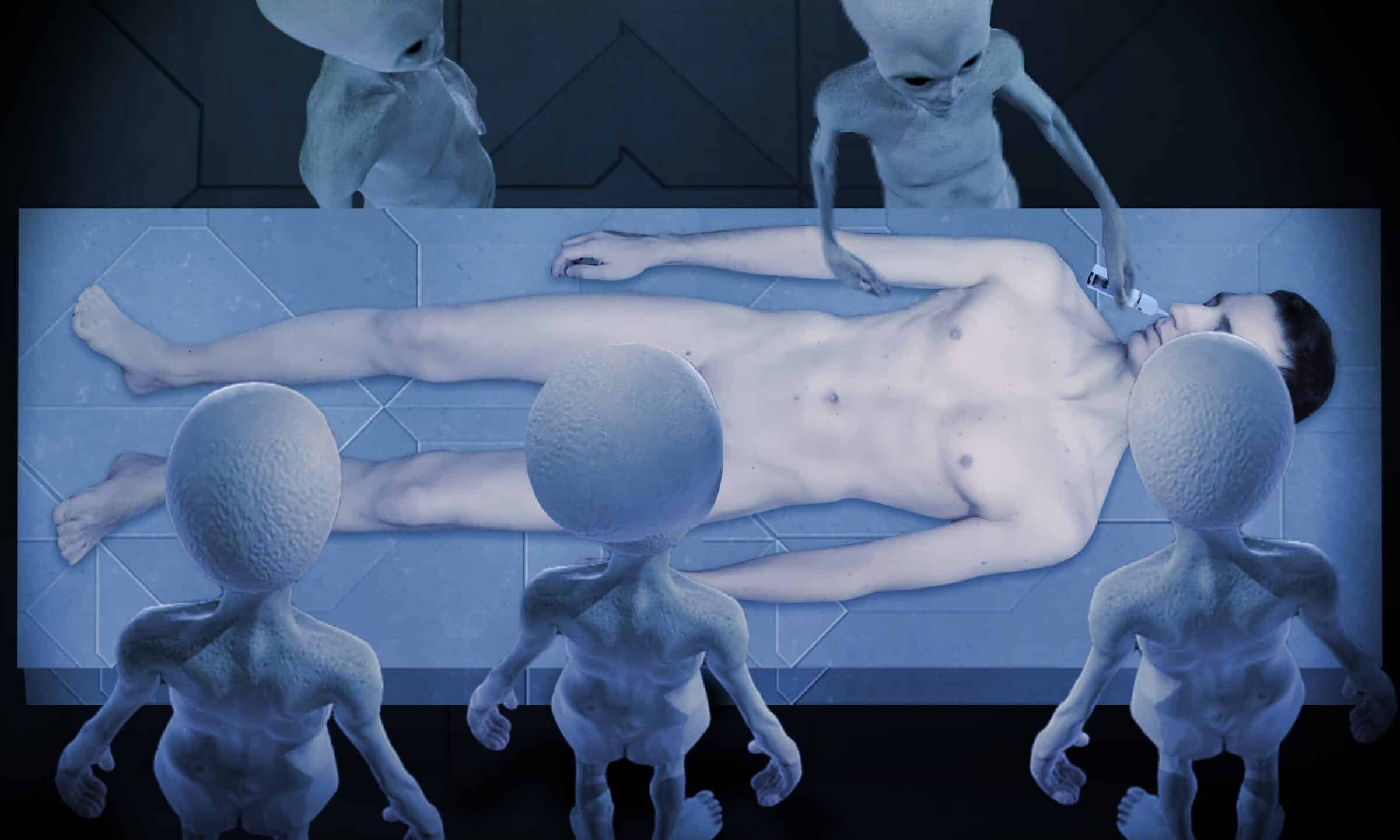
Third, what about the existence of stereotypical humanoid “gray” aliens, which also show up in Disclosure Day? What would be the implications if humanoid aliens were to show up one day on the White House lawn? This is obviously an outlandish thought experiment, but if it did occur, it would be a massive disproof of Darwinism. Darwinian evolution is supposed to be blind and unguided — and the likelihood of evolution totally independently producing aliens with a human-like body plan elsewhere on another planet through “convergent evolution” is virtually zero. If humanoid aliens exist, then there must be a common designer that made both us and them. It couldn’t happen by chance or blind evolutionary processes. So humanoid aliens would only further point to intelligent design.
Fourth and lastly, there’s crucial evidence that appealing to aliens cannot explain. The best evidence shows the universe exploded into existence in a Big Bang from an infinitely small, infinitely dense “singularity” some 13 billion years ago. That’s no job for an alien. It suggests the action of a superpowerful, supernatural First Cause outside the universe — a being most people would call God. Moreover, the laws and constants of nature are balanced on a knife’s edge: if they were only slightly different, life could not exist. Aliens, who live inside the universe and are subject to it, could never explain anything about the origin and fine-tuning of the universe. So aliens would not in any way negate the existence of God — rather, they reaffirm the need for God as the First Cause.
Our vast, beautiful universe wasn’t the work of aliens but of a transcendent intelligent designer who crafted the cosmos, its laws, and its inhabitants — whether they be human, alien, or something else.
What Do I Think About the Movie?
Back to Steven Spielberg. Like many people, I would list him as one of my all-time favorite directors. Disclosure Day is a very good movie — great acting, great action, a lot of fun, and a highly relevant and engaging storyline (if you can forgive a few serious plot holes). But if you’re hoping for a masterpiece about UFO disclosure that’s going to change your life, then you’ll probably be disappointed. In fact, I think that much of the recent government “disclosure” may have made the final “disclosure reveal” at the end of the film a bit anticlimactic. Ironically, in some ways the film may be so tied to present real-world events that the government scooped Spielberg’s plot.
That said, many have been talking about how Spielberg has been on a media campaign promoting the movie claiming it’s “more truth than fiction” and that the evidence of UFOs would challenge the religious faith of many people. I think this was a bit of hype, which I suppose is to be expected. After all it’s his job to promote his own movie.
But I’m happy to report that, overall, religion is portrayed quite positively in Disclosure Day. If your faith is challenged by the film, that probably says more about your faith than it does about the movie. I like what the YouTuber Nerdrotic said:
As far as Disclosure Day leading Christians to question their faith in God, the only thing they’ll be questioning after watching it is their faith in humanity.
Perhaps that’s a joke, but I think he’s on to something: the bad guys in the movie aren’t the church or religion; they are the U.S. government that has hidden evidence about UFOs from the public for decades. I’m a big believer in sunshine laws, so if the government has evidence on this topic, it ought to be released. So far what has been disclosed in the real world is largely ambiguous blurry photos or grainy videos of little black and white dots zipping around, so I remain skeptical that they have “disclosed” any clear-cut evidence of ETs.
Spielberg Is Picking a Side
That leads to my one major philosophical gripe about Spielberg’s storytelling here: Without spoiling the plot, the movie portrays aliens as entirely benevolent and friendly. But I think a lot of folks out there, who would be willing to accept that aliens exist, would also say that they’re not necessarily benevolent.
As Christian Ufologist L. A. Marzulli put it, Spielberg “flips the script and makes the grays the good guys.” Or, as a recent guest on the Michael Knowles show said, “if aliens were to try to put together a propaganda puff piece for themselves, they couldn’t have done a better job than Steven Spielberg did on this film.”
Spielberg wants us to think his movie is telling us something true about the real world. So his message is apparently not only that aliens are real but also that they’re good and they’re our friends. I find that very curious: How is he so sure? He bases his story upon lots of UFO lore, but then ignores all the lore that say the opposite — that these “aliens” are actually not here with good intentions, and may even be malevolent.
People who see this movie need to know that Spielberg is clearly picking a side. Why does he do this?
For the moment, despite the media trying to hype things up, all this remains in the realm of a fictional movie and the hypothetical. I remain an interested observer, trying to keep an open mind while also not letting my arguments get beyond what the evidence shows.