







































Editor’s note: We are delighted to welcome the new book by award-winning British engineer and designer Stuart Burgess, Ultimate Engineering: An Engineer Investigates the Biomechanics of the Human Body (Discovery Institute Press), with an excerpt from Chapter 2.
Despite the high praise given to the knee joint by experts in the field, Nathan Lents insists that it’s a bad design. “The problem is due to incomplete adaptation. Nowhere is this clearer than in the human knee,” he asserts. A bit later he adds, “The anatomical adaptation to upright walking never quite finished in humans. We have several defects that are the result of the failure to complete the process…. The ACL is vulnerable to tearing in humans because our upright bipedal posture forces it to endure much more strain than it is designed to.”
Lents makes these comments not because of any clear and compelling scientific evidence but because evolutionary theory predicts poor design. I fully agree with him that the evolutionary paradigm predicts that the knee should be a very poor design. The problem for Lents is that the scientific research points to the knee being a brilliant design and far beyond anything engineers have produced. Compared to the human knee, the best prosthetic knees have a smaller range of movement as well as a much shorter wear life.
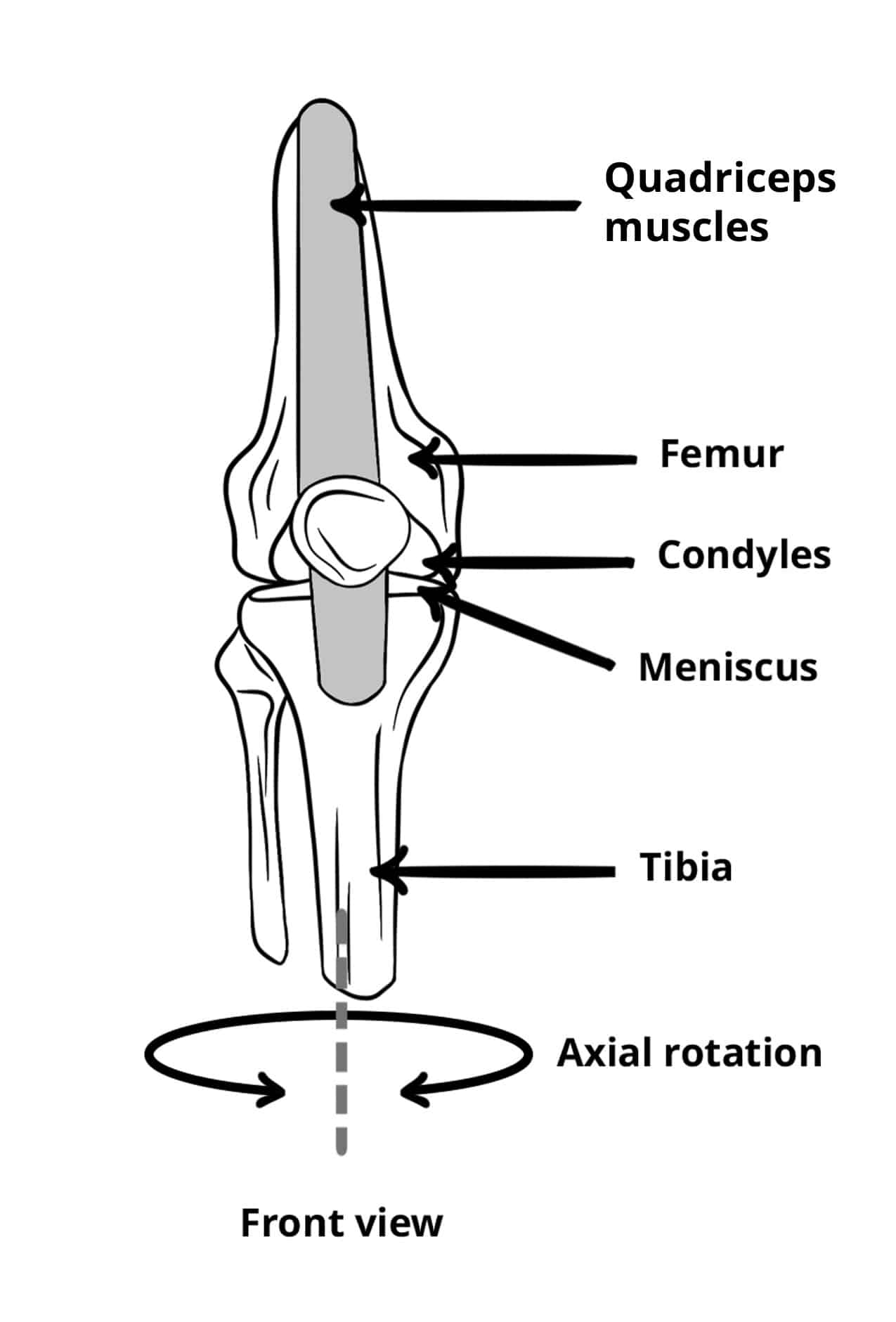
Like the foot, the knee joint is an incredible multifunctioning apparatus. The knee has two main joint functions — large flexion-extension movement and some axial rotation between the femur and tibia. The large range of movement in flexion-extension is necessary for activities like running and jumping. A small amount of knee axial rotation is important for activities like skiing and changing direction in running.
In addition to its two joint functions, the knee has two important structural functions: high strength and locking in the standing position. The knees must be strong because when a person is running and jumping, each knee can experience forces over six times the weight of the body. The knee also needs to be able to absorb shock loads and lock in the standing position. All this, and the knee is able to undergo millions of movements over an eighty-year lifetime.
An Ingenious “Floating Joint”
The knee is a “floating joint” because, unlike most other joints (e.g., the hip joint), the knee has no fixed center of rotation but is free to rotate and roll. The floating nature of the joint — rarely seen in human technology — is an ingenious design, giving the knee joint an exceptional range of movement in flexion and extension.
Figure 2.1 summarizes the special anatomy of the knee joint. The front view shows the patella (kneecap) and the quadriceps muscles. The side view shows the femur, tibia, and patella bones. The femur possesses two separate condyles (rounded protuberances) with a gap in between to give space for the two cruciate ligaments that join the bones together and guide their motion. Additionally, there is a sliding joint located between the patella and a groove in the femur.
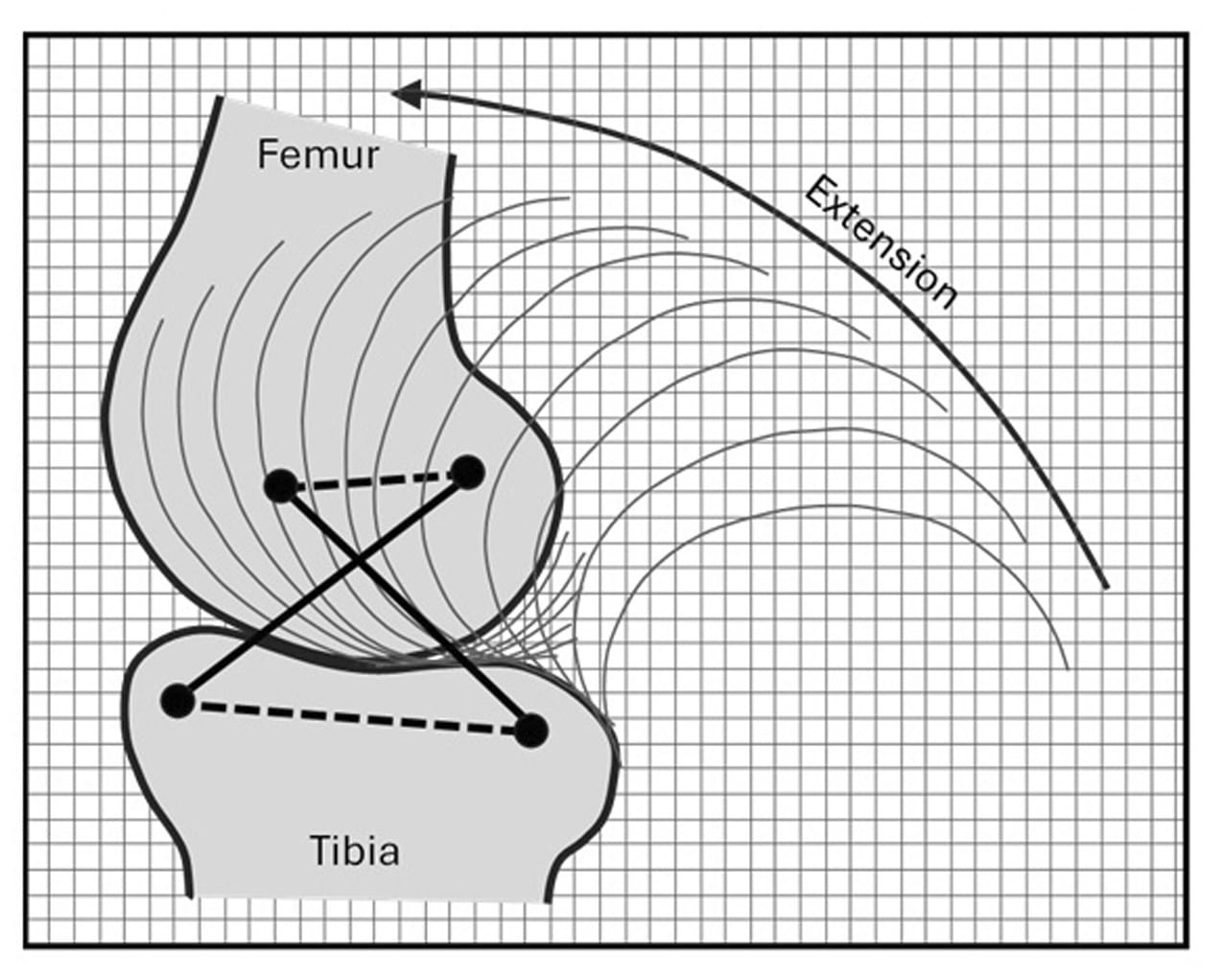
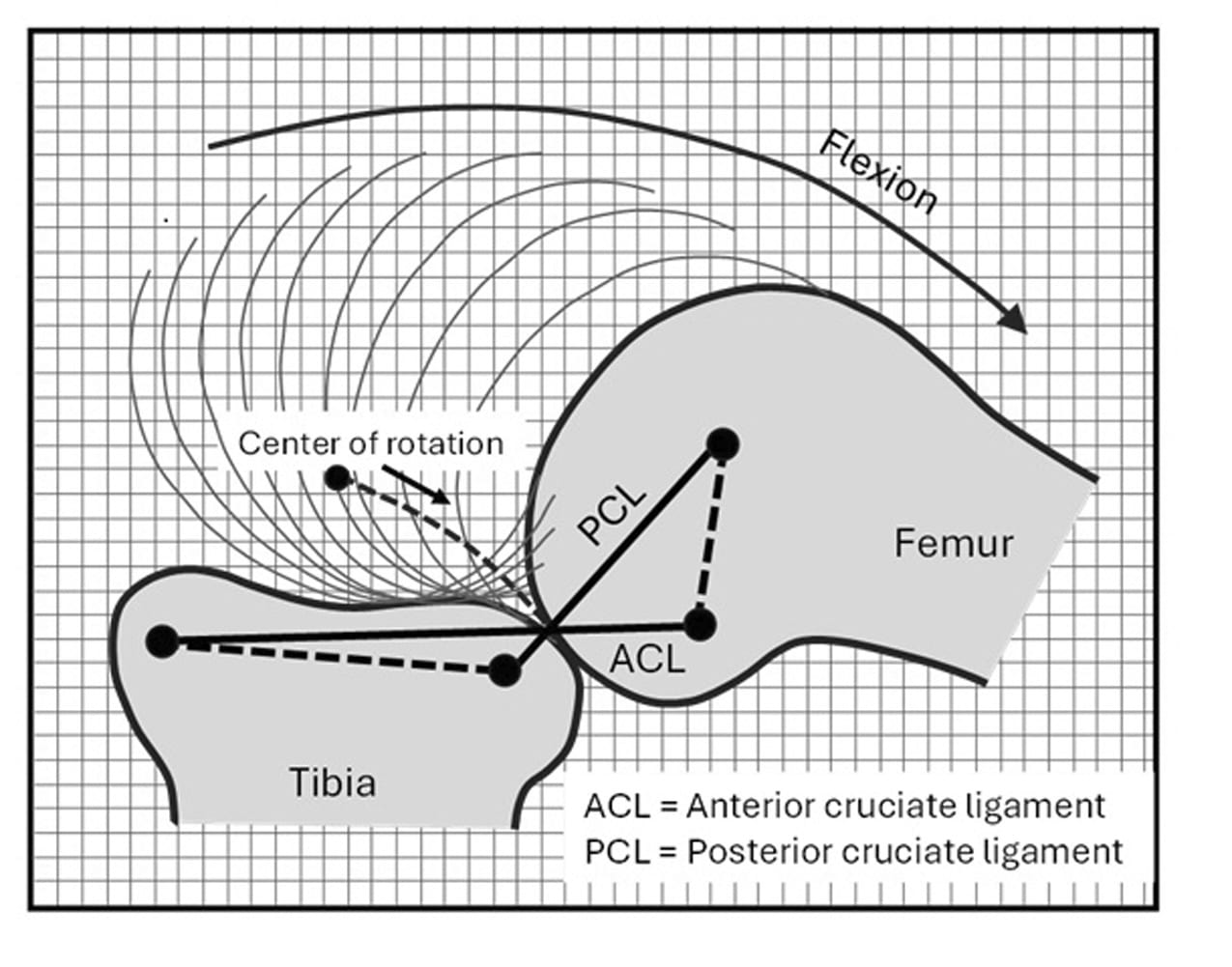
The reason the floating joint is so clever is that it allows the joint to excel in two ways that normally are not possible simultaneously: (1) large load capacity and (2) large range of motion. They’re not normally possible together because to carry high loads, the bones need large curves at the joint to avoid high stress, and these restrict the range of motion to a small angle. The floating-joint design brilliantly overcomes this problem, allowing the femur to roll over the tibia with a moving center of rotation, thus affording a great range of motion.
This clever solution requires some seriously advanced engineering. It requires (1) a complex, fine-tuned geometry in the bones; (2) a sophisticated four-bar linkage system; and (3) a special meniscus structure between the femur and tibia.

Biomechanics of the Four-Bar Linkage Mechanism
The bone geometry and motion of the four-bar linkage are shown in Figure 2.2. The cross links are formed by the anterior and posterior cruciate ligaments (ACL and PCL). The parallel bars are effectively formed by the femur and tibia. (These bars are represented schematically by dotted lines in Figure 2.2.) In technical terms, the mechanism is an inverted four-bar parallelogram mechanism that forms a rolling hinge.
The four-bar linkage mechanism gives the knee a moving center of rotation that enables the femur bone to roll around the tibia and hence produce large flexion angles. The action of the four-bar mechanism also helpfully increases the moment arm of the quads (mechanical advantage) during squatting. This means that the lower you squat, the more force you get from the quads — which is exactly what you need when squatting low.
When engineers first studied the knee joint, they were astonished to find such a creative solution to a complex problem. No engineer had ever thought of such a system.
All notes may be found in the published book.