






































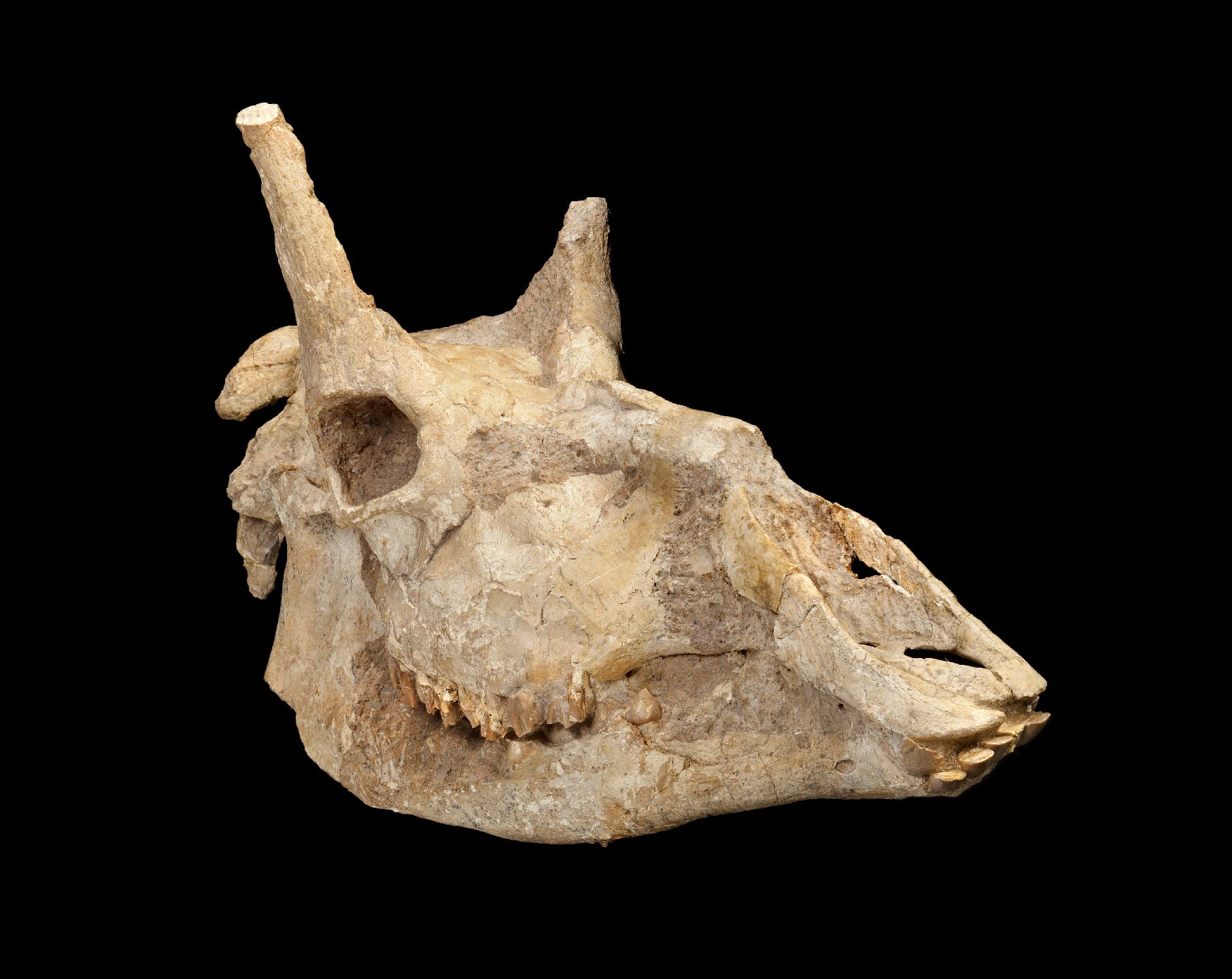
Please see below from the Abstract for my article co-authored with mathematician and computer scientist Karl Friederich Meis, “Giraffe Evolution: The Rise and Fall of Samotherium major as an Intermediate-Necked ‘Real Missing Link.’” We conclude that “the question of how the giraffe’s extremely long neck originated remains entirely unresolved within an evolutionary framework.”
Abstract
This article examines the role of Samotherium major within a presumed evolution of the Giraffidae and challenges the widespread assumption that it represents a “perfectly intermediate” link between the okapi (Okapia johnstoni) and the giraffe (Giraffa camelopardalis). While numerous studies and popular-science accounts present Samotherium as a “truly intermediate” link, the article demonstrates that this interpretation is only possible if crucial morphological differences and mathematical considerations are disregarded.
An analysis of neck lengths shows that the neck of Samotherium, measuring approximately 97.5 cm, is only slightly longer than that of the okapi (approx. 83 cm) but significantly shorter than the neck of modern giraffes (typically 200 – 215 cm, with maxima exceeding 250 cm). A genuinely intermediate value, however, would mathematically have to fall between 141 and 167 cm.
Using the mean value formula:
, the “perfectly intermediate” value can be determined not only between the okapi and the giraffe but, of course, also between any two species. For example, if one inserts 83 cm as the okapi’s neck length (lO) and 215 cm as the giraffe’s neck length (lG), the resulting “truly intermediate” value (lI) is
.
Furthermore, anatomical investigations indicate several unique features that Samotherium shares with neither the okapi nor the giraffe. These concern, above all, the structure of certain cervical vertebrae, cranial elements, and limb bones. This, in turn, means that Samotherium is not regarded phylogenetically as a link between the okapi and the giraffe.
The article therefore concludes that Samotherium cannot represent a transitional form — let alone a “truly intermediate” link — but rather constitutes an independent, mosaic-like taxon.
The full article may be found here. For further background, see Jonathan Witt’s article at Science and Culture Today, “Evolution’s Tall Tale — The Giraffe Neck,” which complements our article in important ways.