






































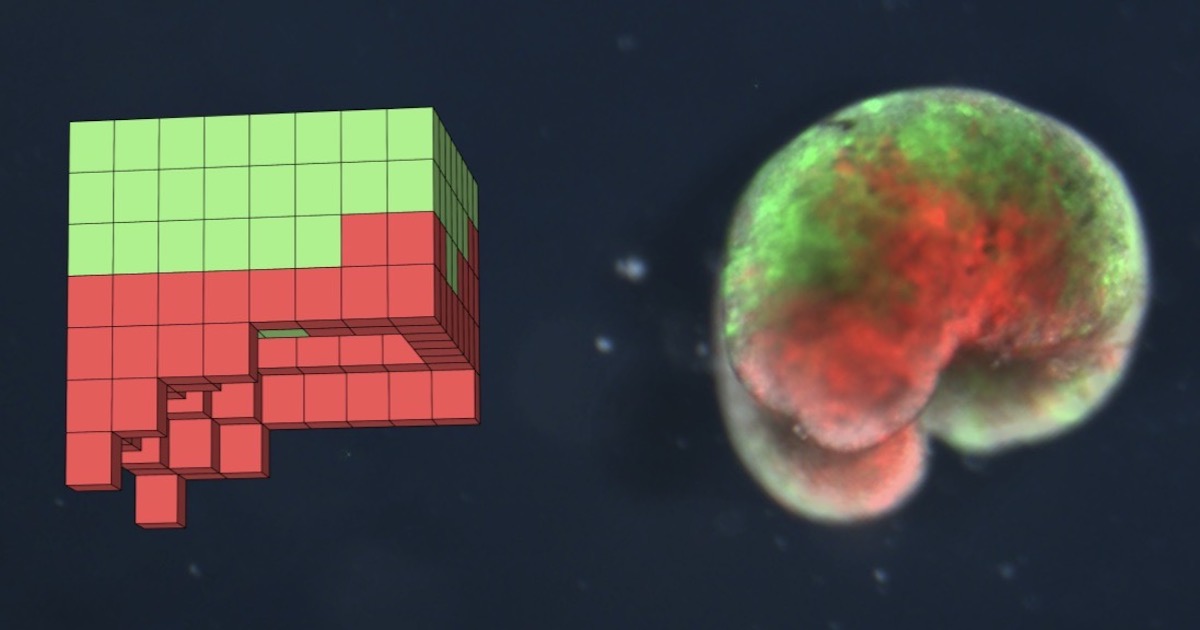
Scientists at the University of Vermont, Tufts University, and the Wyss Institute for Biologically Inspired Engineering at Harvard University claim to have created the first self-replicating xenobot. Xenobots are artificially interconnected biological tissues whose arrangements are determined by some algorithm. An announcement at the Wyss Institute website lauds the researchers for having “discovered an entirely new form of biological reproduction” and for applying their discovery to “create the first-ever, self-replicating living robots.” CNN science writer Katie Hunt described the research in equally glowing terms in her article “World’s first living robots can now reproduce, scientists say”:
The xenobots are very early technology — think of a 1940s computer — and don’t yet have any practical applications. However, this combination of molecular biology and artificial intelligence could potentially be used in a host of tasks in the body and the environment, according to the researchers. This may include things like collecting microplastics in the oceans, inspecting root systems and regenerative medicine.
Achieving true self-replication would be a historical accomplishment, but are these descriptions accurate or more appropriately categorized as hype?
The Actual Research
Kriegman et al.’s PNAS article details their xenobot research. The investigators harvested embryonic cells from frogs and compressed them into spheroids. These “artificial organisms” would move through the motion of cilia on their surface. The investigators placed the spheroids into a Petri dish with separated frog stem cells. The spheroids’ motion captured and aggregated the stem cells into “offspring” spheroids of smaller size in what the researchers termed kinematic self-replication. The offspring could then generate smaller offspring.
The next step in the experiment employed an evolutionary algorithm to generate different configurations of cells. Each configuration was tested in a simulation for its ability to aggregate larger offspring. The most successful configuration was a semitoroid that resembled a Pacman. The semitoroidal progenitor clusters were constructed and then placed in an arena with stem cells. They were able to generate spheroid offspring of considerably larger size than the spheroid progenitors could generate. The offspring produced their own offspring in a reproductive cycle that lasted for a few generations and then stopped after the offspring’s size dropped below a minimal diameter.
A More Sober Assessment
The claim that the researchers created self-replication is highly exaggerated. The aggregation of cells into spheroids was almost entirely due to the innate capacities of the progenitor cell clusters. The researchers only arranged the cells into a configuration that maximized its performance. Their intervention was analogous to a house owner rearranging sprinklers to water more evenly his or her lawn. Most of the work depended on the design of the sprinklers and the plumbing supplying the water.
Cell biologist John Timmer offered a sober assessment of the research in his article “Interesting research, but no, we don’t have living, reproducing robots”:
This is reasonably interesting work, but the researchers involved are a bit excessive in their presentation of it. They call it a “form of perpetuation” that’s “previously unseen in any organism.” Well, yes. It’s not seen in any organisms because it’s not actually a form of perpetuation, since it doesn’t work for more than two generations, much less in perpetuity. And it’s hard to imagine a way of evolving the conditions the humans had to provide here — notably two different culture dishes filled with dissociated cells…
On its own, some aspects of this work are nifty. The researchers used an algorithm to identify a way they could transform a set of odd biological phenomena into the equivalent of an assembly line robot with a finite lifespan. Which is pretty clever.
But the paper buried this in language that, at best, is overhyped, and the researchers aren’t even being technically accurate when describing this work to the press. At a time when trust in science seems to be at an all-time low, this isn’t likely to be helpful.
Such overhyped claims might to some extent be the byproduct of the complete failure of origin-of-life researchers to genuinely explain any aspect of life’s genesis. Many desperately wish to convince themselves that scientists have gained some insight into the origin of self-replication when even such modest results as clumping together cells results from the capacities already engineered into cells from the beginning.