






































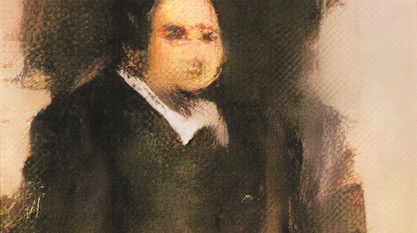
This is dumbfounding. Someone last year spent nearly half a million dollars on “art” generated by a computer. From CNN:
“Edmond de Belamy” has made history as the first work of art produced by artificial intelligence to be sold at auction.
The slightly blurry canvas print, which has been likened to works by the Old Masters, sold Thursday for $432,500 — dramatically exceeding its original estimate of $7,000-$10,000 — at a Christie’s auction in New York.
But “art” implies creativity, and creativity is just what artificial intelligence can’t do. At Mind Matters, Robert Marks explains why AI-generated art is bunk. It has to do with the difference between interpolation and extrapolation.
AI can interpolate among training data but cannot extrapolate anything new and creative. It cannot give results outside the box.
I don’t know for sure but I suspect that the thousands of portraits used to train the Edmond de Belamy AI painting contained few if any of Picasso’s cubist works or Jackson Pollock’s abstract expressionist paintings. Doing so would muddy the results.
The idea of using neural networks to learn and then create images is over 30 years old.
Marks has tried his own hand at it, producing an image he calls the Spooky Dude. MIT neuroscientist Patrick D. Wall recognized the fundamental drawback in thinking that machines can think or create.
I don’t believe that any of the machines that we know today can think. I have a basic question. Do these machines produce anything really new? When you consider the great new ideas produced by men like Newton and Darwin and Galileo, you’ll find, initially, they had to throw away the old rules that they grew up with. Now machines do what they’ve been told to do. They obey the rules that have been fed into them by man. And we know of no machines at present that have means of overcoming this limitation.
As Dr. Marks points out, Wall recognized this in 1961, for goodness sake. Nothing about the judgment has changed since then. Read the rest here.
Image: Edmond de Belamy, by artificial intelligence software [Public domain], via Wikimedia Commons.
