






































Science and Culture Today Discovering Design in Nature
Bruno
Latest

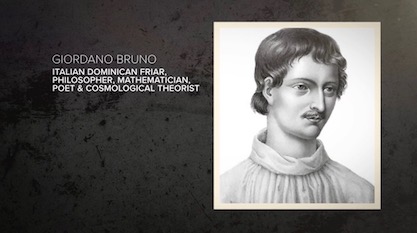
Science Historian Michael Keas: Let’s Not Compound the Tragedy of Giordano Bruno

Categories
Faith & Science
History of Science
Share
Facebook
Twitter/X
LinkedIn
Flipboard
Print
Email

The medieval idea of burning people because of their religious beliefs is horrific enough, but it only adds to the tragedy to say Bruno’s death illustrates the warfare between faith and science. 

Click here to display content from YouTube.
Learn more in YouTube’s privacy policy.

Science historian Michael Keas, a Discovery Institute Fellow, is the author of the new book Unbelievable: 7 Myths About the History and Future of Science and Religion. One of those myths holds that the Roman Catholic Church executed Giordano Bruno (1548-1600) for challenging the dominant religion of his time on scientific grounds. Not true at all, as Professor Keas explains. 

Bruno’s peculiar beliefs, what really got him in trouble, were all theological in nature. He was not driven by science but by his own outlandish religious speculations. That should not have resulted in his terrible death. But neither should modern day myth makers like Neil deGrasse Tyson weaponize the tragedy in their own war on religion.

David Klinghoffer

Senior Fellow and Editor, Science and Culture Today
David Klinghoffer is a Senior Fellow with Discovery Institute’s Center for Science and Culture. He is the author of seven books including Plato’s Revenge: The New Science of the Immaterial Genome and The Lord Will Gather Me In: My Journey to Jewish Orthodoxy. A former senior editor at National Review, he has contributed to the New York Times, Wall Street Journal, and other publications. He received an A.B. magna cum laude from Brown University in 1987. Born in Santa Monica, CA, he lives on Mercer Island, WA.
Benefiting from Science & Culture Today?
Support the Center for Science and Culture and ensure that we can continue to publish counter-cultural commentary and original reporting and analysis on scientific research, evolution, neuroscience, bioethics, and intelligent design.

© Discovery Institute