






































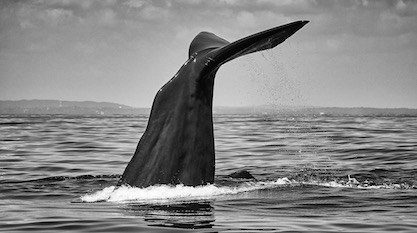
Biologist Jonathan Wells, author of Zombie Science, slices up the “fairy tale” of whale evolution. He describes three massive acts of re-engineering — under the general headings of breathing, swimming, and reproduction — that would need to be accomplished in turning a land creature into a fully marine one like a whale:
If we wanted to turn a land mammal into a whale, these are a few of the changes we would have to implement. Could the changes have happened accidentally, without design?
People who believe in Darwinian evolution point out that fossils have been found of animals that might have been transitional between fully terrestrial mammals and fully aquatic cetaceans. The fossil animals had legs but probably spent much of their time in the water. Darwinian paleontologists call them “walking whales” because they have a particular ear bone that had previously been found only in cetaceans (though the bone has now been found in an extinct land mammal, Indohyus, that is not classified as a cetacean). But the supposedly transitional animals are anatomically more like amphibious sea lions and otters than whales, and the transition from amphibious to fully aquatic must have happened in a geological blink of an eye.11
Even if the transition were perfectly documented with intermediate forms, however, it would not answer the “how” questions. How did the features needed for a fully aquatic lifestyle originate? How would the hind limbs of a sea lion turn into a fluke (which is very different)? How would a male’s testicles become simultaneously internalized and surrounded by countercurrent heat exchange systems? How would a female develop specialized nursing organs to inject milk forcibly into her calf? Indeed, why would any of these changes occur? Sea lions are already well adapted to their amphibious lives.
An intelligence could have planned to make fully aquatic mammals and designed these features to actualize the plan. But Darwinian theory says no design is allowed, and that leaves us with little more than a fairy tale about how natural selection could turn swimming bears into whales.
The rest is over at Salvo. Read it there.
Darwin thought the ancestral land beast was something like a bear. Even after scrubbing this from updated editions of the Origin of Species, stung by mockery for the suggestion, he continued to hold the view privately. Current theories are hardly more credible.