






































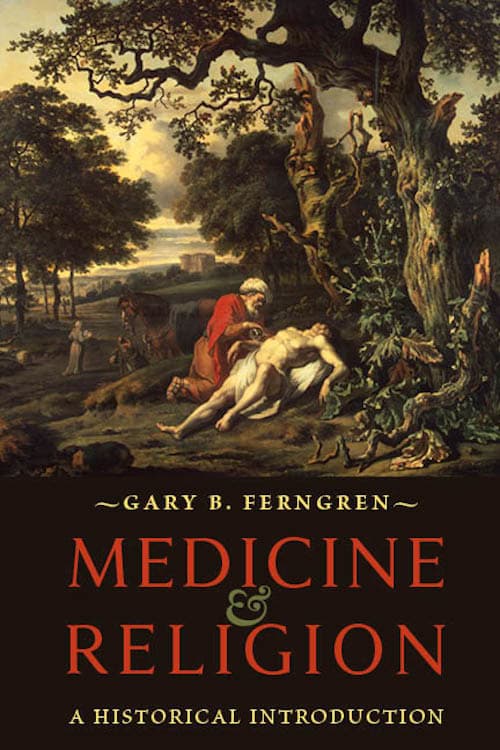
There is a new book out by professor Gary Ferngren of Oregon State University, Medicine & Religion: A Historical Introduction (Johns Hopkins). Ferngren’s book is important in addressing many of the world-view issues that have an impact on medicine and bioethics and therefore should be of interest to readers of ENV. The scientific and cultural problems we grapple with today did not spring forth by chance, but have a historical context that is important to explore and understand.
In eight well-written and thoroughly researched chapters, Ferngren takes the reader from ancient times to the Greco-Roman period, early Christianity, into the Middle Ages and the Islamic world, to the early modern period, and on into the 19th and 20th centuries. The roots of Western medicine, we learn, can be found in the transformative effects of Judeo-Christian traditions.
But the story told here is also about the eclipse of those traditions. While it is not a book on or about Darwinism, Ferngren states accurately that “Darwin’s theory did not make a significant contribution to clinical medicine.” However, he adds:
The widespread adoption by physicians of evolutionary naturalism as a world-view was a factor in divorcing medicine from traditional religious ideas and creating a new image of medicine as a scientific enterprise. Perhaps its greatest influence on medicine, however, was that it professionalized science and recast society as one that specifically privileged scientific enquiry. (p. 176)
Ferngren’s brief but insightful treatment of the rise of Darwinism and its attendant doctrine of methodological naturalism shows him to be a careful historian of ideas. One cannot help but note his phrase “evolutionary naturalism,” as opposed to merely “evolutionary theory,” as one of the significant factors contributing to the secularization of medical practice in the 19th and 20th centuries. Ferngren understands well that not all forms of evolutionary theory have been inimical to religious thought. For example, in the challenge to the efficacy of prayer issued by Baden Powell (1796-1860) and John Tyndall (1820-1893), even a non-Christian evolutionist like Alfred Russel Wallace (1823-1913) presented counter ideas that surely “bridged the gap” (one might say chasm) created by the rise of scientism.
Moreover, Ferngren understands that medicine is much more than the application of reductionist scientific principles. It is a complex human endeavor ranging far beyond the important but limited quantification and analysis of diagnostic measures and the treatment protocols derived therefrom. In the end this is a cautionary tale:
The modern spirit in medicine, whatever else may be credited to it, does not necessarily foster compassion. The best that medicine offers today grows out of the values that a nonreligious world-view encourages: medical positivism and the research that has provided us with our understanding of disease and its cure; and egalitarian health care, which strives to ensure that the finest medical attention is available to all without regard to gender or to social or economic distinction. I do not in the least deprecate these contributions to medical care when I say that an unintentional but perhaps inevitable result of the removal of religious values from health care has been to cut it off from the very source from which compassion springs. (pp. 212-213)
Pointing out that medical technology is not incompatible with compassion, but does not naturally and ineluctably spring from it, Ferngren warns of medicine’s loss of soul and failure of conscience. In an age that at best dismisses religious values as quaint anachronisms and at worst as benighted superstitions, Ferngren’s book is an honest and refreshing historical account that treats the foundations of our striving for compassionate care as more than a dispensable accouterment. Medicine & Religion warrants a close read.