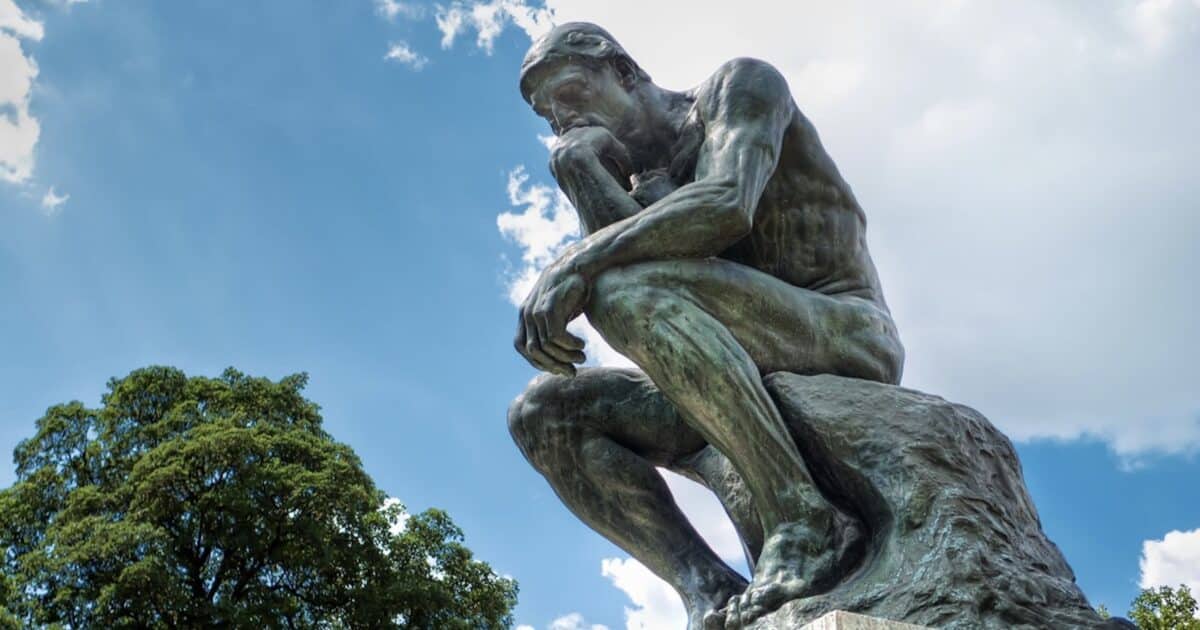
The Thinker Type post Author David Coppedge Date January 16, 2024 CategoriesNeuroscience & MindScientific Freedom Tagged , 1984 (novel), Bertrand Russell, bias, C.S. Lewis, causation, Darwinian evolution, determinism, Enlightenment, evolution, free will, George Orwell, J.P. Moreland, libertarian free will, logic, Miracles (book), North Korea, rigor, The Conversation, The Design Inference, theists, thought police, Trinity College Dublin, United Nations, William A. Dembski, William Provine, Winston Ewert, Woodrow Wilson Freethinking Cannot Be Darwinized David Coppedge January 16, 2024 Neuroscience & Mind, Scientific Freedom 8 An otherwise good essay on the human right to freedom of thought falls into a Darwinian trap of illogical causation. Read More ›
Leonhard Euler Type post Author David Coppedge Date August 4, 2023 CategoriesEvolutionMathematicsNeuroscience & Mind Tagged , blindness, Charles Darwin, consciousness, evolution, intelligence, intelligent design, materialists, mind, Nancy Pearcey, rationality, Richard Dawkins, San Francisco State University, Theodosius Dobzhansky, William Provine, zombies Self-Referential Absurdity in a Theory of Consciousness David Coppedge August 4, 2023 Evolution, Mathematics, Neuroscience & Mind 7 Leonhard Euler was known to work out complex derivations in his head while blind. Of what possible use was this ability for survival? Read More ›
Charles Darwin Type post Author Robert F. Shedinger Date January 13, 2020 CategoriesFaith & Science Tagged , __edited, Abraham Lincoln, American Association for the Advancement of Science, Barbara McClintock, Brooklyn College, central dogma, creationism, Daniel Dennett, Darwinian, Discovery Institute, Divine Foot, Douglas Futuyma, E.O. Wilson, Ernst Mayr, evolutionary biology, Francis Collins, Francis Crick, Francisco Ayala, intelligent design, J.B.S. Haldane, James Shapiro, James Watson, jesus, Luther College, Mackenzie Presbyterian University, Marcos Eberlin, mental illness, Moses, non-overlapping magisteria (NOMA), North American Teilhard Society, Pierre Teilhard de Chardin, Richard Dawkins, Richard Lewontin, skeptics, sociobiology, Stanford University, Stephen Jay Gould, teleology, The Mystery of Evolutionary Mechanisms, Theodosius Dobzhansky, Thomson Mass Spectrometry Laboratory, William Provine Religion, Science, and Evolution: Confessions of a Darwinian Skeptic Robert Shedinger January 13, 2020 Faith & Science 30 As I read through the scientific literature of evolutionary biology to try and convince myself of its accuracy and coherence, I was struck by the frequency with which I encountered “religious” language. Read More ›
Zeta-Ophiuchi-1 Type post Author James Le Fanu Date September 9, 2019 CategoriesBioethicsBiology Tagged , __edited, Big Bang, Boeing 747, C.S. Lewis, cells, chemical elements, double helix, earth, electromagnetism, fly, Fred Hoyle, geneticists, gravity, Harvard University, humanities, John Polkinghorne, man, mouse, neuroscientists, Nobel Prize, plate tectonics, Sapientia, science, scientism, solar system, speed of light, tornado, universe, William Provine, World War II Between Sapientia and Scientia — Michael Aeschliman’s Profound Interpretation James Le Fanu September 9, 2019 Bioethics, Biology 14 Science, the dominant way of knowing of our age, now finds itself caught between a rock and (very) hard place. Read More ›