






































Science and Culture Today Discovering Design in Nature
Topic

Views

When a Book Review Is Not a “Book Review”

Last updated 3/9/10, 7:00 pm.

As a former book review editor (at National Review), I take a professional interest in book reviews and all the things that can go right or wrong with them. I confess, though, I’ve never seen anything quite like the treatment of Stephen Meyer’s book, Signature in the Cell: DNA and the Evidence for Intelligent Design, on BioLogos, the curious website funded by the Templeton Foundation and specializing in Christian apologetics for Darwin. The site published what was clearly, unambiguously written to look like a review by biologist Francisco Ayala that, as Steve Meyer pointed out already, actually gave every evidence that Ayala had not read the book. (My colleague Dr. Meyer thinks Ayala did read the Table of Contents, but on this I must disagree.)

On what did Ayala base his views about Signature? This is a bit of a mystery. BioLogos president Dr. Darrel Falk is unstinting with fulsome praise for Ayala (“one of Biology’s living legends”). Falk claims he actually asked Ayala to respond to Falk’s review of Signature. Falk purports that in publishing Ayala’s review, he mistakenly failed to introduce it with the disclaimer that Ayala was reviewing Falk’s review, not Meyer’s book per se. Yeah, sure. Falk’s review did not provide Ayala with his absurd misrepresentation of Meyer’s argument. Instead Ayala gives every impression of having derived that from his own assessment of the book itself. As Ayala claims,

The keystone argument of Signature of the Cell [sic] is that chance, by itself, cannot account for the genetic information found in the genomes of organisms. I agree. And so does every evolutionary scientist, I presume. Why, then, spend chapter after chapter and hundreds of pages of elegant prose to argue the point?

Yet that is certainly not the keystone argument of Signature, and Meyer in fact spends only 66 pages (out of 613) on it. But that is not really the point here.

What’s notable is that Falk in his own review, whatever its other faults or merits, never claimed that Signature is all about proving that “chance by itself, cannot, account for the genetic information found in genomes.” Falk doesn’t mention the word “chance.” So where did Ayala get his mistaken notion? All one can say is, not from the book, which he patently didn’t read, and not from Falk. Indeed, Ayala in his essay does not mention Falk or Falk’s review. Clearly, Ayala wanted readers to think he was reviewing Signature in the Cell–or Signature of the Cell as he repeatedly calls it. Thus, for example, he commends Meyer for his “elegant prose.” The idea that Ayala was merely acting in good faith on Falk’s assignment of responding to Falk’s review is hardly believable.

Read More ›
Connect the Dots Between Scientism and Government Spending: Add up the Human and Financial Costs

Left wing ideology, the pursuit of government grants and the stifling of scientific dissent work together to hobble progress, reduce freedom and raise costs. Slowly people are going to figure it out. Support the right to scientific dissent, therefore, or give another weapon to Leviathan.

Unintentional assistance comes our way today from The New York Times.

On its front page the Times reports that Darwin skeptics have decided on a new strategy — linking doubts about Darwinian evolution to doubts about man-caused global warming. The article by Leslie Kaufman makes the ludicrous assertion that there is some sort of plot hatched by conservative Protestants.

Read More ›

Intelligent Design, Front-Loading, and Theistic Evolution

Over at Scott McKnight’s blog at Beliefnet, an anonymous blogger has started a review thread on Steve Meyer’s book. Signature in the Cell. While the blogger (“RJS”) says he ultimately disagrees with Meyer’s argument, it’s clear that he takes Meyer’s argument seriously and is trying to do his best to present the argument accurately. This is much more than can be said for the many hysterical and misinformed “critiques” of Meyer’s argument that are now floating around the Internet. Anyone who’s actually read the book will know that most of these critiques are cliches that Meyer addresses in detail in the book, suggesting that the critics don’t even know the argument they are criticizing.

A civil review like this is welcomed, and I look forward to reading the installments.

In his first installment, RJS suggests that there’s a promising “third way” that Meyer doesn’t address in the book:

Read More ›

A Glimpse Into the Abyss

“Before going on,” said Frost, “I must ask you to be strictly objective. Resentment and fear are both chemical phenomena. Our reactions to each other are chemical phenomena. Social relations are chemical relations. You must observe these feelings in yourself in an objective manner. Do not let them distract your attention from the facts.”

C.S. Lewis, That Hideous Strength (1946)

The relevance of this passage from Lewis will be clear below. But first…

Read More ›

How to Make Eighteen Equal Twelve

Occidental College professor Donald Prothero, who along with Michael Shermer debated Stephen Meyer and Richard Sternberg on November 30, complains that folks at Discovery Institute are now attacking him with “everything they have.” Prothero writes on the NCSE’s blog Panda’s Thumb, “Normally, it is not worth dignifying their garbage with a response,” but in this case he wants people “to get the straight facts.”
According to Prothero:

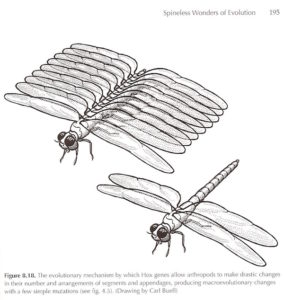
When evo-devo came up in Monday’s debate, Meyer and Sternberg began arguing with each other about reconstructions of a 12-winged dragonfly that I had published in my book. They tried to get a laugh by claiming that such a bug has never been found. As usual, they completely missed the point of that illustration, and failed to read any of the explanation or discussion in the caption or text. The text clearly points out that the 12-winged dragonfly is a thought experiment, an illustration to show that a simple change in Hox genes allows the arthropods, with their modular body plan of adjustable numbers of segments and interchangeable appendages on each, to make huge evolutionary changes by simple modifications of regulatory genes. This is the aspect of evo/devo that should answer structuralist Sternberg’s objections to Neo-Darwinism, if he only bothered to comprehend it, and solves much of the question over how macroevolutionary changes take place.

Unfortunately, it’s Prothero who needs “to get the straight facts.” First, the dragonfly in his book did not have 12 wings, but 18. Second, there is no evidence that “such a bug” ever existed, so it was not “reconstructed,” but invented.

Read More ›

God, Design, and Contingency in Nature

I recently received an email asking if the correspondent correctly understood my views about intelligent design and God. Since I sometimes get similar questions, I’m posting this correspondence for anyone who is interested.

Q: I understand your current position to be that design is detectable in nature, and that design detection is not merely a theological gloss upon the scientific facts, but is actually an activity appropriate for science. I further understand you to be saying that design detection in itself is neutral regarding the way that the design found its way into nature. Thus, if the bacterial flagellum is designed, it *could* be that God took a regular bacterium and miraculously “tweaked” it, or it *could* be that God “front-loaded” the evolutionary development of the bacterial flagellum, in a manner similar to that suggested by, say, Michael Denton. Design detection as a science cannot rule on these things; all that it can show is that Darwinian mechanisms, all by themselves, could not have produced integrated structures such as the flagellum. If there was not direct intervention (tweaking, guiding, steering, etc.) or advance planning (“front-loading”), neo-Darwinian processes would never have been able to produce all the complex varieties of living things that we see today. Have I got your current position correct?

Me: Yes, that’s exactly right.

Q: Then there is the question whether your views have changed over the years. Someone I know claims that in your early writings and early conference appearances, you said directly, or gave the strong impression, that some things (A, B, C …) were brought about by wholly natural processes, whereas other things (X, Y, Z …) were brought about by design (the implication being that “designed” in your early thought was opposed to “natural”). My acquaintance’s picture of Behean evolution would then be something like this: evolution in the early oceans chugs along on its own, via neo-Darwinian and other stochastic processes, as various sorts of marine worms and sponges and so on develop. But then, during the Cambrian Explosion, God takes a direct hand and literally reshapes marine worms into 30 or so new phyla, after which things go on by natural means again, until the next limit is reached, and God has to disrupt the normal flow of nature again (maybe to create land animals, or mammals, or birds, or man). Thus, there would be a jerky, stop-and-start sort of evolution, with chance/natural law causes alternating with fits of miracles. So, looking at any given creature, science would have to say things like: “Human lungs — evolved by blind mechanisms from primitive air bladder; human camera eye — required special intervention from intelligent designer; bacterial cell walls — evolved by blind chemical mechanisms; bacterial flagellum — was made by a bolt of divine lightning.” Etc. Given this understanding of your views, one can see why my acquaintance or other TEs would characterize ID as “God of the gaps” reasoning. My question is: Was it *ever* your view that ID *required* such a jerky view of evolution, and more generally that it required miraculous intervention (breaking the causal nexus, violating the laws of nature)? Or was it always the case that your view *allowed for* jerky, stop-and-start evolution, and *allowed for* miraculous intervention, but did not *require* these things?

Read More ›

Even Evolution’s Priests May Doubt

There’s a narrative that should be familiar to most of us by now: a man is considered the great hero of the faith, a sign of hope for every true believer as he advances its claims, but secretly he struggles with his doubts about what he’s preaching.

This time, there’s a twist to the old story: the faith the man espoused publicly was Darwin’s theory, and the man was the brilliant Stephen Jay Gould.

In Suzan Mazur’s fascinating new book, The Altenberg 16: An Exposé of the Evolution Industry, Richard Milner describes Gould as “a popular articulator of Darwinian evolution to a new generation, while privately, his creative and rebellious mind sought to move beyond it.” (emphasis added) A personal friend of Gould’s, as well as his editor at Natural History magazine, Milner goes on to explain that “Gould took issue with those who used natural selection carelessly as a mantra, as in the evidence-free ‘just-so stories’ concocted out of thin air by mentally lazy adaptationists.”

So here we have a picture of a man committed to his creed (“The universe is all there is, or ever was, or ever will be”) who was nonetheless unhappy with the easy answers of reductionists such as Richard Dawkins.

Read More ›

The Science of Denial

Scientists sometimes find themselves wishing things were different. In one sense that’s a thoroughly unremarkable observation. After all, scientists are human, and humans have always found themselves wishing things were different.
But what if some of the things scientists wish were different are the very things they have devoted themselves to studying? In other words, forget about salaries, teaching loads, and grant funding. What if some scientists want the brute facts of their own field of study to be other than what they really are?

As odd as it may seem, particularly to non-scientists, that tension between preference and reality has always been a part of doing science. Like everyone else, scientists don’t just have ideas — they favor them… even promote them. And for scientists, as for everyone else, sometimes those cherished ideas are just plain wrong.

Read More ›

Richard Weikart Responds to Larry Arnhart’s Review of Hitler’s Ethic

The first review of my book, Hitler’s Ethic: The Nazi Pursuit of Evolutionary Progress, has appeared. Larry Arnhart, professor of Political Science, Northern Illinois University, author of Darwinian Natural Right: The Biological Ethics of Human Nature, posted a perceptive review to his blogsite.
He provides a good summary of the book, and then offers the following remarks:

The elements of Nazi ideology seem diverse — racism, German nationalism, anti-Semitism, socialism, militarism, imperialistic expansionism, the ‘leadership principle,’ eugenics, and genocide. But Weikart is remarkably persuasive in showing how all of these strands of Nazi ideology are woven together by the final end of Hitler’s ethic — the evolutionary improvement of the human species through the triumph of the Aryan race in the struggle for existence. Proponents of Darwinian ethics — like myself — should be honest in recognizing the impressive evidence that Weikart marshalls from Hitler’s writings and speeches to show how Hitler’s thought and actions were driven by a coherent view of Darwinian ethics.

Read More ›

© Discovery Institute