Science and Culture Today Discovering Design in Nature
Topic

Views

New Atheist Atheology

P.Z. Myers answered my eight questions about what New Atheists really believe. Myers provided his “fast and flippant” answers; yet he provides a fine synopsis of New Atheist atheology. More detailed book-length New Atheist apologetics (Dawkins, Harris, etc) are less fast but no less flippant.

My original questions are followed by Myers’ answers, then by my reply.

1) Why is there anything?

Read More ›

“…you don’t get to use the influence of government to help promote your cult.”

I shouldn’t drink my morning coffee while reading P.Z. Myers. I almost choked. Myers, avant garde of the cult of atheism, commented on Delaware Senate candidate Christine O’Donnell’s observation that the First Amendment contains no phrase “separation of church and state.”
Myers:

Read More ›

Evolution, Then and Now

Let’s set the record straight; things have changed a lot since “then.”

When Darwin first ventured to propose an explanation for the origin of species, he didn’t really try to address the question of the origin of life. No one, at that point, had any good idea of what even really needed to be explained.

When early optical microscopy gave us our first images of cells, what we saw was puzzling, but not particularly awe-inspiring. As microscopy advanced, in conjunction with advances in physics and chemistry, what came clearer into focus was that cellular structure, function and metabolism, and thus biochemistry as a whole, was a universe awaiting new discoveries of its own.

Who could have guessed that the micro-world would dwarf in complexity and organization the macro-cosmos we had only recently come to more fully appreciate? Or that additional discoveries on all orders of scale would point more cogently to deliberative design than ever?

A parable might help. Two people are walking down the beach; one is a philosopher, the other a geologist. As they walk along, they take in the view, and appreciate the beauty of the scene. The geologist explains the visible coastal rock formations, the action of plate tectonics, erosion and sedimentation, and — wait; what is that?

Read More ›

Intelligent Design as State of the Art

[NOTE: Today we welcome a new contributing writer to Evolution News & Views, Guy Coe. Mr. Coe graduated from the University of California at Davis with a B.A. in Rhetoric and a minor in political science. As a lifelong student of argumentation and logical analysis, his career has taken him from Executive Salesman, to News Reporter, to U.S. Senate Communications Aide, to Tour Guide, to Retail Management, to father of a budding teenager, “where all communications logic begins to break down.” With a lifelong interest in the issues of intelligent design and origins theories, his status as “interested layperson” allows him to continue to follow the evidence where it leads, while showing proper respect for the lifelong dedication displayed by practitioners of the hard sciences. And, somehow, he still manages to communicate with his teenager…]

Much ink has been spilled, and heat generated, over the “intrusion” of the intelligent design hypothesis into the now seemingly exhausted “creation vs. evolution” debate.

Is intelligent design only reworked creationism, or is it something dynamically different? Now that intelligent design has “evolved” a little, and the theory of evolution has been a little more “intelligently designed,” the focus of our attention has been changed back to the very puzzling questions of the origins of the complexity within cellular organization, while the “old regime” merely argues over the vestiges of an assumed progression from this unexplained point.

For their parts, many creationists and evolutionists are at such an impasse in old paradigms that each of them are left shaking their heads in wonder at the apparently willful ignorance of their opponents — building their knowledge base on two supposedly vastly different approaches, and being at a loss to explain how the “convincing” evidence each position marshals can be so blithely dismissed by the “other side” — to the point that charges of irrationality, and even willful self-deception, are rife.

As an eager observer of this unfolding drama over the last several decades, I have to say that my honest impression is that both sides manage to play fast and loose with the facts, ignore the anomalies, and distort the evidence, by virtue of prior philosophical convictions. Or perhaps it is more charitable to say that, given the same set of facts, many come to vastly different interpretations by virtue of poorly-constructed logic, selective evidence, and poor methodology.

Read More ›

James Lee Was Disturbed, but What Happens When an Entire Culture Embraces Social Darwinism?

There is little doubt that hostage-taker James Lee’s virulent Social Darwinism was the product of a tragically disturbed man. But can an entire culture fall for the pernicious ideology of Social Darwinism, especially its scientific and political elites? Unfortunately, the answer to that question is an unequivocal yes, as I have documented in my book Darwin Day in America, and as the new documentary “What Hath Darwin Wrought?” persuasively shows. Perhaps the most jarring fact about the troubling views of James Lee is that similar views have been espoused over the past century by leading scientists, politicians, and thinkers. Ideas do have consequences, and not just for seriously disturbed individuals like James Lee.

Hawking Not Needed to Explain His New Book, Says Universe

Reached today for comment about Stephen Hawking’s new book, the Universe said that Professor Hawking should receive no credit for the ideas. “You humans naively assume that ‘physicists’ exist, who discover theories,” said the Universe. “But I did it all. Me. The transitory entity known to you as ‘Stephen Hawking’ is merely an epiphenomenon of the laws of nature, otherwise known as Me, the Universe itself. Mindless physical stuff, the only thing that ever really existed, or ever will exist.” “Hawking, and that other guy — what’s his face, Dawkins — have been stealing my royalties for years. I’ve got some lawyers working on that.” “Anyway, I don’t know why Hawking and Dawkins, or Harris and Dennett and the rest Read More ›

Major Media Spike Discovery Channel Gunman’s Darwinian Motivations

If someone opposed to abortion were to take hostages at an abortion clinic, you can be sure the newsmedia would tenaciously track down and publicize every anti-abortion association and comment of the criminal in question. But when a gunman inspired by Darwinism takes hostages at the offices of the Discovery Channel, reporters seem curiously uninterested in fully disclosing the criminal’s own self-described motivations. Most of yesterday’s media reports about hostage-taker James Lee dutifully reported Lee’s eco-extremism and his pathological hatred for humanity. But they also suppressed any mention of Lee’s explicit appeals to Darwin and Malthus as the intellectual foundations for his views. At least, I could find no references to Lee’s Darwinian motivations in the accounts I read by the New York Times, the Los Angeles Times, the Washington Post, ABC, CNN, and MSNBC. Read More ›

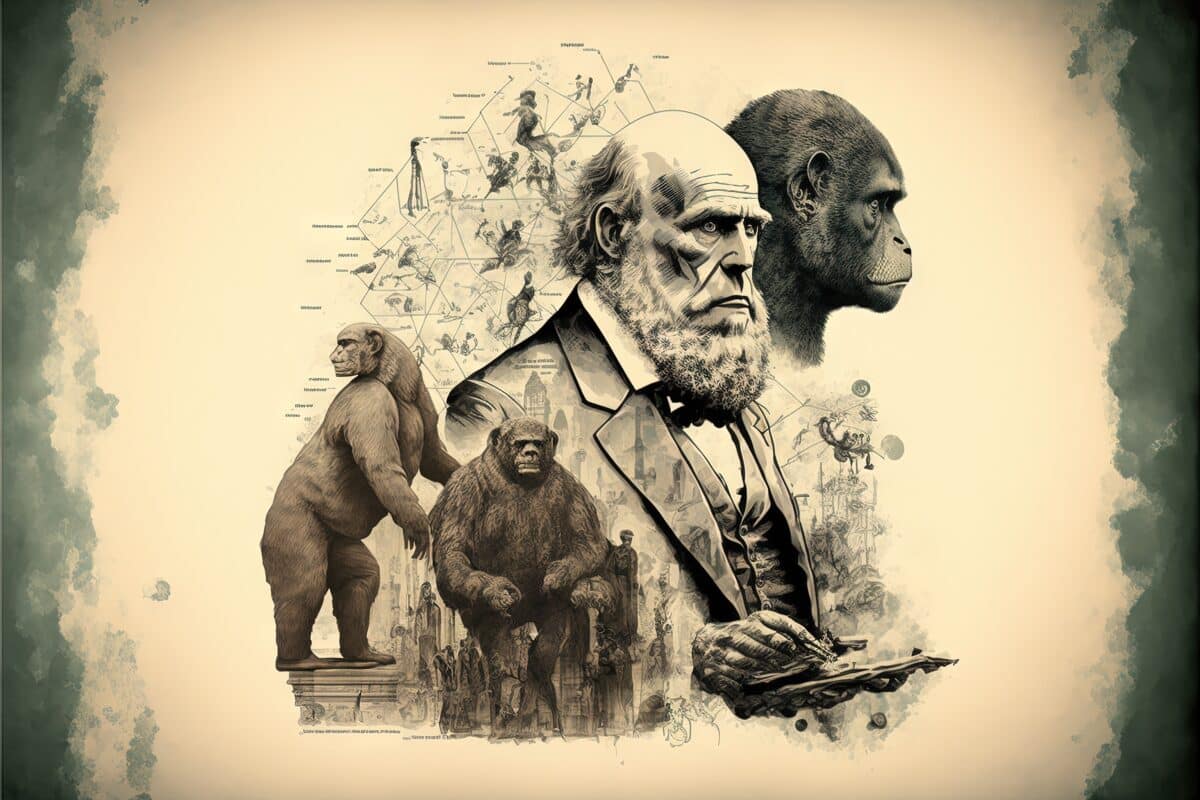
world-darwin-day-representing-the-evolotuion-theory-illustration-generative-ai-stockpack-adobe-stock
World Darwin Day representing the evolotuion theory illustration generative ai
Image Credit: Andrea Izzotti - Adobe Stock

How Not to Defend Darwin on “Survival of the Fittest”

Evolutionary biologists make poor historians, especially when it comes to Charles Darwin. So intent on preserving the reputation of St. Charles, evolutionists typically do their best to paper-over Darwin’s less-than-savory views on issues like race or the application of natural selection to society. British biochemist and theistic evolutionist Denis Alexander runs true to form in a newly posted interview at BioLogos. In the interview, Alexander does his best to disassociate Darwin from the idea of “survival of the fittest,” noting that the phrase was coined by Herbert Spencer rather than Charles Darwin, and that it was then picked up by nasty politicians like Kaiser Wilhelm and Adolf Hitler, who used it to promote their noxious views.

Alexander is correct that Spencer coined the phrase “survival of the fittest,” and that the idea was adopted by the Kaiser and by Hitler. But he neglects to mention one other important figure from history who embraced the term: Charles Darwin himself. As I point out in my book Darwin Day in America, Darwin eventually described “survival of the fittest” as “more accurate” than his own term of “natural selection,” and he employed the phrase repeatedly in the fifth and sixth editions of On the Origin of Species as well as in other works.

Read More ›

Eric Hoffer’s Skepticism About Darwinism

ENV is pleased to welcome guest blogger Tom Bethell, a senior editor of The American Spectator and author of The Politically Incorrect Guide to Science (Regnery) and other books.

Many years ago I interviewed Eric Hoffer (1898-1983), and may have been the last journalist to do so. Widely known as the Longshoreman Philosopher, he was for years a member of the dockers’ union in San Francisco, but his views were not those of your typical stevedore. He had published The True Believer in 1951, and more books after that. Impressed by the breadth of his mind and the unconventional nature of his opinions, I wrote and asked if I could come and interview him. That was in 1980. He invited me to come.

He had written that “when God died in the middle of the 19th century there was immediately set in motion a process which tended to reverse the separation of nature and human nature.” Darwinism, and the intellectual currents of his day, “aimed to reduce human nature to nature.” Biologically, man was now seen as nothing more than “a superior monkey.” Politically, he was an automaton who could be manipulated by a Mao or a Stalin.

Hoffer’s refusal to join the parade of thinkers who accepted that man was little more than a boastful ape was perhaps his finest hour as a philosopher. It showed him at his most independent. And his perception of the unique qualities of man encouraged him to ponder man’s Creator.

Out of the blue, when I arrived in San Francisco, I asked Hoffer whether he believed in evolution. His reply was immediate: “It’s easier to believe in God.”

Read More ›

© Discovery Institute