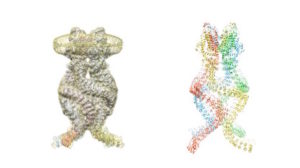
flagellum Type post Author Casey Luskin Date December 8, 2023 CategoriesEvolutionIntelligent Design Tagged , bacterial flagellum, beauty, Brian Miller, co-option, Darwin's Black Box, Darwinian evolution, Emily Reeves, evolution, exaptation, hammer, Howard Berg, intelligent agency, intelligent design, Irreducible Complexity, Michael Behe, mousetrap, natural selection, proteins, Religions (journal), Rope Kojonen, serendipity, Stephen Dilley, The Compatibility of Evolution and Design, The Compatibility of Evolution and Design (series) Want to Harmonize Evolution and Design? Consider the Bacterial Flagellum Casey Luskin December 8, 2023 Evolution, Intelligent Design 11 I hope it’s clear that Kojonen’s effort to harmonize evolution and design (as he envisions it) is not so easy in the case of the bacterial flagellum. Read More ›
flagellum Type post Author William A. Dembski Date June 22, 2022 CategoriesBiologyEvolutionIntelligent DesignTechnology Tagged , bacterial flagellum, BioEssays, Bruce Alberts, Darwinism, David Hume, Dubai, E. coli, evolution, Guide to Reading Jason Rosenhouse (series), Harvard University, Howard Berg, intelligent design, Jason Rosenhouse, magnetotactic bacteria, mountains, nanomachines, National Academy of Sciences, Stone Age From Darwinists, a Shift in Tone on Nanomachines William A. Dembski June 22, 2022 Biology, Evolution, Intelligent Design, Technology 7 The shift in tone from then to now is remarkable. What happened to the awe these systems used to inspire? Read More ›
bacterial flagellum Type post Author David Coppedge Date May 5, 2022 CategoriesBiologyEvolutionIntelligent Design Tagged , bacterial flagellum, Darwinists, E. coli, evolution, gears, Harvard University, Howard Berg, intelligent design, magnetotactic bacteria, microbes, PNAS, Proceedings of the National Academy of Sciences Get a Load of This Souped-Up Hyperdrive Magnetotactic Bacterium David Coppedge May 5, 2022 Biology, Evolution, Intelligent Design 7 "MO-1 is a magnetotactic bacterium capable of orienting its cell body along the geomagnetic field lines by using magnetosomes." Read More ›
molecular springs Type post Date July 14, 2017 CategoriesEvolutionIntelligent Design Tagged , __k-review, bacterial flagellum, Darwin's Black Box, dynein, Howard Berg, intelligent design, Irreducible Complexity, mechanotransduction, Michael Behe, myosin, Research, Scott Minnich Molecular Machines Use Physics to Do Mechanical Work Science and Culture July 14, 2017 Evolution, Intelligent Design 9 Recent findings show cellular machinery using pushes, pulls, and even electrical forces to accomplish physical work. Read More ›