






































Science and Culture Today Discovering Design in Nature
Topic

__k-review

Will Darwinists Make the Same Mistake with RNA that They Made in Ignoring So-Called “Junk” DNA?
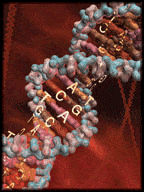
Yesterday the Boston Globe published an amazing and insightful article about DNA and what scientists are learning about the inner-workings of the cell. As it turns out, the more we learn, the more we realize how much more there is to learn.

“The picture that’s emerging” of how living cells actually operate and evolve “is so immensely more complicated than anyone imagined, it’s almost depressing,” Rigoutsos said.

One interesting thing that leapt out at me when reading this was the fact that, while many scientists now realize that it was a mistake to jump to the conclusion that there were massive amounts of “junk” in DNA (because they were trying to fit the research into a Darwinian model), they are on the verge of committing the same exact mistake all over again, this time with RNA.

No one knows what all that extra RNA is doing. It might be regulating genes in absolutely essential ways. Or it may be doing nothing of much importance: genetic busywork serving no real purpose.
Many researchers believe the truth falls somewhere in between.
“Half of it may be doing something very useful,” said Lander, who is also a professor of biology at MIT. “The other part may turn out to be, well, just junk – doing neither great good nor great harm.”

Read More ›

California Literary Review Interviews Michael
Behe on The Edge of Evolution

California Literary Review has a short and insightful interview with Michael Behe about his latest book and among other things asked him what evidence there is of a designer.Behe explains in part: Whenever we perceive a “purposeful arrangement of parts” we suspect design. The more parts there are, and the more clearly they fit the purpose, the more confident our conclusion of design becomes. In the past fifty years science has discovered a very purposeful arrangement of parts in the cell’s molecular machinery. That is the evidence for the involvement of a designer in life on earth. You can read the full interview here.

Op-ed in Waco Paper Highlights Baylor Univeristy Censorship of Intelligent Design Website

The Waco Tribune Herald today published an op-ed, keeping the spotlight on Baylor University’s crusade to stifle research questioning Darwinism or supporting intelligent design.
Aside from the fact that they got both the author and the professor’s name wrong (Mark Ramsey is the author, Robert Marks is the professor), the op-ed continues to showcase the censorship used by the Baylor administration to suppress intelligent design.

Read More ›

Human Origins Update: Harvard Scientist and New York Times Reporter Get the “Plug Evolution Memo”…Sort of

What a difference a month, and a couple likely internal memos, can make. Last month I discussed the fact that newly reported Homo erectus fossils predated fossils of “Homo” habilis, meaning that habilis could not possibly have been an evolutionary link between the Australopithecine apes and our genus Homo. When the press covered that story, Harvard biological anthropologist Daniel Lieberman was quoted in the New York Times stating that those fossils “show ‘just how interesting and complex the human genus was and how poorly we understand the transition from being something much more apelike to something more humanlike.’” It’s a fascinating admission, and I wrote at the time, “Daniel Lieberma[n] apparently did not get the memo about refraining from making Read More ›

Baylor President Stays Mum on University’s Suppression of Intelligent Design

The Baylor student newspaper continues to report on the story of the shut down of distinguished professor Robert Marks’ evolutionary informatics website due to aonymous complaints that it was pro-intelligent design. Baylor president John Lilley refused to speak with Expelled filmmakers about the suppression of intelligent design scientists and scholars. Filmmakers had to settle speaking to a public relations reprsentative and the Dean of Marks’ school. “With both of them it was really limited because they have a certain line they are holding, which the issues are all about procedures and not about the content,” Mathis said, “and all the information we have seen says that that’s not true.”Mathis said the main indication to him about the issue being about Read More ›

The French Reject Prayer while Accepting Evolution and Geocentrism

Earlier this summer, Mike Gene posted on Telic Thoughts a YouTube video where a contestant on a French version of “Who Wants to be a Millionaire?” was asked a question where he had to decide whether it was the Sun, or the Moon that revolved around the Earth. The contestant (see below) wasn’t sure, so he polled the audience for the right answer. After the poll, 56% of the French audience thought the Geocentric model of the Solar System was correct, i.e. they thought the sun revolved around the earth, rather than visa versa. After much deliberation, this French contestant went with the majority vote and decided that the Sun revolves around the earth. What does this say about scientific Read More ›

Expelled Filmmakers Want to Talk to Baylor President About University’s Crackdown on ID Scientists

According to the Baylor student newspaper:

Troubled by the Baylor administration’s removal of an intelligent design Web site from a Baylor server, a producer from the film Expelled: No Intelligence Allowed is planning a Thursday trip to campus in hopes of meeting with President John Lilley.

Distinguished professor Dr. Robert Marks’ personal research Web site on evolutionary informatics was taken down from a Baylor server last month, and producers of Expelled want to speak to Lilley about it.

“We are disturbed with what happened with Dr. Marks,” executive producer Walt Ruloff said. “He was working on some really vital research.”

Read More ›

Intelligent Design Debate Tomorrow at Penn State Altoona

I just found out about a debate tomorrow that will be of interest to any of you in the Penn State area. Dr. Michael Shermer and Dr. Paul NelsonEvolution vs. Intelligent Design – A DebateThursday, September 20, 20077:30 p.m. – Wolf Kuhn Theatre – Misciagna Family Center for Performing ArtsClick here for more details.

Scientific Journals Promoting Evolution alongside Materialism

In July, I noted that Francisco Ayala wrote an article in Proceedings of the National Academy of Sciences describing evolution as “randomness and determinism interlocked in a natural process” where “is no entity or person who is selecting adaptive combinations.” Clearly, some theists might find that such descriptions of evolution contravene their religious beliefs. Indeed, there are a number of recent examples of scientific papers promoting evolution alongside anti-religious sentiments: It seems that none of these scientists got Eugenie Scott’s memo to not promote evolution alongside materialistic philosophy. While I may not agree with what these Darwinists assert, and personally hope that more scientists would take Eugenie Scott’s advice to leave out materialistic philosophy when promoting evolution, it seems that Read More ›

Dr. Shallit Takes the Fifth

On a very important question that goes to the heart of the debate about Darwinism and intelligent design, Dr. Jeffrey Shallit is exercising his right to remain silent. Dr. Shallit had recently used the example of S.E.T.I. research on a blog post in which he ridiculed author and editor Tom Bethell for defending intelligent design. Mr. Bethell pointed out that it’s perfectly appropriate for scientists use the inference to design under certain circumstances, and he believes that biology is one of them. Dr.Shallit ridiculed him, calling him a “blathering buffoon”, a ‘liar’, ‘gullible’, ‘dishonest’, and ”simply stupid’ and categorizing his views as “Idiocy”. I was taken back by Dr. Shallit’s incivility and lack of professionalism- he’s a professor responsible for teaching students appropriate standards of discourse, for goodness sake- and I responded to his post.

I replied that the analogy between the inference to design in S.E.T.I. research and the inference to design in biology was to some extent valid, and asked Dr. Shallit a question:

If the scientific discovery of a ‘blueprint’ [in a signal from space] would justify the design inference, then why is it unreasonable to infer that the genetic code was designed?

It’s a simple enough question, and it gets to the heart of the debate over intelligent design. If the receipt of a coded signal from space – for example a blueprint to build a complex device- would be immediately recognized as designed, why do Darwinists insist that the inference to design in biology isn’t at least a reasonable inference, open to the same kind of scientific investigation to which we would subject a coded ‘blueprint’ signal picked up by a radio telescope?

I have twice asked Dr. Shallit, a leading professor of computer science who studies and teaches information theory, to answer this simple question, which after all, hinges on information theory. These are Dr. Shallit’s replies:

Read More ›

© Discovery Institute