Science and Culture Today Discovering Design in Nature
Topic

__k-review

3 Myths About the Dover Intelligent Design Trial

In 2005 Judge John E. Jones, presiding over the Dover intelligent design trial, ruled that intelligent design is religion, not science, because he felt he was in the best position to “traipse into such a controversial area” and settle the debate over intelligent design once and for all. Tomorrow, PBS will air NOVA’s propaganda piece reenacting some parts of the Dover trial, “Judgment Day: Intelligent Design on Trial.” PBS claims the program will tell the true story behind the Dover trial. But will it? The program features the usual cast of characters: anti-ID activist Eugenie Scott, Darwinist Ken Miller, and apparently Judge Jones himself (currently on his second annual self-congratulatory globe-trotting tour — be sure to catch him on your Read More ›

Was Justice Denied to Foundation for Thought and Ethics during the Dover Intelligent Design Trial?

Was justice denied to Foundation for Thought and Ethics during the Kitzmiller intelligent design trial? Whether or not it was, do you think NOVA will relate this information in their Judgment Day program about the trial next week? Don’t count on it.
Last year attorneys Seth Cooper and Leonard Brown published an article entitled, “A Textbook Case of Judicial Activism: How a Pro-ID Publisher Was Denied its Day in Court,” which describes how the publisher of the textbook Of Pandas and People, Foundation for Thought and Ethics (FTE), was denied the right to become a party to the Kitzmiller trial, despite the fact that its intellectual property rights were implicated in the lawsuit.

Interestingly, FTE had completed manuscripts of a new intelligent design book, The Design of Life, and at that time it was already under review for publication.

Read More ›

NOVA Program on Intelligent Design Biased,
Not by Chance but Because They Designed It That Way

First they dramatized the O.J. Simpson trial. Then they acted out Michael Jackson’s courtroom drama. This time around we have NOVA reenacting parts of the 2005 Dover intelligent design trial presided over by Judge John E. Jones.

As NOVA’s website points out, Paula Apsell, senior producer for NOVA’s propaganda piece on intelligent design, Judgment Day, felt “compelled” to make the docudrama. Journalists are usually only “compelled” to report on events by their editors, or by the newsiness (timeliness, proximity, impact, conflict, etc) of a specific issue/event.

So, why were Apsell and NOVA compelled to make this program?

Read More ›

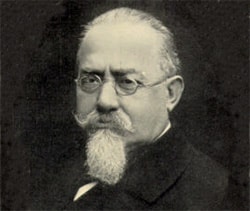
Meet the Materialists, part 4: Cesare Lombroso and the New School of Criminal Anthropology

Note: This is one of a series of posts adapted from my new book, Darwin Day in America. You can find other posts in the series here.

By the end of the nineteenth century, American scholars were already talking with excitement about the “new school of criminal anthropology” that sought to use modern science to identify the causes of crime. Leading the way was Italian criminologist Cesare Lombroso (1835-1909), whose book Criminal Man (1876) remains a landmark work in the field of criminology. Lombroso and his disciples contended that criminal behavior could be explained largely as a throwback to earlier stages of Darwinian evolution.

According to Lombroso, infanticide, parricide, theft, cannibalism, kidnapping, theft and anti-social actions can all be found throughout the animal kingdom, as well as among human savages. In earlier stages of development such behaviors aided survival and were therefore bred into animals by natural selection. As William Noyes, one of Lombroso’s American disciples, explained, “in the process of evolution, crime has been one of the necessary accompaniments of the struggle for existence.” While crime no longer served a necessary survival function in civilized societies, many modern criminals could be considered atavists—reappearances of characteristics from earlier stages of evolutionary development. According to Lombroso, such atavists were “born criminals,” exhibiting from birth the physical as well as behavioral characteristics of savages. Physical markers of such individuals included “abundant hair,” “sparse beard[s],” “enormous frontal sinuses and jaws,” “broad cheekbones,” a “retreating forehead,” and “volumnious ears.”

Read More ›

Rebuttal to Paul Gross’ Review of The Edge of Evolution – Error #3: Ignoring Behe’s Rebuttal of Exaptation Speculation

[This four part series responding to Paul Gross can be seen in: Part 1, Part 2, Part 3, Part 4.] An urban legend has cropped up among Darwinists that Michael Behe ignores indirect routes of evolution, commonly called “exaptation,” when he argues for irreducible complexity. In his review of The Edge of Evolution in The New Criterion, anti-ID biologist Paul Gross wrongly accuses that “Behe had failed to understand ‘exaptation’ (the use of an available part in function ‘B’ despite its original function ‘A’).” But in Darwin’s Black Box, Behe clearly accounts for exaptation and explains why it does not refute irreducible complexity: “Even if a system is irreducibly complex (and thus cannot have been produced directly), however, one can Read More ›

Rebuttal to Paul Gross’ Review of The Edge of Evolution – Error #2: Failing to Stay Positive

[This four part series responding to Paul Gross can be seen in: Part 1, Part 2, Part 3, Part 4.] In Paul Gross’ review of The Edge of Evolution he wrongly claims Behe’s argument for design is merely a negative argument against evolution. Gross asserts that Behe argues for ID by “offer[ing] some claim that Darwinism is wrong, with the (unwarranted) conclusion that life is therefore the work of an intelligent agent.” (emphasis in original) This misrepresents Behe’s argument. Behe does not say that because Darwinian evolution has flaws, therefore intelligent design is proven correct. As Behe writes in the afterward to the new edition of Darwin’s Black Box: [I]rreducibly complex systems such as mousetraps and flagella serve both as Read More ›

Rebuttal to Paul Gross’s Review of Michael Behe’s The Edge of Evolution – Error #1: A Calculation Is not “A Mere Guess”

[This four part series responding to Paul Gross can be seen in: Part 1, Part 2, Part 3, Part 4.] In 2005, Michael Behe published an op-ed in the New York Times entitled “Design for Living. Paul Gross has now reviewed Michael Behe’s book The Edge of Evolution in The New Criterion, using exactly the same title as Behe’s 2005 New York Times op-ed, accusing Behe of making so many mistakes that “it would need a book longer than The Edge to restate the model together with its already noticed (in print and online) errors and omissions.” Yet as I will recount in this four-part response, Dr. Gross’s review has many mistakes, and many of his key criticisms of Behe Read More ›

Meet the Materialists, part 3: Frankenstein, Giovanni Aldini, and the Reanimation of the Dead

Note: This is one of a series of posts adapted from my new book, Darwin Day in America. You can find other posts in the series here.

This week’s installment of “Meet the Materialists” is particularly fitting for the week of Halloween.

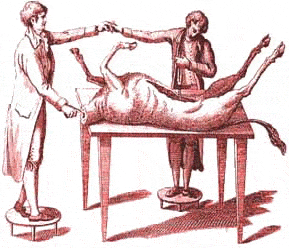
By the turn of the nineteenth century, Italian scientist Giovanni Aldini was performing macabre experiments on decapitated oxes, horses, lambs… and humans. “The unenlightened part of mankind are apt to entertain a prejudice against those… who attempt to perform experiments on dead subjects,” Aldini later acknowledged, but he maintained that such experiments were justified because the object was to improve human welfare. “It is… an incontrovertible fact, that such researches in modern times have proved a source of the most valuable information.”

Determined to understand the workings of what he called “the human animal machine,” Aldini knew that he needed to procure bodies while they were still fresh and “retained… the vital powers in the highest degree of preservation.” His solution? “I was obliged, if I may be allowed the expression, to place myself under the scaffold, near the axe of justice, to receive the yet bleeding bodies of unfortunate criminals, the only subjects proper for my experiments.”

Read More ›

PBS and NOVA Set to Spin Their Wheels in Dramatization of Dover ID Trial

In 2001 an internal PBS memo titled The Evolution Controversy, Use It or Lose It: Evolution Project/WGBH Boston, revealed an improper political agenda behind PBS’s miniseries “Evolution.” The memo made very clear how “Evolution” would be used to influence government officials and marketed to the public in an effort to exercise control over how evolution is taught in public schools.

Here they go again. November 13th, PBS’s NOVA will air Judgment Day, which PBS describes as “recreations based on court transcripts, NOVA presents the arguments by lawyers and expert witnesses in riveting detail and provides an eye-opening crash course on questions such as ‘What is evolution?’ and ‘Does intelligent design qualify as science?'” You can bet there won’t be any leaked memos about how they plan to spin the Dover trial. (We hardly need one having been inundated with misrepresentation after mistreprsentation of the trial’s impact for almost two years now.)

Read More ›

© Discovery Institute