






































Science and Culture Today Discovering Design in Nature
Author

Richard Sternberg

Brain Cancer Chromosomes. Chromosomes prepared from a malignant glioblastoma visualized by spectral karyotyping (SKY) reveal an enormous degree of chromosomal instability -- a hallmark of cancer. Created by Thomas Ried, 2014
Image Credit: National Cancer Institute - Unsplash

Ayala and Falk Miss the Signs in the Genome

In his recent response to Stephen Meyer’s Signature in the Cell, Francisco Ayala claimed that repetitive portions of our DNA called “Alu” sequences are “nonsensical.” Ayala wrote: “Would a function ever be found for these one million nearly identical Alu sequences? It seems most unlikely.” In his response to Ayala, Meyer showed that Ayala is factually wrong about this. According to recent technical papers in genomics, Alu sequences perform multiple functions.

In a rejoinder to Meyer, Darrel Falk defended Ayala and claimed although “a number of functional regions have been discovered within Alu sequences,” there “is no question that many Alu sequences really have no function.”

In my last blog, I showed that the vast majority of the genome is transcribed, either into protein-coding genes or into regulatory RNAs. The technical literature — some of which I cited in that blog — reports that the genome is an RNA-coding machine. Clearly, most DNA really does have function.

In this and subsequent posts, I will provide other sorts of evidence that so-called “junk DNA” is not junk at all, but functional.

We have all seen a variant of the plot in a movie. A strange signal appears–in one film it is a recurrent wireless telegraph code that is transmitted from San Diego after a global nuclear holocaust (On the Beach); in another it is radio transmissions from deep space (Contact); in still another it is crop circles (Signs). As we all know, the first signal turns out to be due to a Coca-Cola bottle: Wind blowing on a window shade next to the bottle results in the latter being occasionally nudged, which sometimes leads to a telegraph key being tapped by the very same. But in the second movie, the signals received turn out to contain a complex set of encrypted data with an intricate mathematical pattern — they are the specifications for building a device that can travel through space-time wormholes, sent from a friendly alien civilization. So also are the crop circles in the third film messages from an extraterrestrial race, except that the designs portend an attack on humanity.

Now, the reason we are drawn in by such stories is obvious: The signals have serious implications for the characters. It could mean the survival of mankind after a thermonuclear war; it could mean that there are other sentient beings in the universe. That is why we would quickly lose interest in the plot if, say, in every scene where a scientist appeared before an important governmental group and said, “The outer space signal contains over sixty thousand, multidimensional pages of complex architectural plans,” she were countered with, “This is exactly the predicted outcome of billions of years of cosmic evolution — you see, random interstellar events lead to just this kind of complex specified information…we are not impressed.” We would want our money back.

My purpose for bringing up this subject is that I have a mysterious genomic signal for you to see — which I will show you tomorrow. We detected it some time ago and it has aroused the interest of some genomicists, but you will find no mention of it books such as Francis Collins’s The Language of God — which is peculiar. But I have another aim in mind, too, for broaching this possible chromosomal code: A key first indicator of functionality is a distinctly non-random pattern. The persistence of a distinct signal in different contexts often suggests functional constraints are operative–that is why genomicists look for them. And since I want to focus on the global functions of such Short Interspersed Nuclear Elements (SINEs) as human Alus and their mouse and rat counterparts, their far-from-random placement cannot be elided. In fact, I will argue that it is a critical part of the genome story that the folks at Biologos aren’t telling you.

To prepare for the mysterious genomic signal, though, I want to draw your attention to this figure:


What you are seeing are the relative densities of Long Interspersed Nuclear Element (LINE) L1s and SINEs along 110,000,000 DNA letters of rat chromosome 10.1 (From Fig. 9d of reference 1.) The x-axis represents the sequence of letters in DNA and the blue line indicates where SINEs occur — what Ayala calls “obnoxious sequences” that are supposedly due to “degenerative biological processes that are not the result of ID.” The red line indicates where LINE sequences occur.

By the way, Francis Collins is a principal author of the Nature paper where these results are published.

Both LINEs and SINEs are types of mobile DNA, namely, retrotransposons, and together they can comprise around half of the mammalian genome. As should be clear from the figure, LINEs tend to peak in abundance where SINEs taper off and vice versa (see the blue boxes). We have known about this pattern since the late 1980s, so it is no surprise to someone who has been following the subject. What should be surprising to anyone, however, is that the same machinery is responsible for the movement of both types of retrotransposon. A complete L1 element encodes the proteins necessary to “reverse transcribe” an RNA copy of itself back into DNA, and to insert the generated duplicate into some chromosomal site. SINEs, by way of contrast, rely on the L1-specified proteins for all their copying and pasting routines.

This compartmentalization of LINEs and SINEs along the mammalian chromosome can also be detected by using molecular probes for L1 or Alu(-like) sequences2:
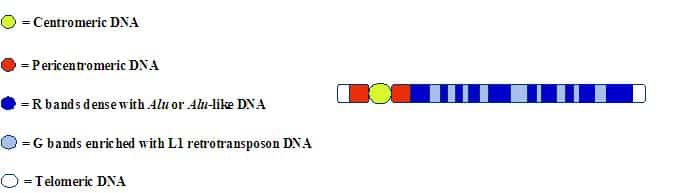
For junkety-junk elements that can make up fifty percent of a mammal’s mostly junkety-junk genome, the rule seems to be: Location, location, location.

Interestingly, this higher-order pattern cannot be detected when small sections of DNA are examined. It only becomes evident when stretches that are millions of nucleotides long are studied.
This banding pattern has been known for decades–but for some reason it is rarely (if ever) discussed by “junk DNA” advocates. The bands on the chromosome arms fall into two general categories:

Read More ›

Asking Darrel Falk to Pick a Number, Any Number

I have long questioned the assumption that most genomic DNA sequences are “nonsensical” or “junk.” And given the data that have emerged over the past seven or so years, a functionalist view of genome has robust empirical support. It is for this reason that I think many of the arguments presented by the Biologos Foundation are “wrong on many counts,” to borrow a phrase from Darrel Falk.

Here is an example. While reading the “critique” of Steve Meyer’s book, Signature in the Cell, by Francisco Ayala, a number struck me that I know to be incorrect. The integer that I am referring to is “25,000” and it is claimed to be the known tally of genes in our chromosomes:

The human genome includes about twenty-five thousand genes and lots of other (mostly short) switch sequences…

Now, the problem with such a statement is this: While there are ~25,000 protein-coding genes in our DNA, the number of RNA-coding genes is predicted to be much higher, >450,000.1 Some of the latter range in length from being quite short–only 20 or so genetic letters–to being millions of letters long. Since 2004 we have learned that over 90% of our DNA is transcribed into RNA sequences at some developmental stage, in different cell and tissue types.2, 3, 4 (Our brain cells are unusually rich in these non-translated RNAs.) These RNAs are then processed into regulatory and structural sequences of all sizes.2, 3, 4

Read More ›

How The Junk DNA Hypothesis Has Changed Since 1980

As someone who has studied the concept of “junk DNA” for over twenty years, I am dismayed by two statements that appear repeatedly on various blog sites discussing evolution. No, I am not referring to arguments of the form “the onion has six times more DNA than do mammals; therefore, there is no deity,” that are invariably followed by terms of disparagement hurled at anyone who even marginally departs from the Darwinian perspective. Rather, my consternation stems from a half-truth and a false fact that are recycled ad nauseum by those who apparently believe that, despite all the genomic and transcriptomic data that have been obtained only in this decade — data that have overturned a number of trenchant assumptions–a certain hypothesis published in 1980 is outside the purview of serious questioning.

The half-truth is the oft-read comment that goes something like this: “No one ever asserted that junk DNA is without function…it was long suspected that these sequences have important roles in the cells.” Now, to be fair, it is correct to say that models for, say, repetitive DNA-based operations in metazoan development, have been proposed since the 1960s.1 It is also true that the evolutionary process of exaptation — the accidental acquisition of a function — has been used to explain how the odd transposon here or there along a chromosome can regulate a locus. Nonspecific effects of “extra” DNA on the cell have also been suggested for around three decades, if not longer. That said, the junk DNA hypothesis that one commonly reads as being an unassailable observation, as an incontrovertible empirical conclusion, presents as a clear prediction that the vast majority of non-gene sequences are devoid of any precise specificational role in ontogeny. Allow me to explain.

Read More ›
chromosome-structure-with-glowing-telomere-ends-in-scientifi-1464111025-stockpack-adobestock
Chromosome structure with glowing telomere ends in scientific 3D illustration, showing genetic material and cellular biology in dark blue background
Image Credit: INT888 - Adobe Stock

Guy Walks Into a Bar and Thinks He’s a Chimpanzee: The Unbearable Lightness of Chimp-Human Genome Similarity

I am often struck by how the topic of evolution in general, and chimp/human ancestry in particular, can be an immediate conversation opener that just as quickly becomes a conversation closer. Read More ›

Shoddy Engineering or Intelligent Design? Case of the Mouse’s Eye

We often hear from Darwinians that the biological world is replete with examples of shoddy engineering, or, as they prefer to put it, bad design. One such case of really poor construction is the inverted retina of the vertebrate eye. As we all know, the retina of our eyes is configured all wrong because the cells that gather photons, the rod photoreceptors, are behind two other tissue layers. Light first strikes the ganglion cells and then passes by or through the bipolar cells before reaching the rod photoreceptors. Surely, a child could have arranged the system better — so they tell us.

The problem with this story of supposed unintelligent design is that it is long on anthropomorphisms and short on evidence. Consider nocturnal mammals. Night vision for, say, a mouse is no small feat. Light intensities during night can be a million times less than those of the day, so the rod cells must be optimized — yes, optimized — to capture even the few stray photons that strike them. Given the backwards organization of the mouse’s retina, how is this scavenging of light accomplished? Part of the solution is that the ganglion and bipolar cell layers are thinner in mammals that are nocturnal. But other optimizations must also occur. Enter the cell nucleus and “junk” DNA.

Only around 1.5 percent of mammalian DNA encodes proteins. Since it has become lore to equate protein-coding regions of the genome with “genes” and “information,” the remaining approximately 98.5 percent of DNA has been dismissed as junk. Yet, for what is purported to be mere genetic gibberish, it is strikingly ordered along the length of the chromosome. Like the barcodes on consumer items that we are all familiar with, each chromosome has a particular banding pattern. This pattern reflects how different types of DNA sequences are linearly distributed. The “core” of a mammalian chromosome, the centromere, and the genomic segments that frame it largely consist of long tracks of species-specific repetitive elements — these areas give rise to “C-bands” after a chemical stain has been applied. Then, alternating along the chromosome arms are two other kinds of bands that appear after different staining procedures. One called “R-bands” is rich in protein-coding genes and a particular class of retrotransposon called SINEs (for Short Interspersed Nuclear Elements). SINE sequence families are restricted to certain taxonomic groups. The other is termed “G-bands” and it has a high concentration of another class of retrotransposon called LINEs (for Long Interspersed Nuclear Elements), that can also be used to distinguish between species. Finally, the ends of the chromosome, telomeres, are comprised of a completely different set of repetitive DNA sequences.

Read More ›

When “Junk DNA” Isn’t Junk: Farewell to a Darwinist Standard Response

In the Darwinist repertoire, a standard response to evidence of design in the genome is to point to the existence of “junk DNA.” What is it doing there, if purposeful design really is detectable in the history of life’s development? Of course this assumes that the “junk” really is junk. That assumption has been cast increasingly into doubt. New research just out in the journal Nature Genetics finds evidence that genetic elements previously thought of as rubbish are anything but that. The research describes tiny strands of RNA, previously thought to be junk, that now turn out to play a role in gene expression. Another finding by Dr. Geoff Faulkner shows that “retrotransposons,” a further variety of “junk” as the dogma previously taught, play a similar role.

Nearly half of the mammalian genome (less than 45 percent) is comprised of DNA sequences thought for decades to be but evolutionary flotsam and jetsam or junk: retrotransposons. Found along every one of our chromosomes, retrotransposons mobilize within our cells via RNA copies, copies that are then converted into DNA and afterward pasted into different DNA sites. To be sure, the vast majority of these “jumping gene” duplicates, well over a million elements, appear to be little more than pseudogenes, defective images of master templates that merely drift by mutations into a phylogenetic oblivion.

Retrotransposons appear to fit the neo-Darwinian story perfectly. First, the master templates of these elements seem to serve no other purpose than to promote their own replication at the expense of the cell, and so, by the criteria of Richard Dawkins’s 1976 book The Selfish Gene, retrotransposons are selfish genes par excellence. Second, the DNA progeny of such “endogenous viruses” are without a doubt marred in various ways, as just mentioned. Relative to the original, in other words, they are junk. Third, a retrotransposon inserted into a chromosome can disrupt normal gene functions, and mutations due to these sequences have long been detected. Fourth, only a comparative few retrotransposons are conserved across different groups of mammals, with most of the DNA families being restricted to certain families, genera, or even species. Humans and mice as well as mice and rats can readily be separated solely on the basis of their retrotransposon profiles. So the bulk of these sequences do not merit being retained by natural selection.

Read More ›

© Discovery Institute