






































Editor’s note: We are delighted to welcome Dr. Douglas Groothuis as a new contributor to Science and Culture Today.
Walter Isaacson is a best-selling biographer who has written about the lives of Albert Einstein, Steve Jobs, Elon Musk, Leonardo da Vinci, and others. Yet he is far from an accurate and fair historian about what he calls, in the title of his new book, The Greatest Sentence Ever Written. The student of American history, and specifically of the Declaration of Independence, is far better served by John West’s well-documented, carefully reasoned, and timely book, Endowed by Our Creator: The Bible, Science, and the Battle for America’s Soul.
The title of Isaacson’s tiny book, only 76 pages in length, makes a titanic claim. Given the upcoming 250th anniversary of America’s Founding, against the backdrop of our unrest as a nation, some reflection on the philosophy behind America is appropriate, even urgently needed. He presents the revered sentence in poetic form:
We hold these truths to be self-evident
that all men are created equal,
that they are endowed by their Creator with certain unalienable Rights,
that among them are Life, Liberty and the Pursuit of Happiness
If we exclude statements from the Bible, Issacson is on to something. No previous national document had made such a bold and clear claim, nor has any other nation labored so hard to live up to its founding vision. But to make that argument he needs to explain adequately the meaning and background of this world-historical declaration. He attempts to laud what he considers the greatest sentence of all time, and his intent is noble. Yet, the result falls short.
To Secularize the Founding
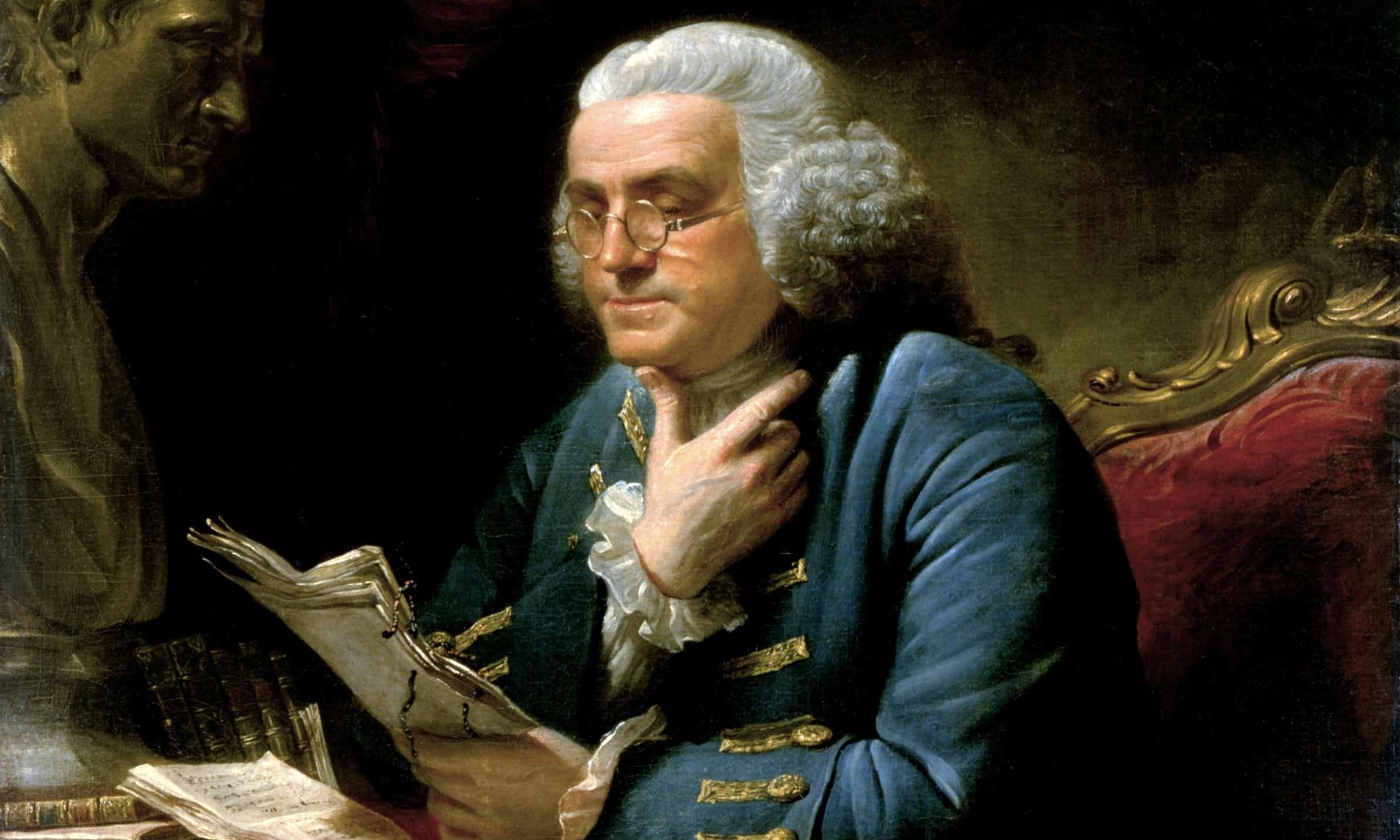
Although this statement is often attributed to Thomas Jefferson, in Issacson’s rendering the hero is more properly Benjamin Franklin. That is because it was he who supposedly changed the wording of Jefferson’s first draft from “We hold these truths to be sacred and undeniable,” to “We hold these truths to be self-evident.” The claim is historically debatable, but Issacson employs it to render the sentence more secular than it actually is. Removing the word “sacred” hardly lightens the theological load, since it is followed by “created equal” (God creates and what he creates is sacred) and by “unalienable rights” endowed by the “Creator.” Religion is everywhere here. Isaacson has to admit this, but his burden is to secularize the Declaration and the Founding in general. After mentioning Franklin’s change, Isaacson writes, “The declaration they were writing was intended to herald a new type of nation, one in which our rights are based on reason, not the dictates or dogma of religion” (1). We need to analyze this flippant statement.
Isaacson is right that America became a nation without a state church and did not compel religious involvement. This was marvelously clarified in the First Amendment in 1791. Nevertheless, Isaacson wrongly assumes that religion cannot provide a reasonable basis for human rights. This begs the question and is a false dichotomy. The basis for rights, he asserts, must be religion or reason. It cannot be religion supported by reason. I disagree.
Not every religion, given its worldview, can provide a basis for universal human rights. Neither Islam (which affords infidels few rights) nor Hinduism (with its hierarchical caste system) can do so. Buddhism likewise fails to grant humans any sanctity, since the self is taken to be an illusion.
Religion Backed by Reason
Isaacson to the contrary, there is religion backed by reason, as the great tradition of Christian philosophy affirms through the writings of stellar thinkers such as St. Augustine, Thomas Aquinas, Blaise Pascal, and C. S. Lewis, attested as well by the rise of Christian philosophy in the past fifty years in America. But Isaacson prejudices the case against religion by using the derogatory word “dogma,” which is associated with unreasonable insistence on a position without evidence or argument.
The Judeo-Christian tradition teaches in Genesis 1 that men and women are made in the image and likeness of God and that God pronounced his creation of them and the rest of nature as “very good.” The Declaration does not quote the Bible or speak of “the image of God,” but the Judeo-Christian worldview lies behind this great statement, and mere reason would be powerless to provide a supporting worldview. Even the Deists and Unitarians of the day were partially dependent on a more theologically robust Christian theism for their basic beliefs. Certainly, no naturalistic account of human life, rooted in Darwin’s purposeless evolution, has reason to account humans as special in nature or as bearing unique and incomparable rights.
The Meaning of Happiness
Isaacson’s secular approach is further evident when he discusses the phrase, “the pursuit of happiness,” which he claims means, “It is your right — and your opportunity — to seek fulfillment, meaning, and well being however you personally see fit” (26). But Jefferson, although not a Christian, was neither a hedonist nor a relativist. If we are endowed with unalienable rights by our Creator, as he wrote, then we have no right to pursue pleasure at the expense of others’ rights, or at the expense of our duties, or at the expense of virtue. “Happiness” in the Declaration means a life of virtue lived well with others. Moreover, all the Founders believed that the freedoms of a new nation were dependent on personal virtues best supported by strong religious faith. Of this, Issacson says nothing. On this, recent books by Os Guinness are illuminating, such as Last Call for Liberty and A Free People’s Suicide.
Isaacson concludes the book with several short appendices, including Jefferson’s first draft of the Declaration, the final draft, and an extract from John Locke’s Second Treatise on Government. These are apt. But he also includes a short section from Jean-Jacques Rousseau’s The Social Contract (50-51), which begins with the famous line, “Man is born free and everywhere he is in chains” and makes a reference to “the general will” as normative for a social contract. While Rousseau is part of the social contract theory that influenced the Founders, his account of human nature as basically good and only corrupted by society is utterly alien to their thinking.
It is the French Revolution (1789) — with its anti-Christian animus, its authoritarianism, its utopianism, and its mass executions by guillotine — that owes its philosophy largely to Rousseau’s philosophy of the perfectibility of man and his rejection of God-given and unalienable rights. The American Revolution and the French Revolution are absolute antipodes. As Walter Isaacson does not fully convey, the American Revolution was made of better stock, far better.