






































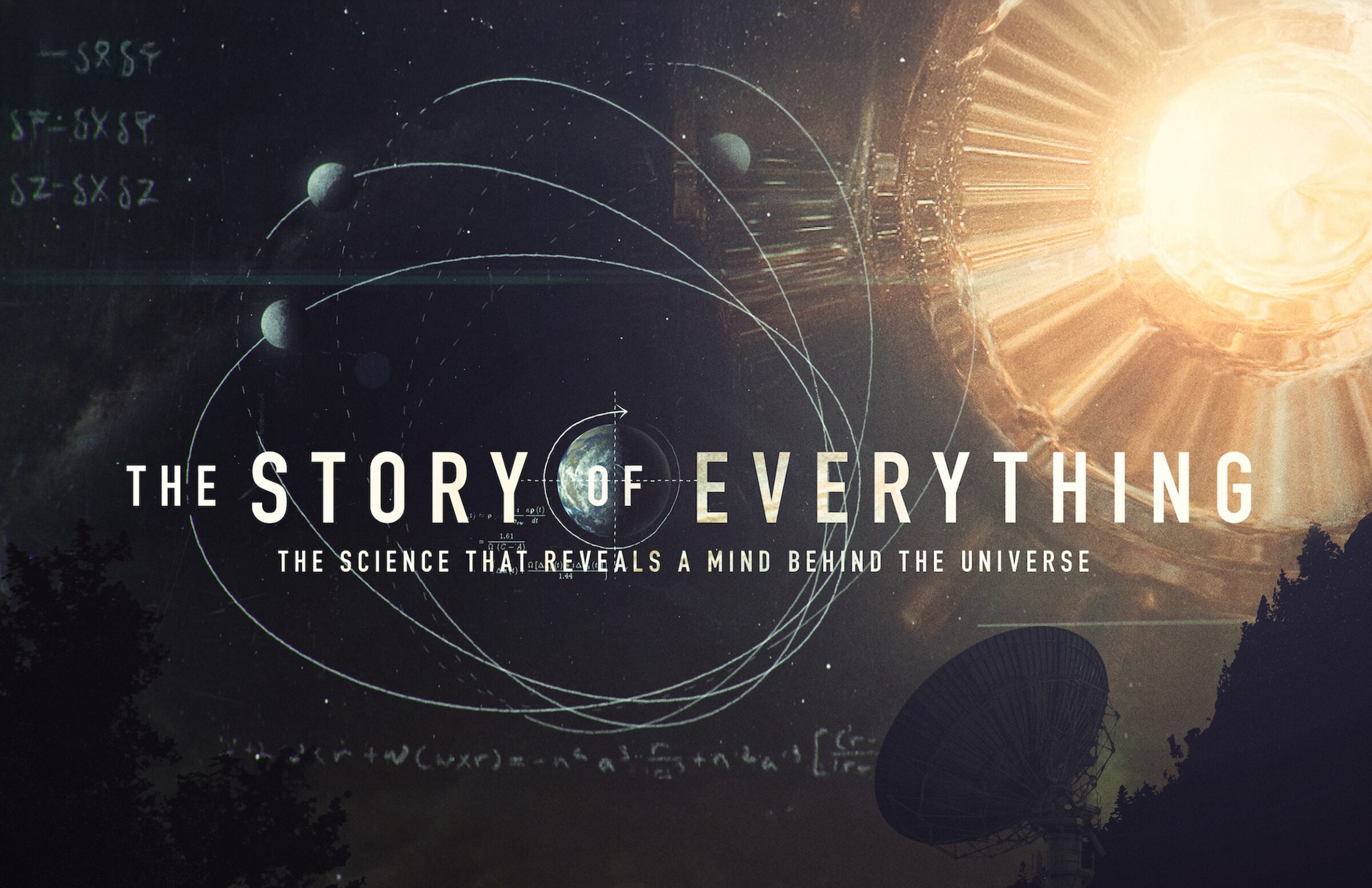
It was a bestselling book. Now it’s a theatrical film, in theaters nationally from April 30 to May 6. The Story of Everything is the exciting film adaptation of Return of the God Hypothesis, by philosopher of science Stephen Meyer. It features a diverse range of scientists, some familiar to those who follow the work of the Center for Science and Culture, but others very much not.
Released in 2021 the book immediately made waves in scientific circles, was endorsed by a Nobel laureate, garnered media attention from Joe Rogan, Ben Shapiro, Piers Morgan, Jordan Peterson, and more. And now it is the basis for a beautifully produced film, directed by Eric Esau, that explores some of life’s biggest and toughest questions, bringing those to an entirely new audience.
The film from Fathom Entertainment, like the book, deals with claims that belief in religion is at odds with “the science” of today. Has science explained away all evidence of design in life? Can you believe in God and science at the same time? Do our lives have meaning and purpose or were they just happy accidents?
We’ve All Heard the Usual Materialist Story
The narrative goes like this: The universe came from nothing; life came from the chemical soup; mind came from matter. Science has shown that belief in God is now obsolete. But there’s another story. A more truthful story. One based on the evidence and recent scientific discoveries that reveal the intelligent design of life. The real story. It’s The Story of Everything.
The Story of Everything reopens the question of ultimate meaning. It examines the impact of the materialist worldview which holds that life arose by a completely undirected evolutionary process. It also examines the view of life that posits an intelligent designer behind the universe. If true, that view has profound consequences for whether our lives have any meaning or significance.
So, What Is the Theory of Intelligent Design?
The theory of intelligent design, or ID, holds that certain features of the universe and of living things are best explained by an intelligent cause, not an undirected process such as natural selection. It is an effort to empirically detect whether the “apparent design” in nature acknowledged by virtually all biologists is genuine design, the product of an intelligent cause.
The idea that nature supplies evidence of intelligent design has deep roots in philosophy, theology, and science. The idea was expressed by many Greek, Roman, Jewish, Christian, and Moslem thinkers. It was advocated as well by leading scientists during the scientific revolution. Today a growing number of scientists are returning to the idea that there is evidence of design in nature based on recent discoveries in cosmology, biology, and chemistry.
Intelligent design should not be conflated with what is typically defined as creationism. Intelligent design limits itself to what can be known from the observation of nature. It does not try to interpret the Bible or base its findings on the biblical text.
Find the film’s website here. For more detailed information about intelligent design, what it is and what it isn’t, you can go through the FAQs posted at IntelligentDesign.org.