






































Editor’s note: We are delighted to offer this excerpt from Chapter 2 of Winston Ewert’s new book, The Heavens, the Waters, and the Partridge: The Historical Interaction of Faith and Science Before Modern Science. Dr. Ewert is a Center for Science and Culture Senior Fellow, a software engineer, and an intelligent design research scientist.
Are the heavens — what we moderns call “outer space” — made of the same “stuff” as the earth? Today, we take it for granted that the rest of the universe is made up of atoms and molecules of a nature identical to those found on earth. The laws of physics apply equally well in other galaxies as they do here on earth. Fundamentally, the whole physical universe is made of the same stuff and follows the same rules.
However, the classical world did not take this for granted. They widely agreed that everything on earth was made up of four elements: earth, water, air, and fire, and that the properties of any earthly thing could be explained by the combination of elements that comprised it. However, Aristotle proposed that the heavens were not made of these four elements but of a fifth element known as aithēr, or aether. Aether is not to be confused with the ethers, a class of chemical compounds. Aether had unique properties, which explained the unique nature of the heavens. In particular, aether had the property of immutability; it did not change.
Very Strange to Us
The idea of postulating that the heavens were made of a distinct element seems very strange to us. However, it is not so different from when modern cosmologists postulate the existence of dark energy or dark matter. These modern theories postulate entities to account for differences between what we would expect from our understanding of physics and our observations of distant space. Likewise, there were a number of ways in which the movement of the heavens differed from observed movements on earth, leading to the postulation of a unique element.
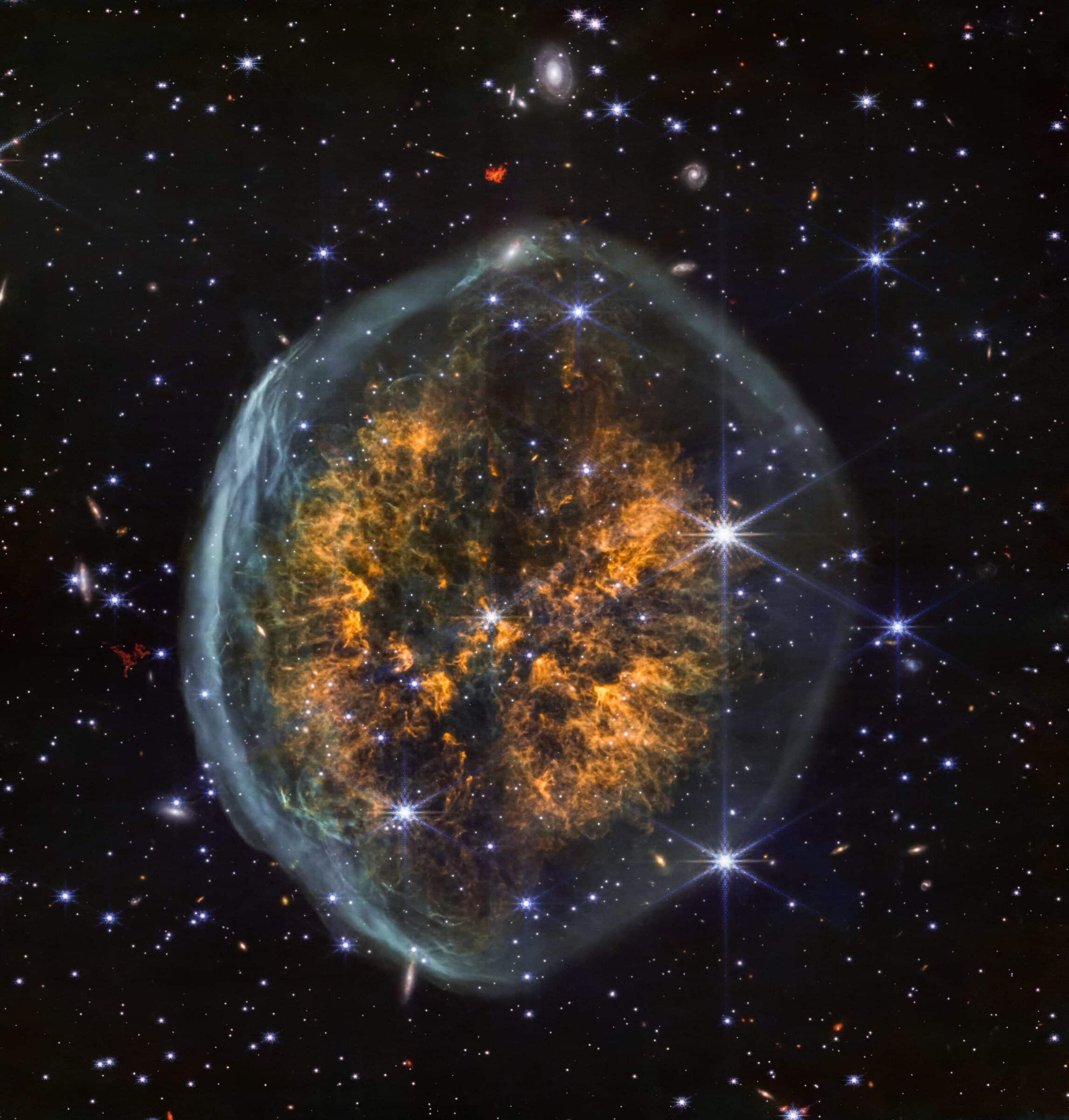
 Image source: Inkwell Press.
A dropped rock will fall to the ground, but stars do not fall from the heavens. According to classical science, this is because a rock is mostly made up of heavy elements. Smoke, on the other hand, rises because it is mostly made of light elements. But stars do neither of these things. They do not fall to the ground like rocks or float away like smoke. They remain an unchanging distance from the earth.
However, the stars do move. In the course of a night, they will all complete a rotation around the north pole. But the movement is circular. Unlike linear movement, circular movement is not necessarily finite. Since a circle feeds into itself, circular movement can continue indefinitely. Thus, stars move in a way that could, in principle, continue forever.
A Constant Pace
Furthermore, this circular movement keeps a constant pace. The stars are neither speeding up nor slowing down. If the stars were slowing down, it would seem they would eventually stop. If they were speeding up, there must eventually be some limit to that speed. Instead, the stars move at an unchanging speed.
Additionally, there are never any new stars. Nor do any stars disappear. Some stars are visible at different times of the year, but the same stars always return. In fact, the same stars have been in the sky as long as people have been watching them. The population of the stars remains unchanging.
The unifying feature of the heavens was their lack of change. The stars did not either fall to the earth or rise. They moved in an unchanging circular motion at an unchanging speed. The population of the stars remained constant, never changing. While things on earth were always in flux and subject to change, the heavens were the realm of immutability.
The Classical Conception
In the classical conception, most objects were made up of some combination of the four elements. A rock, for example, would primarily consist of earth, a heavy element. However, it would also contain some of the other elements. But these different elements had different tendencies in terms of how they moved. If the heavens were made up of a combination of elements with such different tendencies, they could not be stable and would eventually break apart.
These considerations are what prompted Aristotle to postulate that the heavens were not made of the ordinary elements found on earth but instead of their own unique element, aether. Aether, rather than naturally falling towards the center of the universe (the earth), naturally moved in a circle around it. Furthermore, it could not be created, destroyed, damaged, or changed in any way. It was immutable. This unique element explained why the heavens were so different from the earth.
This theory had an important implication. If aether cannot be created or destroyed, this implies that the heavens are eternal. According to Aristotle, the heavens had existed into an eternal past and would exist into an eternal future. They were not brought into existence either by natural forces or an act of divine fiat. Neither would they grow old or eventually cease to exist.
The Biblical Discussion
There are three major issues of potential conflict between the Bible and the heavens being made of immutable aether: the creation, destruction, and decay of the heavens. Aether was postulated to be uncreateable, indestructible, and not subject to decay. On the other hand, the Bible appears to speak of the creation, destruction, and decay of the heavens.
Read the rest in Dr. Ewert’s new book, The Heavens, the Waters, and the Partridge: The Historical Interaction of Faith and Science Before Modern Science. Listen to “Science Before the Scientific Revolution: What Can We Learn from It?” on ID the Future.