






































Over the years I have featured research projects that exemplify “ID in Action” to show that intelligent design is no stranger to science. Examples have included archaeology, cryptology, forensic science, and optimization. Among them, biomimetics — the imitation of nature’s designs — ranks among the strongest examples. But what about “geomimetics”? This term I just coined means “the imitation of geophysical processes.” But since geology and geophysics involve mindless natural phenomena, with no DNA or cells, can anyone reasonably argue that geomimetics is a form of ID science in action? Well, yes and no. To unpack the concept, let’s take a look at new research from Virginia Tech.
Location: Death Valley, California
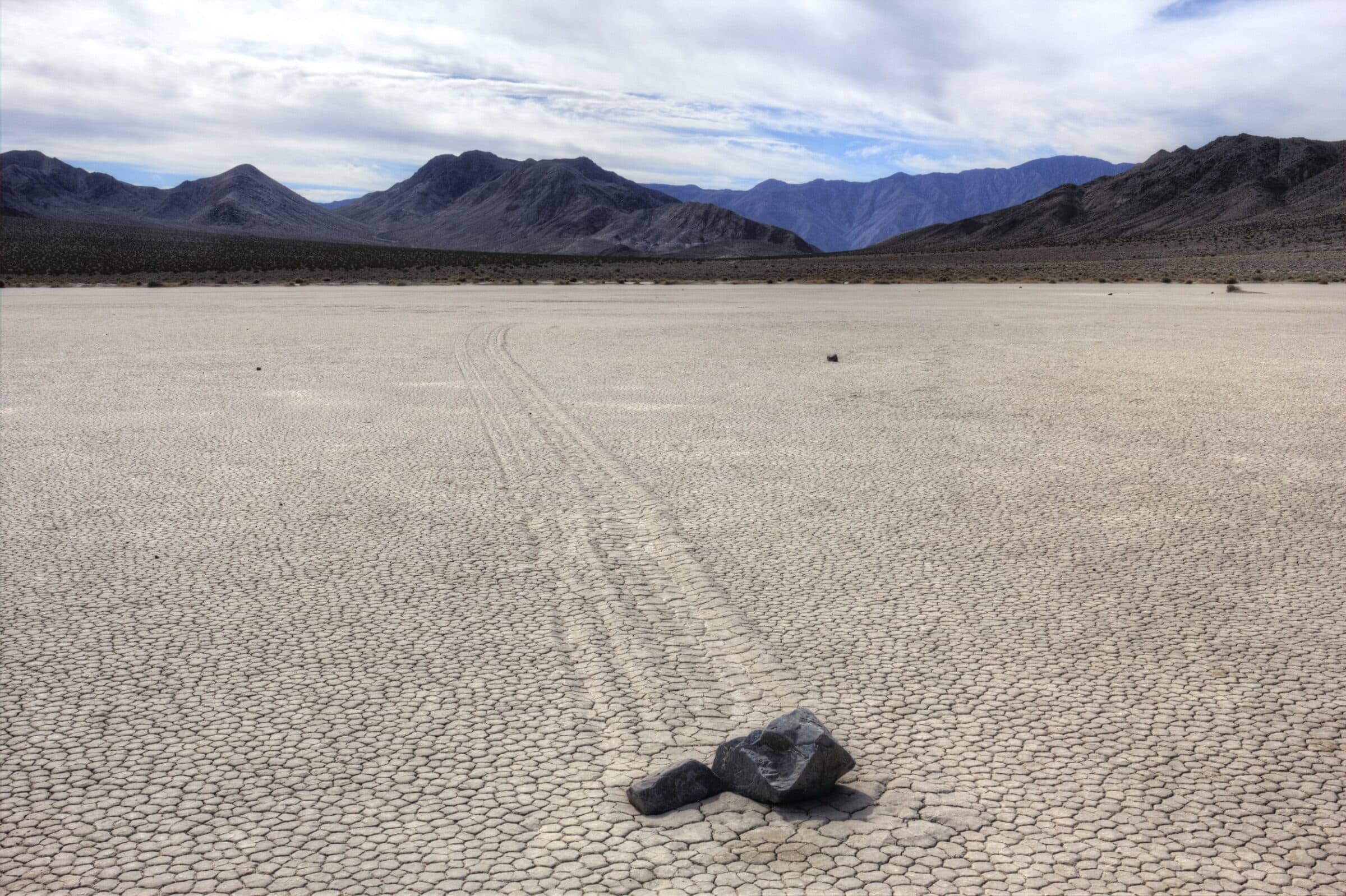
Normally considered one of the hottest and driest places on earth, Death Valley can have cold winters and some infrequent rain. Sometimes this low desert can turn into a near arctic experience if scarce rains and freezing winds combine. One particular spot is home to one of the weirdest phenomena in geophysics: the “sailing stones” of Racetrack Valley. What happens there is so bizarre, it had been unexplained for decades. How do rocks as big as watermelons, some weighing hundreds of pounds, move up to a quarter mile across a dry lakebed, carving tracks in their wake? Because nobody was there to watch it happen, some people were ready to attribute the movement to space aliens or a new-age vortex.
I’ve visited Racetrack Valley twice, once in 1988, and a second time in fall 2014. The long rocky road to reach it helps explain why comparatively few visitors make the effort to get there. On my second trip with a 4WD club in springtime, I got some good photos of the rocks and their tracks. Explorers can find tracks that bend and curve, their lead rocks sitting silently at the end of the tracks indicating that something very strange happened.
In the winter of 2013-2014, a scientific team was lucky to be present when conditions were right. They recorded timelapse videos of the rocks moving very slowly in windy conditions. Briefly, what happens is that one end of the playa can form a shallow pond after rain (they estimate this happens about once a decade). If the temperature drops, the surface can freeze over. As the ice breaks up, ice sheets cling to rocks that had previously tumbled down onto the playa from nearby hills. Wind moves the ice rafts with their embedded stones, which carve tracks in the softened but impermeable mud. Richard Norris, who was part of the eyewitness team, explains this in a video on the Smithsonian Magazine website. The tracks, therefore, have a natural explanation, albeit due to an infrequent convergence of rare conditions.
Understanding Nature to Imitate It
Enter Jack Tapocik, a PhD student at Virginia Tech working in Associate Professor Jonathan Boreyko’s “Nature-Inspired Fluids and Interfaces Lab.” He was “Inspired by the Racetrack Playa in Death Valley” in a way similar to those who work in biomimetics. His subject matter was abiotic but his motivation was the same as those who study gecko toes or elephant trunks: wanting to understand nature to imitate it. And like in biomimetics, it yielded a potential breakthrough for technology. The research team “built a metal surface for the fastest ice on earth — and it could be a future energy solution.” A photo shows how Tapocik
watched a disc-shaped chunk of ice resting on an engineered metal surface. As the ice melted, the water formed a puddle beneath.
Even after many seconds of melting, the ice disk remained adhered to the engineered surface. At first, Tapocik was tempted to conclude that nothing would happen, but he waited. His patience paid off. After a minute, the ice slingshot across the metal plate he designed, gliding along as if it was propelled supernaturally. [Emphasis added.]
It wasn’t space aliens, of course. The researchers explained the physics involved. From their work came a scientific paper in ACS Applied Materials & Interfaces.
While Norris solved a mystery of the rocks, Boreyko’s team was seeking something new: Its members wanted to create a surface that would propel melting ice all by itself, without any wind required. They wanted to harness the science of the racing rocks.
A short video shows how the ice breaks free from the metal surface and moves self-propelled across the plate. Their best model surface contains a herringbone pattern that channels meltwater to flow in one direction, carrying the ice along with it. A different pattern, they figure, could cause the disk to rotate instead. Embedded magnets on the disk could then harvest the energy of rotation for generating power, at least in theory.
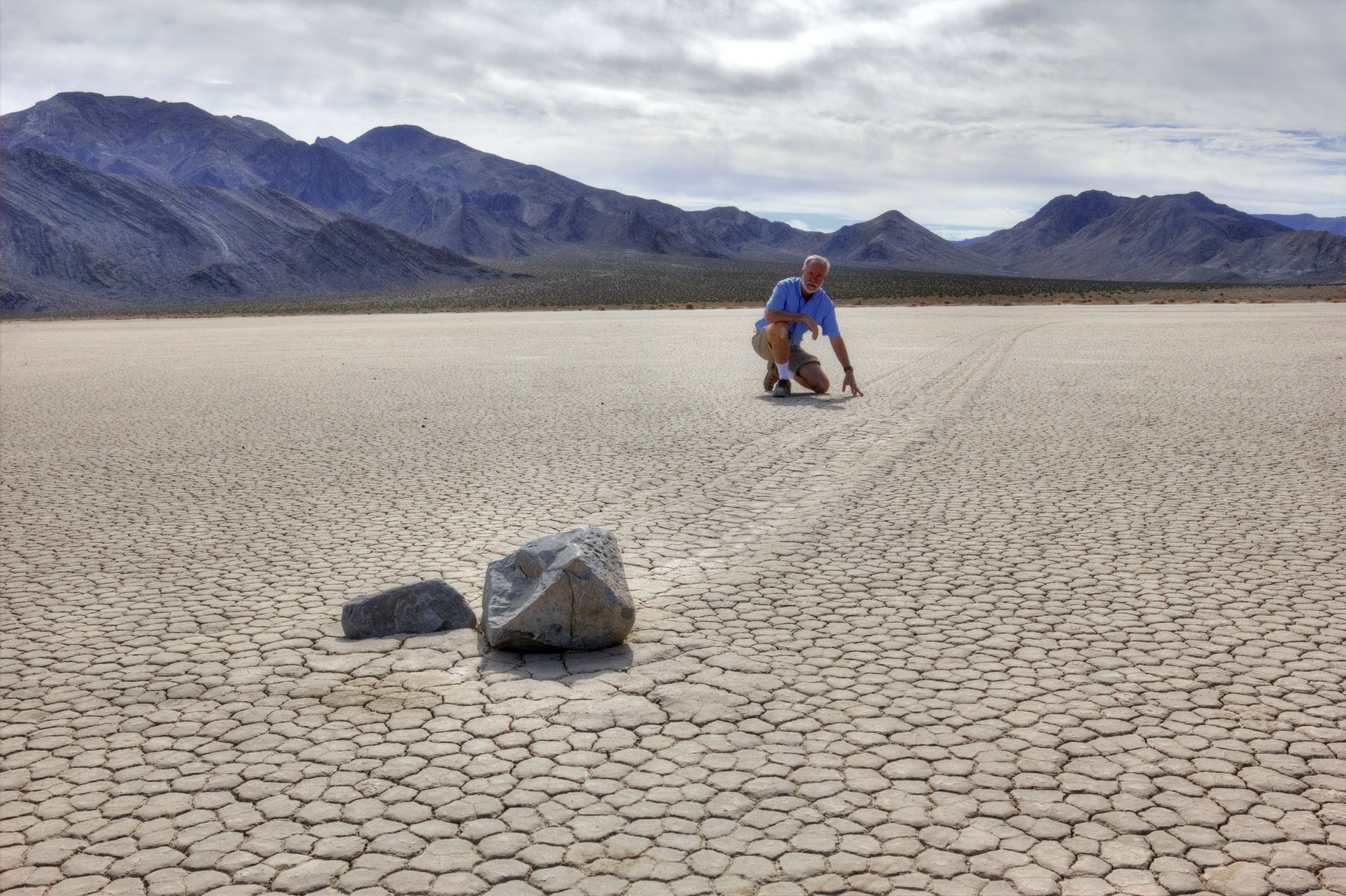 Photo credit: David Coppedge.
Contrast with Biomimetics
So can we add what I term “geomimetics” to the list of ID sciences in action? Like the headline says, “Well, yes and no.” Whether one example suffices to judge an answer, this case seems deficient. There is no code, no DNA, no functional information. It would be a stretch, furthermore, to call the conditions involved in Death Valley’s “sailing stones” an example of irreducible complexity. Watching ice melt and move across a metal plate lacks the elegance of molecular motors or the wing lift mechanism of seagulls.
Abiotic physical processes seem impoverished compared to the rich inspirational potential found in living things (spider webs, butterfly colors, ant navigation, barnacle waterproof glue, mantis shrimp hammers, and so much more). At best, geomimetics (which could be extended to include all abiotic physical processes), speaks to the fine-tuning of the laws of physics that permit such phenomena. Any intelligent design in this arena is found primarily in the minds of the researchers and their abilities to observe and think.
That being noted, there are plenty of abiotic natural phenomena that are highly interesting, challenging to explain, and worthy of investigation — even imitation. Here are a few to get the gears turning.
- Lightning: Did the power of electrostatic discharges inspire Benjamin Franklin and Nikola Tesla?
- Nuclear fission: The Oklo reactor was discovered after the Manhattan Project, but could it have inspired controlled nuclear power?
- Magnetism: This surprising phenomenon first identified in lodestone, needless to say, has produced a plethora of technical applications.
- Rainbows: Isaac Newton’s prism experiment has inspired numerous technologies in optics.
- Snowflakes: The beauty of these hexagonal crystals has inspired jewelers, but is there a technology to consider?
- Volcanoes: Identification of conditions for mineralization in volcanic products like basalt, obsidian, and rhyolite inspire advances in soil productivity or materials science.
- Dew: Death Valley was recently a site for advances in water collection from air.
- Geysers: Could the study of geysers lead to applications in hydrodynamics?
- Blowholes: Could blowholes inspire methods for coastal energy production?
- Cave formations: Could the slow accumulation of deposits from mineral-saturated water lead to improvements in lab equipment or crystallography?
Except in the general sense of being consequences of finely tuned natural laws, none of these abiotic phenomena pass the Design Filter and so can be considered “natural” phenomena. The question for discussion here is whether they have power to inspire science and technology. What does pass the Design Filter is the human brain. In that broadest of senses, therefore, all human scientific activity can be considered ID in Action.