






































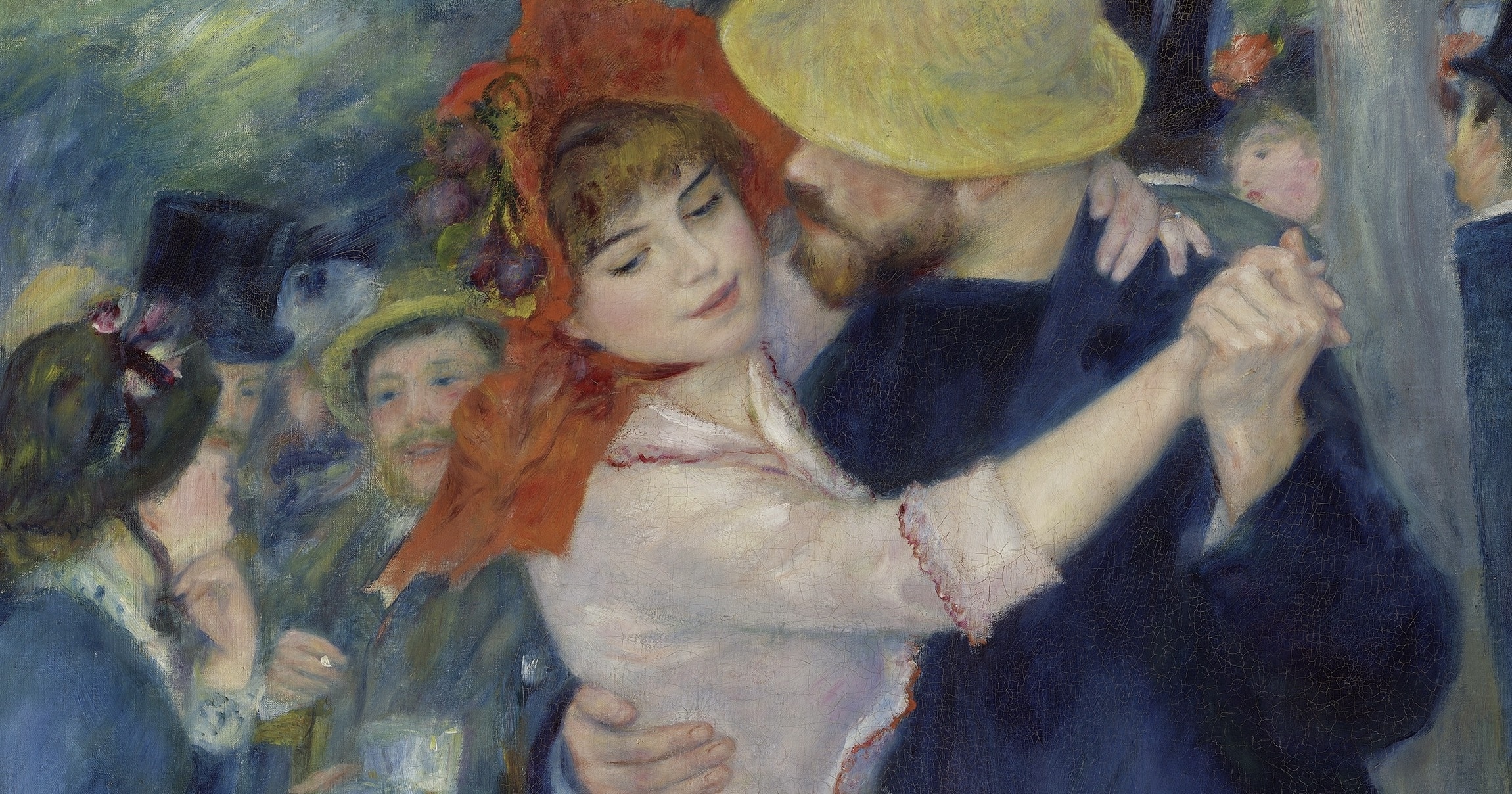
Having spent many of the happiest hours of my life dancing, I thought I’d check out “what the science has to say” about my favorite pursuit. Lo and behold, “science” says that dancing develops general health, connects people socially, and assists in natural selection. Of these three benefits, most dancers could have told you the first two (and a dozen more). As for natural selection, I have my doubts.
Dance Is Remarkably Healthful
There are endless ways in which dance improves your health, and several sources say it is as effective as any other kind of exercise. Glowing reviews of its physical and psychological effects include cardiovascular improvement, muscle toning, increased coordination and balance, expanded flexibility, enhanced cognition, and emotional therapy. Of particular interest is research showing how dance assists people struggling with autism, Parkinson’s, or other constraints. And perhaps you’ve seen “dance movement therapy,” or DMT, on the rise to help people with both bodily and mental health.
In the journal Neuroscience & Biobehavioral Reviews, “Dance for neuroplasticity” sums up:
Structural changes [to the brain] included increased hippocampal volume, gray matter volume in the left precentral and parahippocampal gyrus, and white matter integrity. Functional changes included alterations in cognitive function such as significant improvement in memory, attention, body balance, psychosocial parameters and altered peripheral neurotrophic factor. Based on the evidence, dance practice integrates brain areas to improve neuroplasticity.
Apparently, dancing positively affects a range of brain areas to improve plasticity.
From my own experience, I can attest at least to the internally and externally coordinating effect of dancing. I’ve watched uncoordinated young men turn into gracious leads, well-connected to the ground and to their partner, able to execute a host of moves and communicate unspoken cues to a variety of follows. It’s a beautiful thing to dance with someone unskilled only to find out a year or two later that he’s performed in dance routines or joined leadership for a dance group. (I’ve seen this multiple times.) Practicing dance is an excellent way to develop dexterity while staying active.
I won’t belabor the point, but wide-ranging health benefits make dance a truly impressive pastime, and there are infinitely creative ways to incorporate it into your life.
Dance Promotes Community
Another prominent benefit of dance is its tendency to connect people socially. At the IBSA Foundation for scientific research, writers report, “Moving in synchrony with other people has been linked with the release of the same endorphins involved in social bonding, which dancing can strengthen through cooperative behaviour.” Cooperating to mark time with another person brings a social pleasure, to no one’s surprise.
In “How dance promotes the development of social and emotional competence” (Arts Education Policy Review), Dr. Teresa Borowski (2021) summarizes: “Self-intimation, synchrony, embodied cognition and learning, etc. may be components of dance that assist social emotional competency.” In other words, matching one’s movements both to another person’s or group’s movement and to a rhythm builds social bonds.
I Have a Beef with Reductionist Language
I don’t know about you, but scientific “explanations” of the physical, psychological, and social effects of dance can sound a little trite. Too often, I see language that suggests that all the joy of dance and friendship can be summed up in purely materialist terms. Scientists start to make it sound as though the body, specifically the brain, is the point of dancing. If I listened to their wisdom, I might start to believe that the point of dance is to better connect my left and right hemispheres, rather than that connection being, in part, for the purpose of dancing.
As some background, I lead a swing dance called the Kitsap Kats. When I think of the Kitsap Kats, I don’t think to myself, “The entrainment of their movements to the repeated rhythmic emphases is thankfully resulting in a synchronicity that assists their greater endorphin release and enhances their empathy.” I think of how Stacey made friends and how James learned how to talk to girls. I remember when Lance decided he wasn’t too tall to move in public and when Jack and Jill found each other. By contrast, explanatory scientific jargon is a little wanting.
My complaint is not that scientific terms tend to be five syllables long. That can even be fun. The trouble is that scientists start to make it sound as though the body, specifically the brain, is the point of dancing. Harvard writers say, “How many of those who are ballroom dancing, doing the foxtrot, break dancing, doing the foxtrot, break dancing, [sic] or line dancing, realize that they are doing something positive for their bodies — and their brains?”
The culture learns from this and starts to say, “Did you know that dancing actually does something to your brain? You think you’re just having fun dancing, but really you’re releasing more endorphins.” As though the state of my brain is the point, the true reality of what’s going on! If only I’d known that I could have been increasing my dopamine levels, why, I would have made a point to dance more. Don’t tell me dancing is “fun” or “healthful.” Tell me that my prefrontal activity will increase, and then I’ll dance!
The brain assists with all sorts of goals without being the goal itself. It’s no news that practically everything we do does something in our brains: riding a bike, practicing piano, memorizing a speech, resolving a conflict, and encouraging a teammate all show brain activity. While our pastimes have a stunning backdrop of neural activity, none of these pursuits can be reduced to neural signaling.
Does Dance Assist in Natural Selection?
As for the last “benefit” of dancing, that of natural selection, I have some more thoughts. But first, here’s what evolutionists have to say:
Dr. Sandra Klaperski-van der Wal et al. (2025) write, “Evolutionary psychologist Dunbar (2004) (see also Liebenberg, 2017) proposed the more formative position that the endorphins given off from … [dance] are an adaptive strategy to promote group bonding and prosocial behaviour. In effect, attention to music and rhythm are a critical aspect of the continued evolution of primates.”
No pressure! If you ever worried that you weren’t doing enough to improve our evolutionary trajectory, find a dance class now.
Dr. Bernhard Fink et al. (2021) sound a little more hypothetical:
The need for accurate social signaling may have accompanied increases in group size and population density. Because of its complexity in production and display, dance may have evolved as a vehicle for expressing social and cultural information. Mating-related qualities and motives may have been the predominant information derived from individual dance movements, whereas group dance offers the opportunity for the exchange of socially relevant content, for coordinating actions among group members, for signaling coalitional strength, and for stabilizing group structures. [Emphasis added.]
In other words, we don’t actually know what happened way back when for the evolution of humankind and their social structures. If you’re inclined to believe that synchronized movement helped us evolve, you can surmise along with the best of them.
A Gamesome Pair Plan to Unlock Evolutionary Mysteries
I tracked with particular interest two scientists’ attempt to explain dance in an evolutionary context. According to an October 2021 press release from NYU, Dr. Constantina Theofanopoulou and Dr. Sadye Paez set out to find the connection between dance and evolution: “Why do humans dance? And what can dance teach us about the brain? … The research will also tackle a larger, more existential question: Why exactly did humans evolve to dance?”
Paez marveled, “Many species crawl, climb, slither, swim, walk, leap, and more. But the ability to move rhythmically, what we call ‘dance’ or ‘movement to sound,’ is unique.”
Theofanopoulou spun out the question more: “Why is it that the non-human apes studied thus far find it so difficult to hear a sound and tap out a rhythm like humans do? What purpose does dance serve? Evolution is a fascinating component of this research.”
The resulting paper in November of 2024 leaves readers just as much in the dark about evolution as before. From their conclusion, I was informed that … the attempt was expensive but had a lot of potential:
Conclusions: The art-science collaboration that we reported here was a unique, complex, multidisciplinary experiment that required the coordination, management, and execution of a diverse team, including dancers, engineers, neuroscientists, musicians, multimedia artists, logistic personnel, facility management crew, and students. In addition, securing funding for the travel expenses and artists’ fees was critical to the success of the project. Last but not least, trust and respect for each other were essential to conduct the project in an accelerated timeline. The resulting data, best practices, approach, code, and audiovisuals present a unique opportunity for the scientific and artistic communities to harness the data, knowledge, and lessons learned from this project, to answer novel questions, deploy new algorithms or computational methods, and create new art-science works. [Emphasis added.]
Hoping that the “lessons learned” were tucked elsewhere in the paper, I searched for further analysis. I found nothing more conclusive.
Who knows? Perhaps their further attempts to unravel the problem will succeed. After all, Paez and Theofanopoulou“also plan to sequence the genomes of highly specialized dancers to understand if these dancers have specific DNA variants or genetic commonalities, compared to non-dancers.” The missing variant could be just a few billion dollars away.
If We Didn’t Evolve, What Did Happen?
Taking a look at the relevant science from the CSC, I would say that my ability to dance is the result of forethought, not an aid to or result of evolution.
Dancing was not an add-on feature that came a couple of mutations after mankind figured out how to shamble. Dancing is only possible because of a complex set of engineering feats:
- My ankles and feet are wonders, built optimally for flexibility and stability. When my dance partner subtly rolls from his heel to his toe, I have a corresponding toe-to-heel roll that beautifully connects our movement. If I had a bird claw, or a horse’s hoof, or even a dog’s pad, this “simple” but elegant maneuver would be wrecked. Check out Your Designed Body or Stuart Burgess to learn more about your ankles and feet: “The Design Genius of the Ankle and Wrist.”
- My frame is a unique design. A good frame keeps dancers from stepping on each other’s toes and knocking knees. “The hand’s attachment to the end of a highly mobile appendage about two-and-a-half feet long — the human arm — further contributes to its universal utility. … Our upright bipedal gait and android design frees the human arms and hands from the ambulatory function. … Among primates, a habitual bipedal posture is only present in humans and in a handful of fossil hominin species.” (The Miracle of Man, pp. 193-194.)
- My proprioceptors and vestibular balancing mechanism are miraculous. If you’ve ever watched a “Jedi Jack and Jill” competition, you’ve seen these design features on display: with their eyes shut, partners can pick up on each other’s position, direction, step size, speed, timing, and even (to a degree) location in the room. Your senses send signals to and from your brain to accomplish this, neither stinting on relevant information nor flooding the system with too much at one time, like a computer screen loading too slowly. You can dig deeper into this by reading Your Designed Body, “Balance and Movement.”
- My respiratory system is a dream. My brain and blood require plenty of oxygen every day of the week, but at a Lindy Hop dance, I suddenly need more — and my lungs kick in to do the job. When I’m done dancing, my breathing returns to normal to keep me from getting dizzy from oxygen. If I decide to dance every evening day in day out, my body adjusts to my new needs.
These are just a few of the systems I used to take for granted. The more I learn about the design of the body, the more I’m surprised that anyone can spin on one foot, glide without jerks, rotate in a new direction, kick without toppling, bounce in rhythm, freeze without warning, or jump for joy. Not only that, but partners can sense each other’s balance and movement to coordinate all of these actions in pursuit of a fun, musical, and social evening.
Is all this the product of genetic code breaking down over the course of generations? (Thinking that through, I’d love to see the first human cut a rug. What a sight.) Not a bit of it. Without being able to stand upright, turning on a two-step tune would do nothing for me. Without being able to match my oxygen intake to a faster beat, having stable left and right feet would be insufficient to start a Charleston.
People who claim they “have two left feet” shouldn’t worry that they will be “naturally selected” out to leave a left- and right-footed gene pool. Instead, they should realize that they have been uniquely designed to dance. Only humans have combined society and music in the ridiculously fun form of dancing, because only humans can.
So what does intelligent design theory say about my favorite pastime? My takeaway is that a designer with forethought uniquely engineered the human body for dancing. I could jump for joy!
(And I do.)