





































Science and Culture Today Discovering Design in Nature
alien life
alien life
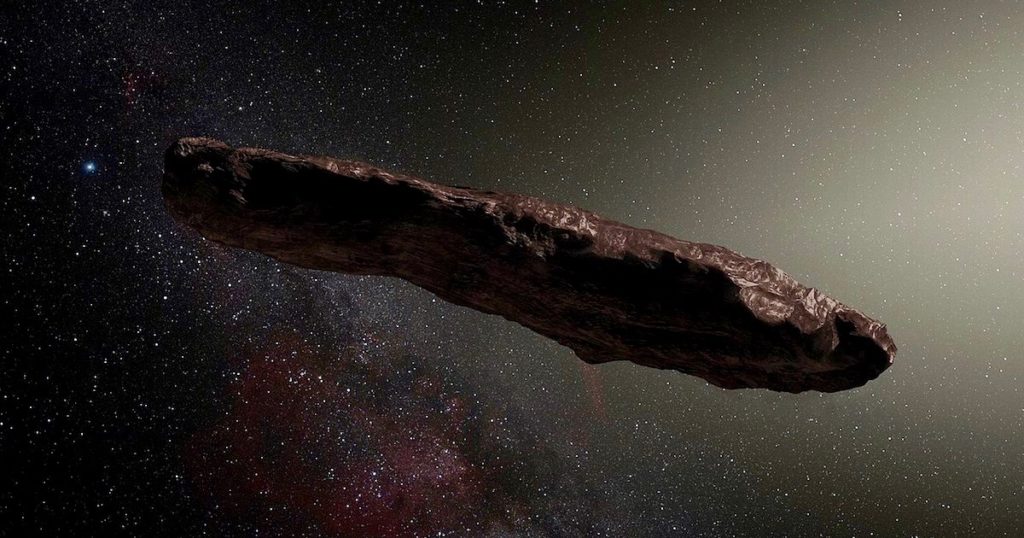
Image: ʻOumuamua, by ESO/M. Kornmesser. Derivative: nagualdesign [CC BY-SA 4.0 ], via Wikimedia Commons.
Latest

Avi Loeb Bumps Up Against Methodological Naturalism 

Categories
Astronomy
Intelligent Design
Physical Sciences
Planetology
Share
Facebook
Twitter/X
LinkedIn
Flipboard
Print
Email

Jonah Goldberg talked with Harvard astronomer Avi Loeb about “Oumuamua, Alien Life & Fighting the Mainstream Science Community.” Loeb, we should note carefully, is not an advocate of intelligent design, in the sense of inferring that a transcendent designer of the universe exists. He is an atheist, in fact.

But as you can see from this extract from the conversation, Loeb encounters the implacable resistance — i.e., the a priori wall — of methodological naturalism (MN) in his astronomical investigations. He says:

What’s the chance that the first three interstellar objects out of four would be so unusual, unfamiliar? It says something. It says that we need to collect more data. It’s intriguing. And instead what I hear from my colleagues is, “No, it must be natural. It’s a rock of a type that we’ve never seen before but it’s natural. Period. End of discussion, let’s move on. And I say “No it’s actually very interesting. Let’s figure out what it is.” And in fact, that’s the way science is done, by collecting more evidence.

Unless MN has a well-defined escape clause — a reachable point at which one may rationally entertain design (intelligent causation) — it is a science stopper. Science killer, actually. 

Goldberg highlighted the clip on Twitter, which is how I found it. It’s very interesting to me that he chose this particular comment from Loeb. See the video here, starting at 12:59.

Click here to display content from YouTube.
Learn more in YouTube’s privacy policy.

Paul Nelson

Senior Fellow, Center for Science and Culture
Paul A. Nelson is currently a Senior Fellow of Discovery Institute’s Center for Science and Culture and Adjunct Professor in the Master of Arts Program in Science & Religion at Biola University. He is a philosopher of biology who has been involved in the intelligent design debate internationally for three decades. His grandfather, Byron C. Nelson (1893-1972), a theologian and author, was an influential mid-20th century dissenter from Darwinian evolution. After Paul received his BA in philosophy with a minor in evolutionary biology from the University of Pittsburgh, he entered the University of Chicago, where he received his PhD (1998) in the philosophy of biology and evolutionary theory.
Benefiting from Science & Culture Today?
Support the Center for Science and Culture and ensure that we can continue to publish counter-cultural commentary and original reporting and analysis on scientific research, evolution, neuroscience, bioethics, and intelligent design.

© Discovery Institute